Licensed & Insured — NJ HIC #13VH13359900
njgoldstarconstruction@yahoo.com · 24/7 Emergency · (862) 271-1225

Home › Services
Local Home Improvement Contractor in Bergen County
A family-owned and operated construction company, fully licensed and insured, providing free estimates for chimney, roofing, gutters, masonry, siding and deck work. Satisfaction guarantee and 24-hour emergency service, seven days a week.
Every Service, One Crew
One licensed contractor for the whole exterior — no juggling trades, no finger-pointing between crews.
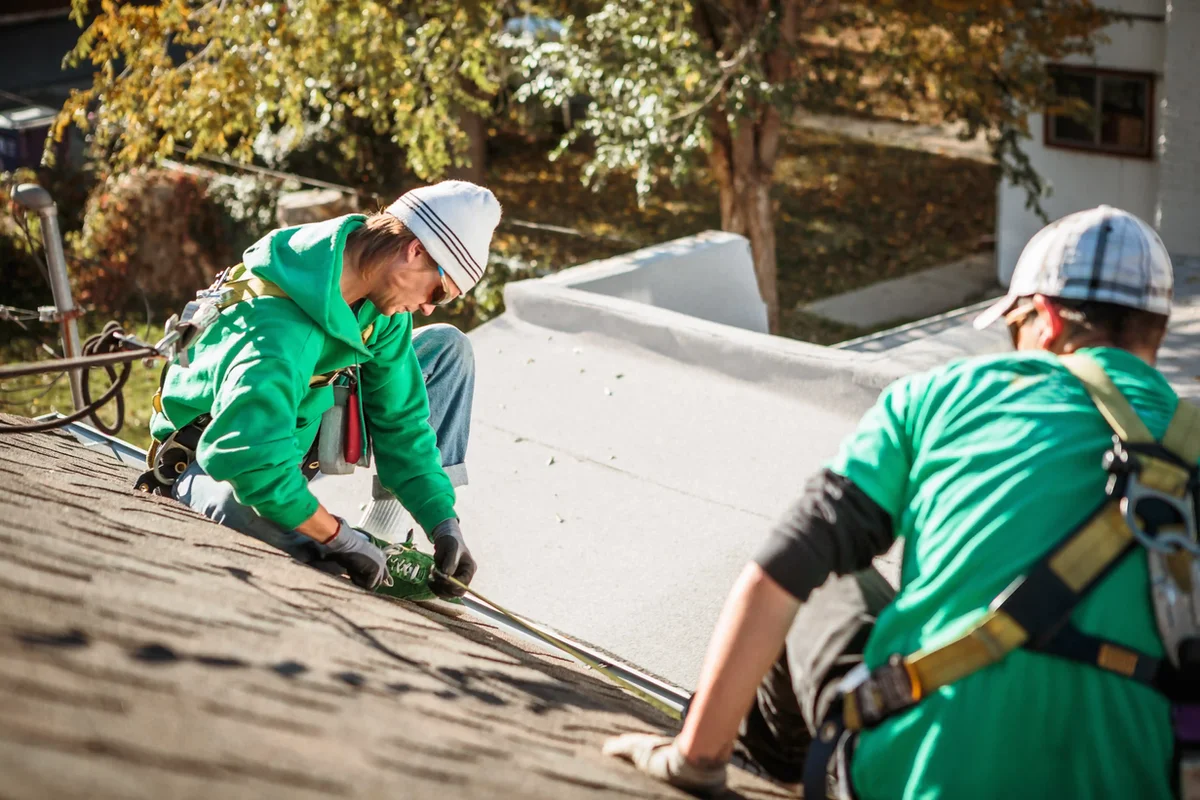
NJ Gold Star Construction repairs and replaces asphalt shingle, flat and metal roofs across Bergen and Passaic County. Most repair…
We repair, repoint, reline and fully rebuild masonry chimneys throughout North Jersey, and we clean flues and remove creosote to N…
We install seamless aluminum and copper gutters, add guards and screens, and repair or clean existing systems across North Jersey.…
We build and repair steps, walkways, patios, sidewalks, retaining walls and stone veneer across Bergen and Passaic County. Every j…
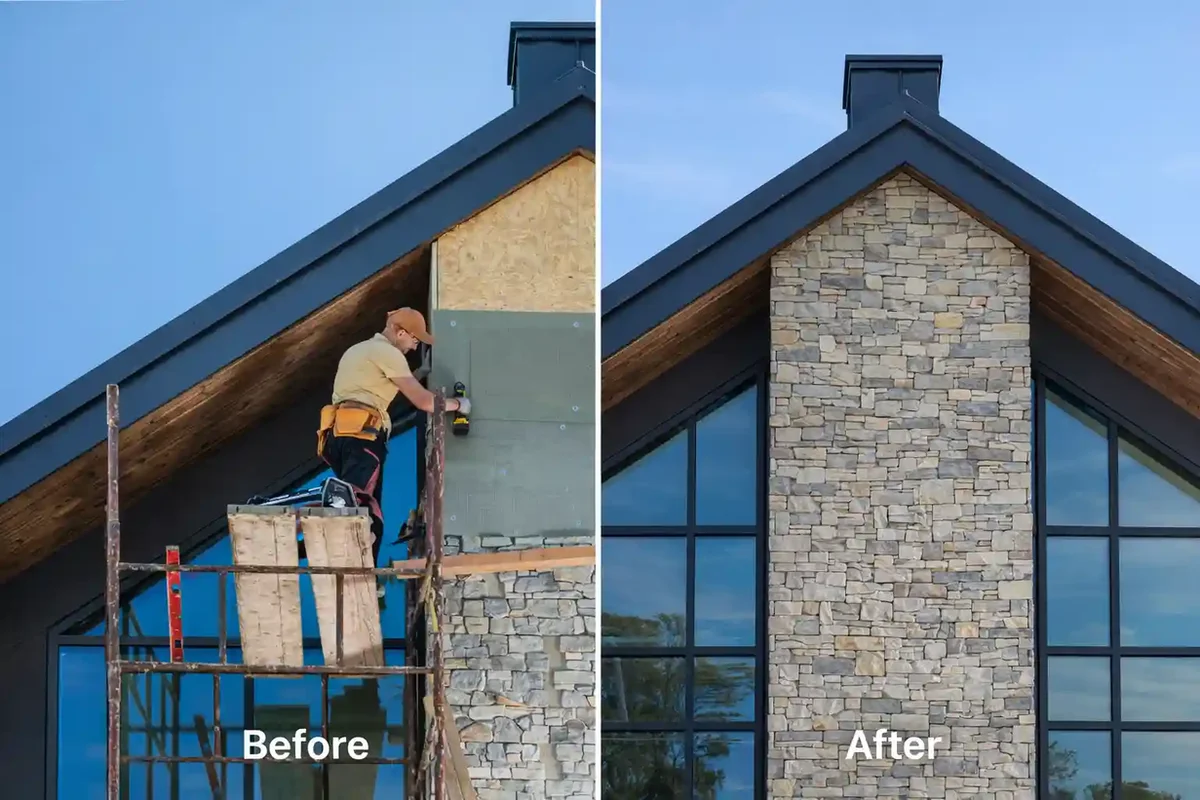
We install and repair vinyl, fiber cement and wood siding across North Jersey, including the water-resistive barrier, flashing and…
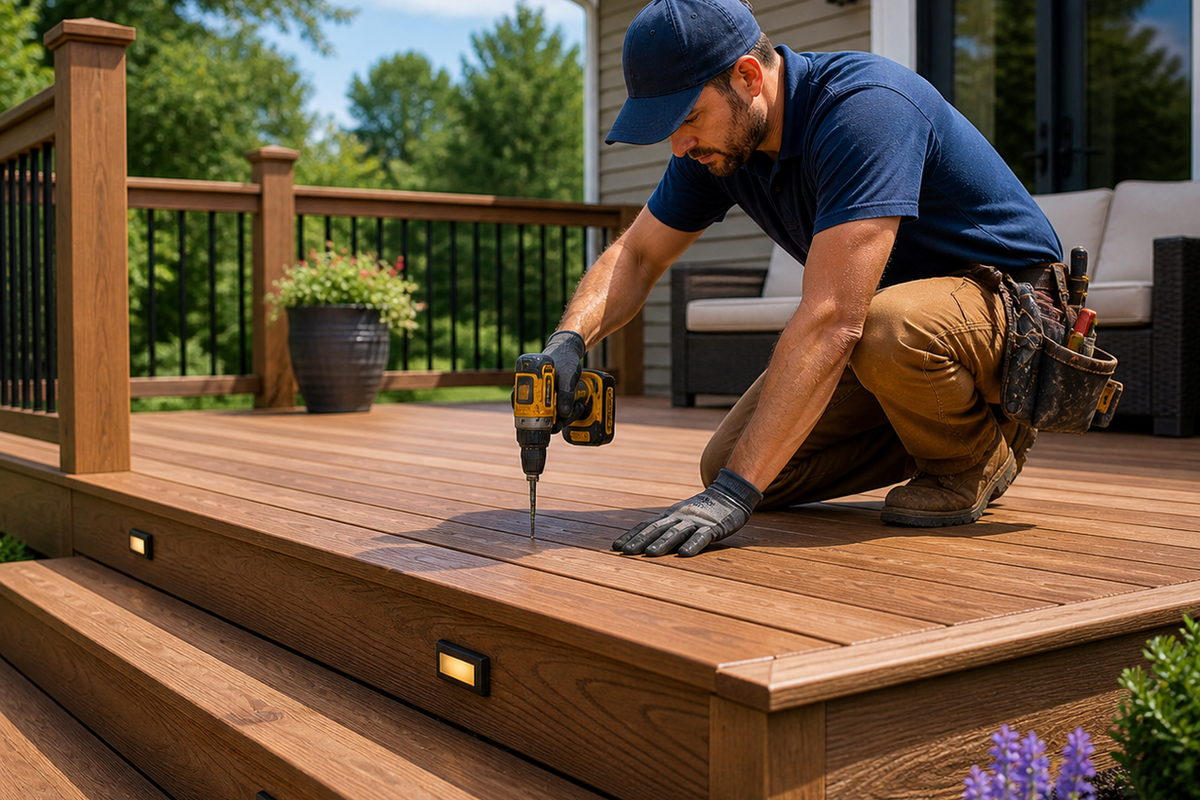
We build new decks and repair existing ones across North Jersey — footings, framing, decking, railings and stairs. Repairs start w…
Roofing Services
Your roof is the one system on the house that fails invisibly. Water finds a gap at a flashing joint or a lifted shingle, travels along the sheathing, and shows up as a ceiling stain three rooms away. By then the repair is no longer a roofing job — it is drywall, insulation and sometimes framing.
- Roof repair for leaks, missing shingles, flashing failures and storm damage
- Full roof replacement with tear-off, deck inspection and new underlayment
- Attic intake and ridge ventilation to stop condensation and ice dams
- Flat and low-slope roofing for additions, porches and dormers
- 24/7 emergency tarping and leak containment
Chimney Services
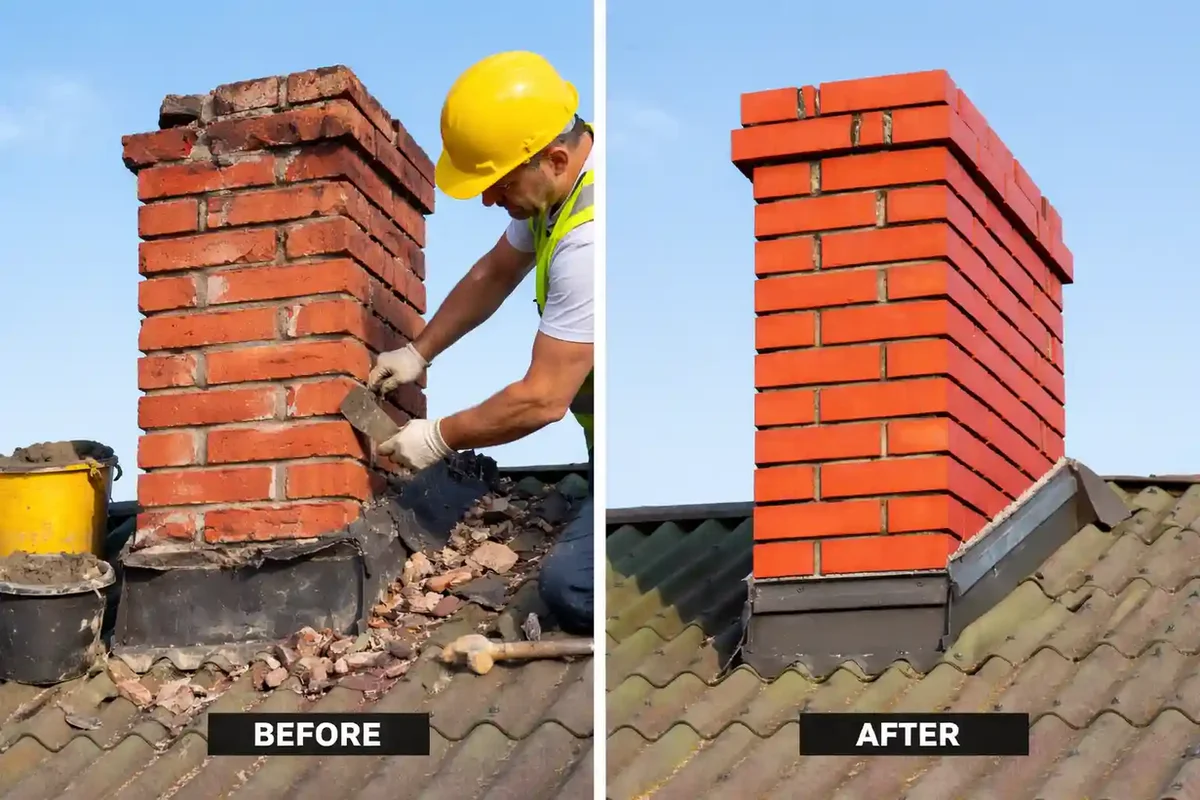
A chimney takes more weather than any other part of the house. It stands above the roofline, exposed on four sides, and every freeze-thaw cycle drives water deeper into open mortar joints. Left alone, a hairline crack becomes spalling brick, then a leaning stack, then water in the ceiling below.
- Repointing and tuckpointing of failed mortar joints
- Partial and full chimney rebuilds above and below the roofline
- Crown repair and rebuild, cap and chase cover installation
- Stainless liner installation for fireplaces, furnaces and boilers
- Deep cleaning, creosote removal and flue inspection
Gutters Services
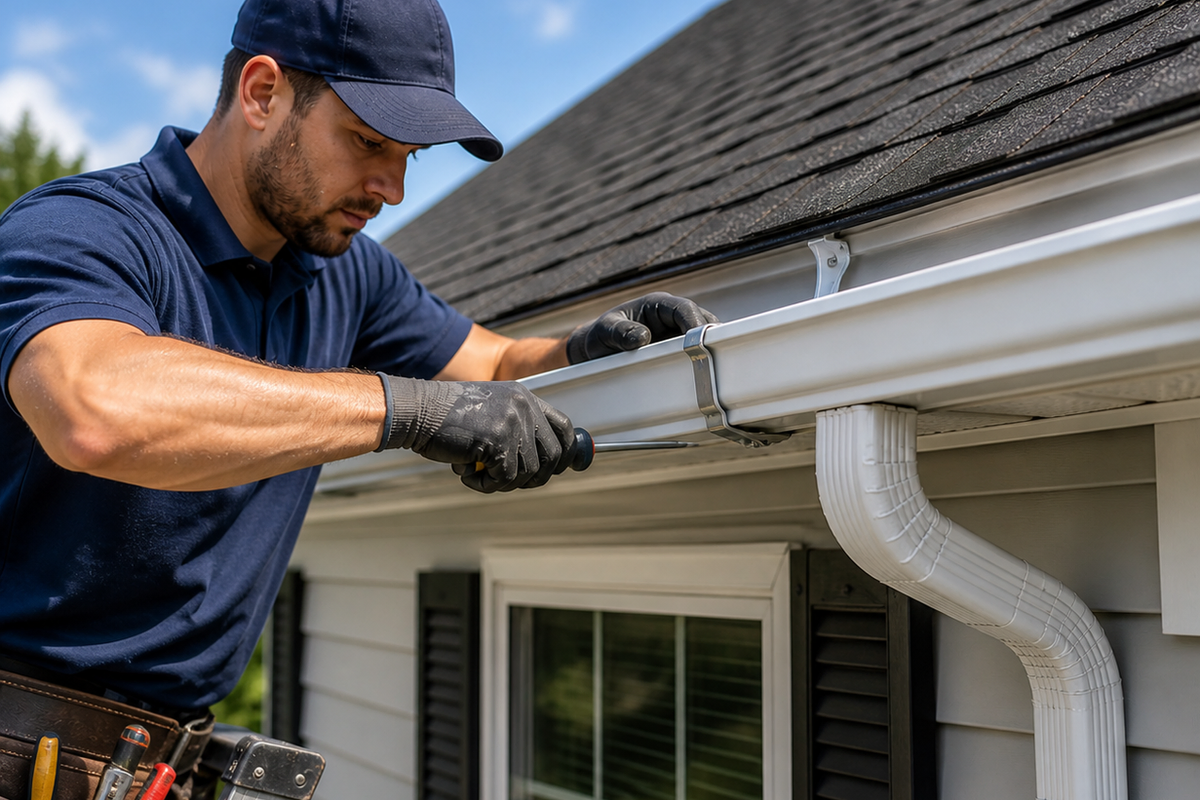
A clogged or undersized gutter is the cheapest problem on the house and the most expensive one to ignore. Water that overshoots the trough runs down the siding, saturates the soil at the footing and finds its way into the basement — and in January it backs up under the shingles as ice.
- Seamless aluminum, copper and vinyl gutter installation
- Gutter guards and screens sized to your debris load
- Downspout replacement and underground drainage tie-ins
- Leak sealing, hanger replacement and pitch correction
- Seasonal cleaning and maintenance programs
Masonry Services
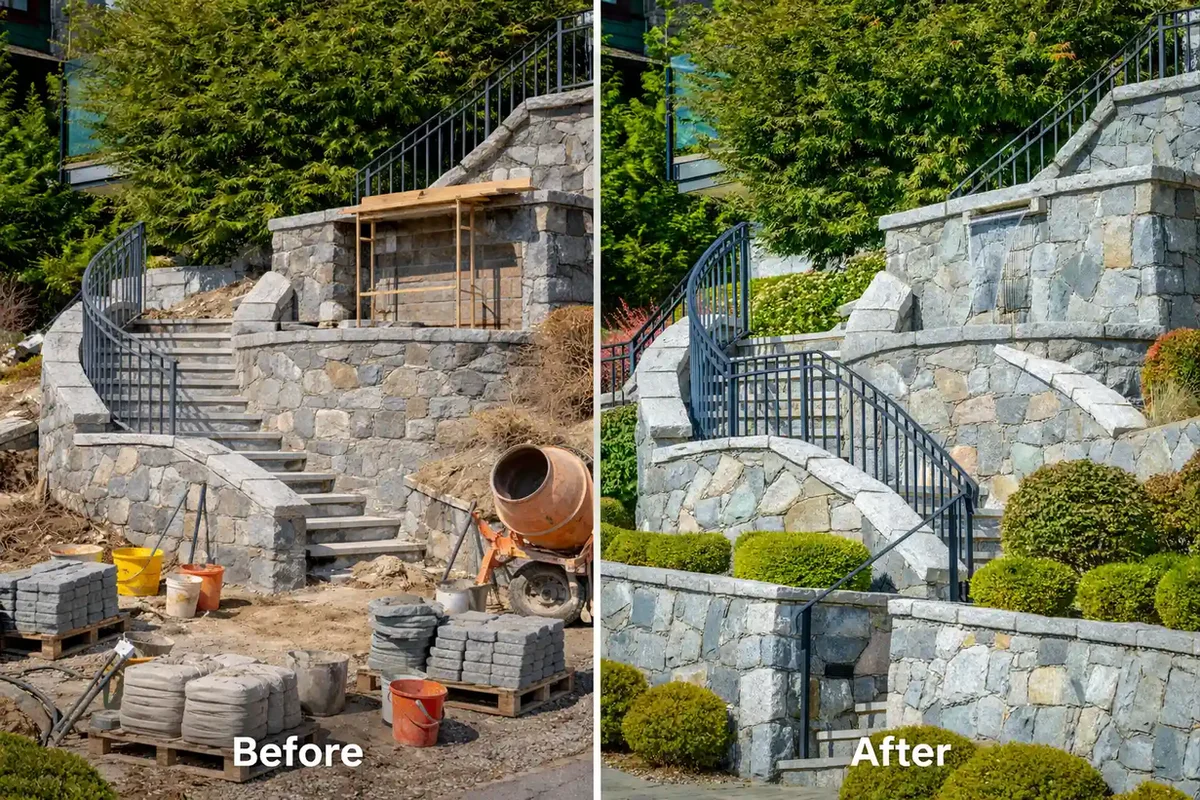
Most failed masonry in North Jersey did not fail at the surface. It failed underneath, where a thin or uncompacted base held water through a freeze and lifted the whole assembly. Cracked joints and settled pavers are the symptom.
- Paver and stone patios, walkways and driveways
- Front steps, stoops and multi-level stone staircases
- Retaining walls with proper drainage and geogrid where needed
- Sidewalk repair and replacement to municipal standards
- Stone veneer, brickwork, repointing and foundation repair
Siding Services
Siding is a rain screen, not just a finish. What keeps a wall dry is the layered detail behind the panel — house wrap lapped correctly, flashing over every window head and at every transition, and a path for incidental water to drain back out.
- Vinyl siding installation and re-siding
- Fiber cement (James Hardie-style) installation and painting coordination
- Panel and section repair matched to existing profiles
- House wrap, window and door flashing, trim and corner detailing
- Soffit, fascia and stone-veneer accent integration
Decks Services
The parts of a deck that make it safe are the parts nobody looks at: how the ledger is fastened and flashed to the house, how the posts bear on footings below frost depth, and how the guard rails are anchored.
- New deck design and construction, single or multi-level
- Structural repair of ledgers, joists, beams and posts
- Board replacement in pressure-treated, cedar or composite
- Railing, stair and landing rebuilds to current code
- Cleaning, sanding, sealing and full restoration
How a roof leak becomes a foundation problem
A roof leak becomes a foundation problem when water that starts at a lifted shingle or open flashing joint runs down the sheathing, overflows an undersized gutter, and saturates the soil at the footing. In Bergen County’s clay-heavy soil, that repeated saturation is what cracks basement walls and heaves masonry steps.
Most homes we inspect in Bergen County did not fail all at once. The chain starts at the roof — a nail pop, a cracked pipe boot, a valley where two roof planes meet — and the water does not stop there. It travels along the roof deck, drops behind the fascia, and either bypasses the gutter or overflows one that cannot keep up with the volume.
Once water is on the ground, it looks for the path of least resistance, and in older Bergen and Passaic County neighborhoods that is often straight down along the foundation wall. Foundation repair calls we get almost always trace back to grading, downspouts or a gutter problem upstream, not a flaw in the concrete itself.
Where we start looking
- Flashing at roof-to-wall transitions and chimney bases — see our roof repair page for the usual leak points.
- Gutter pitch and capacity, covered under gutter repair.
- Where downspouts discharge relative to the foundation and window wells.
Treating the whole path as one system, instead of patching the symptom closest to the ceiling stain, is why a home improvement contractor sees these jobs differently than a roofer working alone.
Why one licensed crew beats coordinating five separate trades
One licensed home improvement contractor coordinating roofing, chimney, gutters, masonry, siding and decks means a single point of accountability, one crew that already knows the house, and no gap where two trades each assume the other is handling flashing, drainage or cleanup between adjoining jobs.
A roofer, a mason and a gutter installer each have their own scope, their own schedule and their own idea of where their responsibility ends. On a project where a chimney rebuild meets a new roof, or a retaining wall sits below a gutter downspout, that boundary is exactly where problems start — a flashing detail nobody owns, a drainage line nobody connects.
NJ Gold Star Construction uses our own crew, not a rotating list of subcontractors, across chimney, siding and deck work as well as roofing, gutters and masonry. The same team that flashes a chimney rebuild can tie the new gutter run into it correctly, because they built both.
What that changes for you
- One written estimate covers the whole scope, instead of three separate contracts with three different start dates.
- One crew is on site for the full job, so nothing sits half-finished between trades.
- Our satisfaction guarantee on workmanship applies to the whole project, not just whichever trade you hired last.
What actually needs a permit from your town's construction office
What needs a permit depends on the town, not the county — New Jersey’s Uniform Construction Code applies statewide, but each municipality’s own construction code office issues permits and schedules inspections. Totowa’s office, for example, requires permits for driveways, sidewalks, fence replacement and most structural work.
New Jersey runs one building code for the whole state — the Uniform Construction Code, administered by the Department of Community Affairs — but every town enforces it through its own local construction code office. Bergen, Passaic, Essex, Hudson, Morris and Union County towns each have a separate office, a separate application and a separate inspector.
In our home base of Totowa, the Building Department lists permits as required for tree removal, driveways, sidewalks and fence replacement, in addition to the structural work you would expect — additions, new decks, siding and masonry retaining walls above a certain height. Roof covering replacement on a detached one- or two-family home is usually treated as ordinary maintenance and does not need a permit, though the work still has to meet code.
Our part in the process
- We tell you upfront whether your project needs a permit before we price it.
- Our paperwork carries our HIC registration number, #13VH13359900, so the office can verify us.
- We schedule required inspections around the crew’s timeline instead of around ours.
Lead-safe work rules if your home was built before 1978
Homes built before 1978 may contain lead-based paint, and the EPA’s Renovation, Repair and Painting rule requires anyone disturbing painted surfaces on those homes — siding repair, trim replacement, window work — to follow lead-safe work practices or hire a certified renovator, since about half of pre-1978 homes test positive for lead paint.
A lot of the housing stock in older Bergen and Essex County towns predates 1978, the year the federal government banned consumer lead paint. The EPA’s Renovation, Repair and Painting rule covers exactly the kind of exterior work we do on these homes — sanding, cutting or replacing siding, trim and window flashing — because that work can create lead dust even when nobody is sanding paint on purpose.
The EPA recommends testing a pre-1978 home before renovation and hiring a lead-safe certified contractor for the work. We follow lead-safe containment and cleanup practices on applicable homes rather than treating an old house the same as new construction.
What this means in practice
- Plastic sheeting and containment around the work area before cutting or sanding painted trim.
- HEPA-filtered cleanup instead of a standard broom-and-dustpan finish.
- No open burning or dry scraping of painted surfaces.
When to schedule each exterior project
The best time to schedule exterior work follows North Jersey’s weather, not the calendar year: masonry and paver work needs temperatures reliably above freezing, roofing and siding go fastest in the long stretch between the average May 4 last frost and the October first frost, and chimney inspections belong on the calendar before the heating season starts.
| Season | Good time for | Why |
|---|---|---|
| Spring (April–May) | Gutter cleaning, masonry and paver work | Frost is normally out of the ground by early May, so mortar and paver bases can set and compact properly. |
| Summer (June–August) | Roof replacement, siding, new decks | Long dry stretches and warm temperatures suit shingle sealing, siding fasteners and deck framing. |
| Fall (September–October) | Chimney inspection, post leaf-drop gutter cleaning | Getting the flue and gutters clear before the first frost, typically around October 7, cuts down on winter callbacks. |
| Winter (November–March) | Emergency leak and storm repair | We respond to active leaks and storm damage year-round; larger installs usually wait for milder weather. |
None of this is a hard rule — we handle roof repairs and emergency chimney repairs in every season, and our annual chimney inspection guide is worth reading before booking ahead of the fall rush. The table is a starting point for planning a project, not a restriction on when we’ll come out.
Service Areas We Proudly Serve
NJ Gold Star Construction provides reliable chimney, roofing, gutter, masonry, siding and deck services across North Jersey.
Frequently Asked Questions
Does NJ Gold Star pull the permit for my project?
Your town’s construction code office issues the permit itself, not us. When a project needs one, we tell you before we price the job and put our HIC registration number, #13VH13359900, on the paperwork so the office can verify our license, then we schedule required inspections around the crew’s timeline.
Do I need to test my house for lead paint before a renovation?
If your home was built before 1978, the EPA recommends testing before work that disturbs painted trim, siding or windows, since roughly half of pre-1978 homes contain some lead paint. We follow lead-safe containment and cleanup practices on that work regardless, under the EPA’s Renovation, Repair and Painting rule.
Can one contractor really handle roofing, chimney, siding, gutters, masonry and decks?
Yes — NJ Gold Star Construction uses one crew across all six trades instead of subcontracting pieces out, so the same team that repoints a chimney can tie the new gutter run into it, and the same people who build a retaining wall can grade it to drain away from the house.
What's the best time of year for a roof replacement in Bergen County?
Late spring through early fall — after the average May 4 last frost and before the October first frost — gives shingles the warm, dry conditions they need to seal properly. We still handle emergency roof repairs and tarping in any season, including winter.
Does scheduling a roof and gutters together save time?
Yes — one crew handling both means the same staging and access serves both jobs, and gutter work can be tied directly into new roof flashing instead of scheduled as a separate visit weeks later. Each service still gets its own written, itemized estimate.
- The Uniform Construction Code (NJAC 5:23) — New Jersey Department of Community Affairs, Division of Codes and Standards
- Building Department — Borough of Totowa, NJ
- Renovation, Repair and Painting (RRP) Program: Consumers — US Environmental Protection Agency
- Overview of the Climate of New Jersey — Office of the New Jersey State Climatologist, Rutgers University