Licensed & Insured — NJ HIC #13VH13359900
njgoldstarconstruction@yahoo.com · 24/7 Emergency · (862) 271-1225

Home › Areas We Serve › Jersey City
Roofing, Chimney, Siding & Masonry Contractor in Jersey City, NJ
NJ Gold Star Construction serves Jersey City from our Totowa shop with roof repair and replacement, chimney work, siding, seamless gutters, masonry and decks. Licensed under NJ HIC #13VH13359900, insured, free written estimates, and 24/7 emergency response.
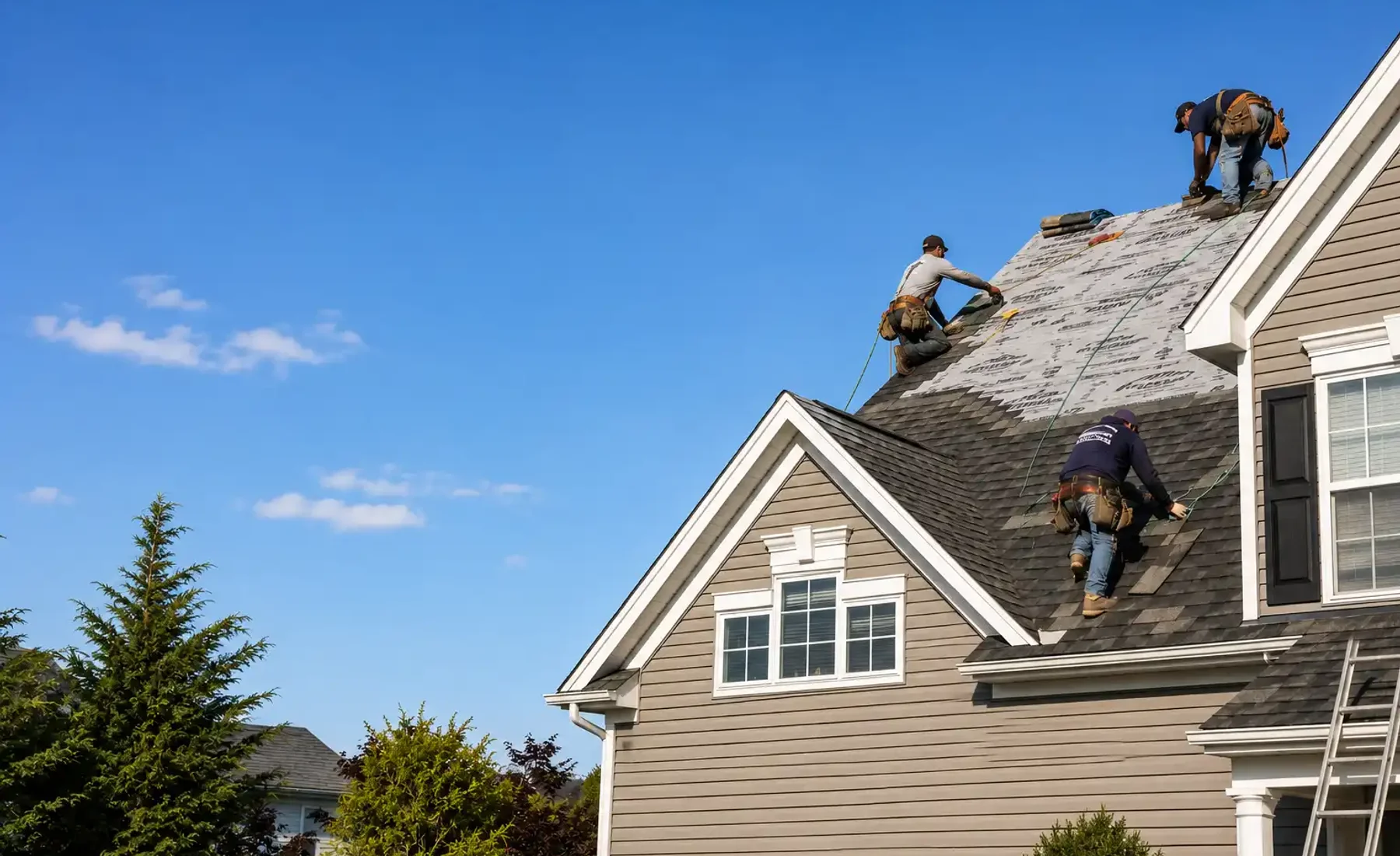
Jersey City’s brownstones and row houses mean flat roofs, party-wall parapets and masonry that has been repointed many times over. We work on roof replacement, parapet and chimney masonry, and gutter and drainage details on attached homes.
Homeowners in Jersey City get the same process we use everywhere: a hands-on inspection, a written itemized scope before anything starts, our own crew on site rather than subcontractors, and a satisfaction guarantee on the finished work. We have been doing this in North Jersey for more than 25 years.
If you are comparing quotes in Jersey City, call (862) 271-1225 and we will tell you plainly what the work needs — repair when repair is the right answer, replacement when it is not.
What the work includes
- Roof repair, replacement and 24/7 emergency leak response in Jersey City
- Chimney repair, repointing, rebuilds, liners and cleaning
- Siding installation and repair — vinyl and fiber cement
- Seamless gutters, guards, screens and cleaning
- Masonry: steps, walkways, patios, sidewalks and retaining walls
- Deck construction, structural repair and restoration
Flat roofs, parapets and drainage on Jersey City rowhouses
Most Jersey City rowhouses and brownstones carry a flat or low-slope roof behind a parapet wall, drained through internal roof drains or through-wall scuppers rather than gutters and downspouts. NJ Gold Star Construction repairs and replaces these membrane roofs and clears the ponding and clogged drains that cause ceiling stains on attached Jersey City homes.
| Membrane | Typical use | What to watch |
|---|---|---|
| EPDM rubber | Common re-roof on older rowhouse decks | Seams and flashing at the parapet need periodic inspection |
| Modified bitumen (torch-down) | Multi-ply systems on older buildings | Granule loss and lap seams are the first sign of wear |
| TPO | New installations and full replacements | Heat-welded seams; panel width limits the number of seams |
A flat roof is not actually flat. It is built with a slight slope or tapered insulation toward one or more drains, because standing water is what shortens the life of any membrane. On a Jersey City rowhouse or brownstone, that water usually leaves the roof one of two ways: an internal roof drain that ties into the building’s plumbing, or a through-wall scupper that discharges through the parapet into a leader on the party wall. Both need to stay clear of leaves, roofing granules and debris, because a blocked drain on a flat roof does not overflow harmlessly the way a pitched roof does — it ponds.
What we check on a parapet roof
- Membrane seams and the flashing where the roof ties into the parapet wall, a common leak point on roof replacement jobs.
- Drain strainers and scupper openings for debris before they back up.
- Counterflashing at any bulkhead, skylight or mechanical curb on the roof deck.
Where the roof drains onto a rear yard through a leader instead of a scupper, that leader is part of the building’s gutter and drainage system, and our guide to common roof leaks and how to fix them covers the flashing details that cause most of the calls we get.
Historic district review for roofing and siding materials in Jersey City
Jersey City’s five local historic districts — Hamilton Park, Harsimus Cove, Paulus Hook, Van Vorst Park and West Bergen-East Lincoln Park — require a Certificate of No Effect or Certificate of Appropriateness from the Historic Preservation Commission before any exterior roofing, siding or masonry work begins, even repairs that will not be visible from the street.
If your Jersey City address falls inside the Hamilton Park, Harsimus Cove, Paulus Hook, Van Vorst Park or West Bergen-East Lincoln Park historic district, the city’s Historic Preservation Commission has a say before a roof or siding job starts. Staff can issue a Certificate of No Effect for work that repairs or restores what is already there in kind — replacing cracked slate with matching slate, for example. A Certificate of Appropriateness, which needs full Commission review, is the path for anything that changes a material, profile or visible detail, such as switching a flat roof’s parapet coping or swapping wood clapboard for a different siding product.
Plan the paperwork before the materials
- Confirm whether your block is inside one of the five districts before ordering shingles, membrane or siding.
- Ask whether the scope qualifies for staff-level review or needs a full Commission hearing, since the second path takes longer.
- Keep receipts and photos of the existing material — the Commission often wants to see what is being matched.
We build the review timeline into the schedule for siding repair and chimney repair in these districts so the permit and the Commission approval move in parallel rather than one after the other.
The permit and approval path for a Jersey City roofing or siding project
A Jersey City roofing, siding or masonry project follows the same construction permit process as anywhere in the city, run through the Division of the Construction Code Official at One Jackson Square, with an added historic district review step for homes inside one of the five designated districts before that permit can be issued.
None of this needs to slow the job down. We confirm the historic district status and gather the permit requirements at the same site visit as the roofing or siding estimate, then apply for both the Commission review and the construction permit before ordering material.
Confirm the district
We check whether the property sits inside Hamilton Park, Harsimus Cove, Paulus Hook, Van Vorst Park or West Bergen-East Lincoln Park before any material is ordered.
Historic review, if it applies
Repair-in-kind work is typically eligible for a Certificate of No Effect; a material or design change needs a Certificate of Appropriateness from the full Commission.
Construction permit
The scope goes to the Division of the Construction Code Official at One Jackson Square for the building permit that covers the roofing, siding or masonry work itself.
Inspections and sign-off
Work is inspected at the required stages, and the permit is closed out once the job passes.
Lead-safe practices on Jersey City's pre-1978 rowhouses
Many Jersey City rowhouses and brownstones were built before 1978 and still carry old painted trim, fascia and siding. Under EPA’s Renovation, Repair and Painting rule, any contractor disturbing more than 20 square feet of painted exterior surface on a pre-1978 home must be lead-safe certified and follow contained work practices, not just standard cleanup.
Roofing tear-off usually does not disturb painted surfaces, but siding, trim, fascia and soffit work on an older Jersey City rowhouse often does. The U.S. Environmental Protection Agency’s Renovation, Repair and Painting rule covers any paid work that disturbs more than 20 square feet of painted exterior surface, or any window replacement, on housing built before 1978. Firms doing that work must be EPA lead-safe certified and use contained work practices: plastic sheeting to catch debris, wet sanding or HEPA-vacuum sanding instead of dry grinding, and verified cleanup before the job is called finished.
What to ask before hiring
- Ask to see the firm’s EPA lead-safe certification if your home was built before 1978.
- Ask how debris and dust will be contained during siding repair or trim replacement.
- Keep in mind the rule applies to the exterior even when the interior has already been renovated.
This is a homeowner protection, not a sales point — every contractor working on painted pre-1978 exteriors in Jersey City is expected to follow it.
Party-wall masonry and chimney flashing between attached Jersey City homes
Attached Jersey City homes share a party wall that often carries one or two chimneys and takes the brunt of freeze-thaw cycling on exposed brick. Repointing failed mortar joints and resetting flashing where a chimney or parapet meets the neighbor’s roofline keeps water from tracking into both units, not just one.
A row of attached homes shares more than a wall. Where two roofs meet at a party wall, the flashing and coping have to shed water away from both buildings, and a chimney built into that wall carries freeze-thaw stress for both households on one stack of brick. Mortar joints that were fine a generation ago open up under repeated freezing and thawing, letting water into the wall cavity long before a crack is visible from the street.
What we look for
- Open or missing mortar joints in the party wall, especially near the roofline and chimney.
- Chimney flashing and counterflashing where it ties into the parapet or party wall coping.
- Efflorescence or staining on interior party walls, a sign water is already getting through.
Masonry repointing on a shared wall is coordinated work — we let the neighboring owner know before scaffolding or staging goes up, and we tie the chimney repair into the same scope so the wall gets sealed once, not twice.
Where we work from Jersey City: Secaucus and the rest of Hudson County
NJ Gold Star Construction’s closest true neighbor to Jersey City on our town-page list is Secaucus, which the city borders along Penhorn Creek in the Hackensack Meadowlands. We also take calls from elsewhere in Hudson and Bergen County, including Hackensack, without claiming those towns share a property line with Jersey City.
We are careful about geography, because a lot of local search content assumes towns are neighbors when they are not. Jersey City’s actual border with a town on our service list runs along Penhorn Creek in the Meadowlands, where the creek separates Jersey City from Secaucus. Beyond that, our crews travel from the Totowa shop to jobs across Hudson, Bergen, Essex and Union County, including Hackensack and the rest of Bergen County, on the same day-of-week schedule as any local job.
If you are comparing a roofing, siding, chimney or masonry estimate in Jersey City, get in touch and we will tell you plainly what the historic district, the permit and the work itself will involve.
Services available in Jersey City
NJ Gold Star Construction repairs and replaces asphalt shingle, flat and metal roofs across Berg…
We repair, repoint, reline and fully rebuild masonry chimneys throughout North Jersey, and we cl…
We install seamless aluminum and copper gutters, add guards and screens, and repair or clean exi…
We build and repair steps, walkways, patios, sidewalks, retaining walls and stone veneer across …
We install and repair vinyl, fiber cement and wood siding across North Jersey, including the wat…
We build new decks and repair existing ones across North Jersey — footings, framing, decking, ra…
Frequently asked questions
Do you serve Jersey City?
Yes. Jersey City is part of our regular service area for roofing, chimney, siding, gutter, masonry and deck work.
How fast can you get to Jersey City for an emergency?
We answer 24/7 and reach active leaks in Jersey City the same day whenever possible, tarping to stop water before the permanent repair is scheduled.
Are you licensed to work in Jersey City?
Yes. We hold New Jersey Home Improvement Contractor license #13VH13359900, carry full insurance, and pull permits with your municipality where the work requires them.
Does a roof or siding job in Jersey City need Historic Preservation Commission approval?
Only if the property is inside one of Jersey City’s five designated historic districts — Hamilton Park, Harsimus Cove, Paulus Hook, Van Vorst Park or West Bergen-East Lincoln Park. Inside those boundaries, exterior roofing, siding or masonry work needs a Certificate of No Effect for repair-in-kind or a Certificate of Appropriateness for anything that changes materials or appearance, in addition to the usual construction permit.
What triggers the EPA lead-safe rule on a Jersey City rowhouse?
Any paid renovation, repair or painting work that disturbs more than 20 square feet of painted surface on the exterior of a home built before 1978 falls under EPA’s Renovation, Repair and Painting rule, along with any window replacement regardless of size. Jersey City’s older rowhouse stock means this applies to a large share of siding, trim and fascia jobs in the city.
How does water actually leave a flat roof on a Jersey City rowhouse?
Through an internal roof drain plumbed down through the building, or through a scupper cut into the parapet that discharges into a leader on the party wall — flat roofs on attached Jersey City homes rarely use gutters the way a pitched roof does. Both drain types need to stay clear of debris, since a blocked drain ponds water on the membrane instead of overflowing harmlessly.
Do you coordinate party-wall masonry work with the neighboring owner in Jersey City?
Yes. Repointing or flashing repair on a shared party wall affects both attached homes, so we let the neighboring owner know before scaffolding or staging goes up and time the chimney and masonry work together so the wall is sealed in one pass rather than two separate jobs down the road.
- Construction Code — City of Jersey City, Division of Housing, Economic Development and Commerce
- Historic Preservation — City of Jersey City, Division of City Planning
- Renovation, Repair and Painting Program: Contractors — U.S. Environmental Protection Agency
- Penhorn Creek — New Jersey Meadowlands Commission (Meadowlands Environment Research Institute)
Updated September 2026 · Reviewed by Edgar Lopez Gonzalez, owner · NJ HIC #13VH13359900
Licensed & insured. 25+ years in North Jersey. We answer 24/7 for leaks and storm damage.
- Town
- Jersey City, Hudson County
- License
- NJ HIC #13VH13359900
- Emergency service
- 24/7 — call (862) 271-1225
- Estimates
- Free, written and itemized