Licensed & Insured — NJ HIC #13VH13359900
njgoldstarconstruction@yahoo.com · 24/7 Emergency · (862) 271-1225

Chimney Repair in Bergen County, NJ
Targeted chimney repair — repointing failed joints, replacing spalled brick, rebuilding a cracked crown and re-flashing where the stack meets the roof.
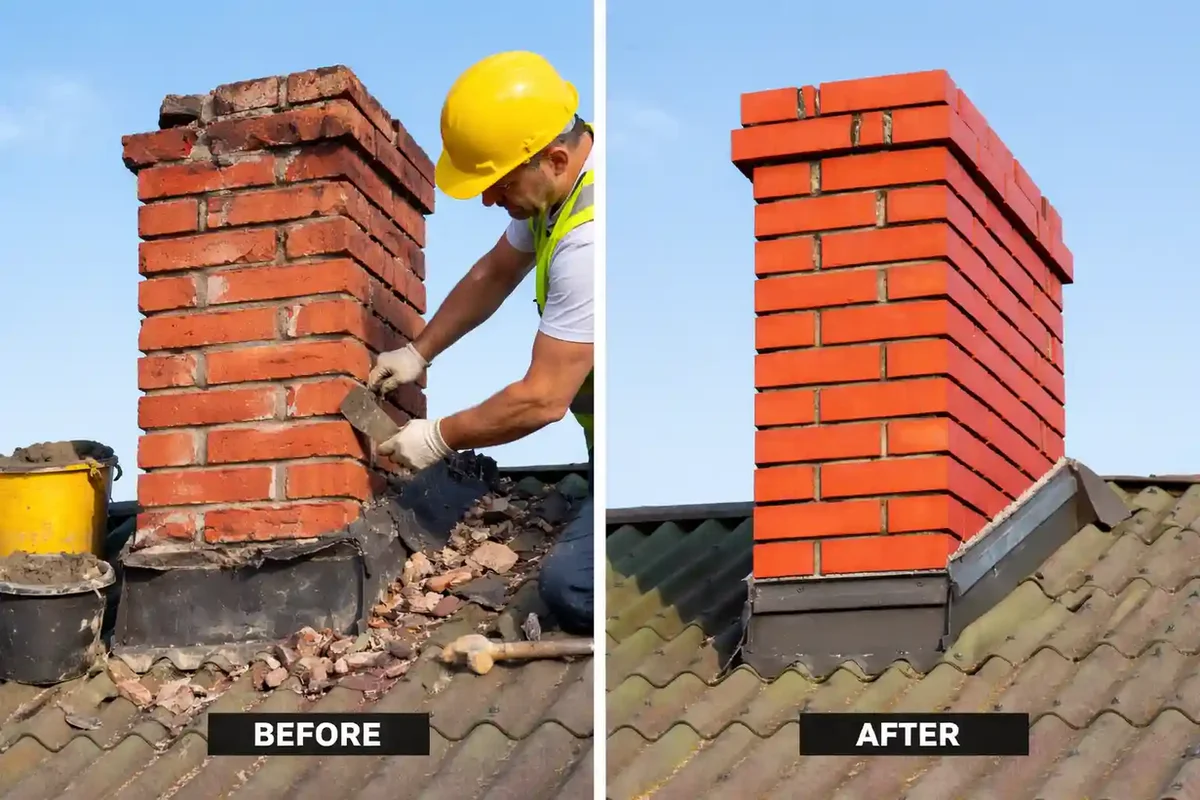
We inspect from the crown down before quoting, because the same ceiling stain can come from a failed crown, open joints or bad counterflashing — and each is a different repair.
This is one part of the chimney work we do across Bergen and Passaic County. Every job is quoted in writing after a hands-on inspection, performed by our own crew rather than subcontractors, and backed by our satisfaction guarantee. We are licensed under NJ HIC #13VH13359900 and fully insured.
What the work includes
- Repointing and tuckpointing
- Spalled brick replacement
- Crown repair and waterproof coating
- Counterflashing replacement at the roof line
Repointing and tuckpointing: two names, one repair
Repointing means grinding out deteriorated mortar to a consistent depth and packing the joint with fresh mortar matched to the original in color and hardness. Tuckpointing is a decorative finishing technique sometimes applied on top of it. On a working chimney, the structural step — repointing — is what actually stops water from getting in.
Mortar joints are meant to be the sacrificial part of a masonry chimney. They are softer than the brick on purpose, so that weathering wears down the joint instead of cracking the brick itself. That only works if the mortar gets replaced before it fails completely.
Why matching mortar hardness matters
A repointing mortar that is harder than the surrounding brick does more damage than the crumbling joint it replaces. Under load and thermal movement, a stronger patch does not flex with the softer, older brick around it — the stress concentrates at the edges of the new mortar and the brick itself starts to crack or spall instead. We match new mortar to the age and hardness of the original mix rather than defaulting to a modern high-strength blend, which matters most on older Passaic and Bergen County housing stock built with softer, more lime-heavy mortars.
Crown repair: the part that takes the most water
The crown is the sloped concrete or mortar cap at the very top of the chimney, and it is the single hardest-working water-shedding surface on the stack. A hairline crack in the crown lets water straight into the brick below it every time it rains, which is why crown repair or a full crown rebuild is often the highest-priority fix on an older chimney.
A well-built crown overhangs the brick on all sides and slopes away from the flue so water drips clear of the chimney face instead of running down it. When we find a crown that is cracked, flush with the brick instead of overhanging it, or missing entirely, the repair options are:
- Crack sealing and a waterproof coating for a crown that is otherwise sound and properly shaped.
- Crown resurfacing when the surface has failed but the underlying structure is intact.
- Full crown rebuild when the concrete has failed structurally or was never built with a proper overhang and slope to begin with.
A cracked crown left unaddressed is one of the fastest routes to the spalling brick and open joints described below, because it feeds water directly into the top course of masonry every time it rains or snows.
Spalling brick: what it looks like and why it happens
Spalling is when the face of a brick cracks, pops off or crumbles away, usually in flakes or chunks, exposing the softer material underneath. It is a freeze-thaw symptom: water gets into the brick through a failed joint, crown or coating, freezes, expands, and physically breaks the brick apart from the inside over repeated winters.
Spalling rarely shows up as an isolated problem. By the time you can see broken brick faces, water has usually been getting into that section of the chimney for at least one full winter, and often longer. The fix depends on how far it has spread:
- A handful of spalled bricks on an otherwise sound stack can be individually replaced and the surrounding joints repointed.
- Spalling scattered across multiple courses, especially combined with a leaning stack, points toward a partial or full rebuild instead of piecemeal patching.
The starting point is always the same: find and fix the water source — a failed crown, open joint or bad flashing — before replacing any brick, or the new brick spalls on the same schedule as the old.
Efflorescence: the white staining that looks worse than it is
Efflorescence is the white, chalky deposit that appears on brick when water carries dissolved salts to the surface and leaves them behind as it evaporates. It is a moisture indicator, not structural damage on its own — but persistent efflorescence more than a year after construction usually means water is getting into the wall somewhere and needs to be traced.
The Brick Industry Association’s technical guidance on efflorescence explains that new masonry sometimes shows a light, uniform “new building bloom” that weathers away on its own within the first year. Efflorescence that shows up or returns well after that point is a different story — it points to ongoing water penetration through a joint, a crown, or flashing that needs to be located and sealed at the source.
One caution worth knowing before you reach for a hardware-store sealer: coating brick that is actively efflorescing, without first fixing the water intrusion, can trap moisture and dissolved salts just below the surface. Those salts can crystallize inside the masonry instead of on top of it, a condition that can push the brick face apart from underneath. Removing the staining is the easy part; finding and correcting the moisture source is the repair that actually matters.
Flashing and counterflashing leaks where the chimney meets the roof
Flashing and counterflashing form the water seal where the chimney passes through the roof, and it is one of the most common leak points on the entire house — not because the material fails often, but because it is frequently installed poorly, caulked instead of properly stepped, or never renewed when the roof around it was replaced.
New Jersey’s residential building code requires flashing at every roof-to-wall and roof-to-chimney intersection to direct water away from the joint rather than relying on sealant alone. A correctly built system uses step flashing woven into the roofing courses against the counterflashing set into or over the masonry, so water sheds in layers no matter which direction it is running. Common failure patterns we find on Bergen and Passaic County chimneys:
- Counterflashing pulled loose from the mortar joint it was set into, often from age or a prior repointing job that skipped it.
- Step flashing that was caulked over instead of replaced during a roof-only replacement.
- A single continuous flashing piece bent around the chimney instead of properly stepped and layered.
Because this is where roofing and chimney work genuinely overlap, our roof repair crews and chimney crews handle it together rather than handing the leak back and forth. Our guide on signs your chimney flashing is failing covers what to look for from inside the attic.
Waterproofing: when it helps and when it hides a bigger problem
A breathable masonry sealer applied to sound, freshly repointed brick can meaningfully slow water absorption and extend the life of the repair. Applied over open joints, active spalling or unaddressed efflorescence, the same sealer traps water inside the masonry instead of keeping it out, which speeds up the damage it was meant to prevent.
The order of operations matters more than the product. Waterproofing is the last step after repointing, crown repair and any brick replacement are complete — never a substitute for them. We use vapor-permeable sealers that let residual moisture escape from inside the masonry instead of film-forming coatings that seal it in, and we only recommend the treatment once the chimney has passed inspection dry.
Ready to have a chimney looked at rather than guessed at? Compare this page against our overview of chimney repair, rebuilds and cleaning, or see the masonry services we also offer for the rest of the house. We work throughout Totowa and Ridgewood and the surrounding towns — contact us for a free written estimate.
Related chimney services
Full flue cleaning and creosote removal with drop-cloth protection and vacuum containment, plus …
Partial and full chimney rebuilds — taking the stack down to sound masonry and rebuilding with m…
Stainless steel liner installation for fireplaces, furnaces, boilers and water heaters, sized to…
Stainless and copper chimney cap installation and replacement to keep rain, debris, birds and sq…
Replacement of rusted chase covers on framed chimney chases with stainless or copper covers, cro…
Frequently asked questions
What is repointing?
Grinding out deteriorated mortar and replacing it with fresh mortar matched to the original mix. It restores the joint without disturbing the brick.
Should a chimney be waterproofed?
A breathable masonry sealer helps after repointing on exposed stacks. It should never be applied over failing joints — that traps water inside.
How do I know if my chimney needs repointing or a full rebuild?
Isolated crumbling joints on a plumb, structurally sound stack are a repointing job. A visibly leaning chimney, wide stair-step cracks running through multiple courses, or masonry that has gone soft to the touch point toward a rebuild instead. The only reliable way to tell is a hands-on inspection, since surface damage does not always match what is happening structurally.
Does efflorescence mean my chimney is falling apart?
No. Efflorescence is a moisture-and-salt deposit, not a structural failure by itself. It is worth investigating because persistent efflorescence usually means water is entering the masonry somewhere, and left unaddressed that water is what eventually causes spalling and joint failure — the staining itself is a symptom to trace, not damage to panic about.
How long does properly installed chimney flashing last?
Quality metal flashing, correctly stepped and counterflashed, commonly lasts as long as the roofing around it. Flashing fails early far more often from poor installation — caulk substituted for step flashing, or counterflashing left disturbed during a prior repointing — than from the metal itself wearing out.
Can chimney repair work be done in the winter?
Some of it, yes. Crown sealing, cap and chase-cover replacement, and flashing repair can typically proceed in cold weather. Mortar work is more temperature-sensitive, since repointing mortar needs to cure above freezing, so major repointing or rebuild work is often scheduled for milder stretches unless an active leak makes it urgent.
- Efflorescence – Causes and Prevention (Technical Note 23A) — Brick Industry Association
- Chapter 9 Roof Assemblies: New Jersey UCC One- & Two-Family Dwelling Subcode 2021 — UpCodes (New Jersey edition of the 2021 IRC)
- Overview of the Climate of New Jersey — Office of the New Jersey State Climatologist, Rutgers University
Updated September 2026 · Reviewed by Edgar Lopez Gonzalez, owner · NJ HIC #13VH13359900
Licensed & insured. 25+ years in North Jersey. We answer 24/7 for leaks and storm damage.
- Service
- Chimney Repair
- Category
- Chimney
- Service area
- Bergen & Passaic County and surrounding North Jersey
- License
- NJ HIC #13VH13359900