Licensed & Insured — NJ HIC #13VH13359900
njgoldstarconstruction@yahoo.com · 24/7 Emergency · (862) 271-1225

Seamless Gutter Installation & Repair in Bergen County, NJ
We install seamless aluminum and copper gutters, add guards and screens, and repair or clean existing systems across North Jersey. Gutters are sized and pitched to the roof area they drain, and downspouts are routed to carry water well away from the foundation.
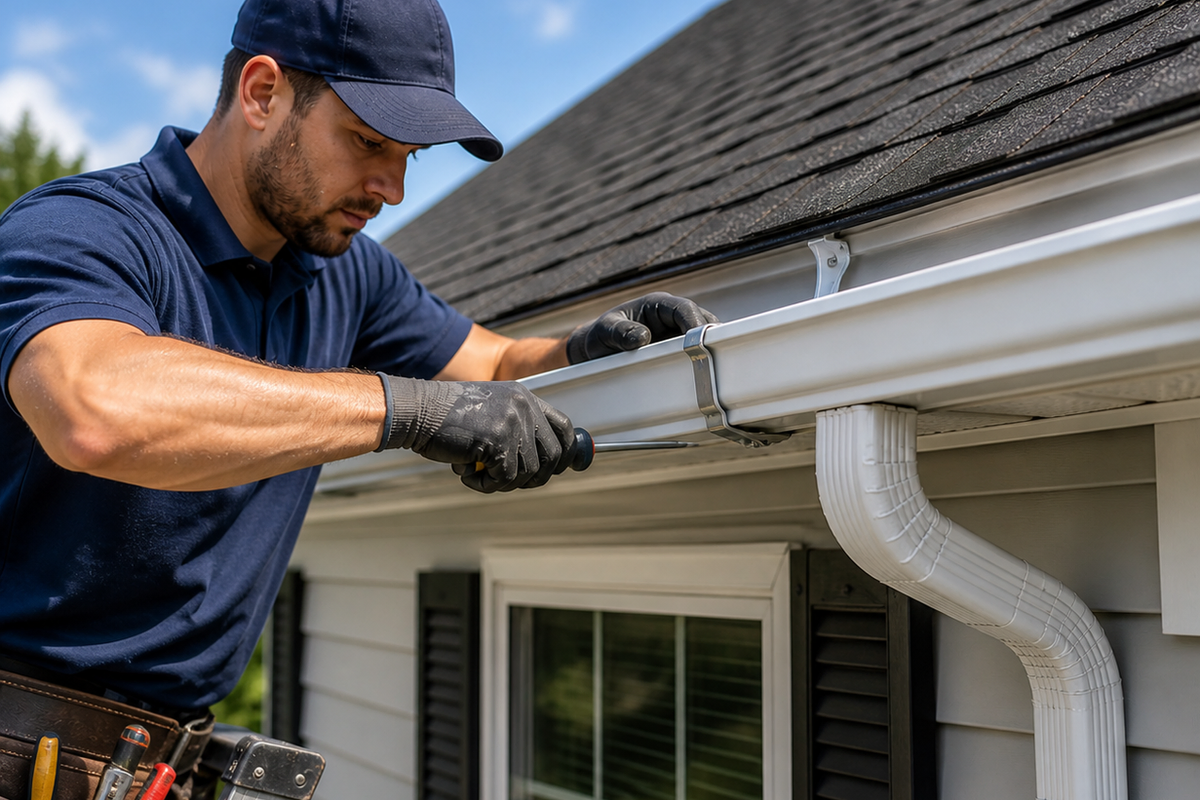
A clogged or undersized gutter is the cheapest problem on the house and the most expensive one to ignore. Water that overshoots the trough runs down the siding, saturates the soil at the footing and finds its way into the basement — and in January it backs up under the shingles as ice.
We size the system to the roof: five- or six-inch trough, appropriate downspout count, hangers on tight centers, and pitch set so nothing stands after a storm. Seamless runs are formed on site, so the only joints are at corners and outlets.
If your existing gutters are sound, we repair and reset them rather than sell you a replacement — resealing joints, replacing hangers, correcting pitch, and adding guards where trees make cleaning a yearly chore.
What the work includes
- Seamless aluminum, copper and vinyl gutter installation
- Gutter guards and screens sized to your debris load
- Downspout replacement and underground drainage tie-ins
- Leak sealing, hanger replacement and pitch correction
- Seasonal cleaning and maintenance programs
Why gutters protect the roof edge, fascia and foundation
Gutters protect a house by catching roof runoff at the eave and carrying it away from the fascia, siding and foundation. On a North Jersey home, a clogged or failed gutter sends water down the wall and into the soil at the footing, which leads to rotted trim, basement seepage and ice at the roof edge.
A roof is a large rain collector. The Department of Energy’s Building America guidance notes that a few inches of rain on an ordinary house roof can produce several thousand gallons of runoff. Every gallon has to go somewhere, and the gutter decides where.
When the trough works, water leaves the eave, drops through the downspout and discharges well clear of the house. When it does not, the damage spreads in three directions:
- Into the roof edge. Water held in a clogged trough soaks the fascia board and the edge of the roof sheathing. Soft fascia stops holding hangers, the gutter sags, and more water pools.
- Down the wall. Overflow runs down cladding and trim, stains masonry and splashes onto sills. Our siding repair page covers what repeated wetting does to vinyl, wood and fiber cement.
- Into the ground. Water dumped at the drip line saturates the soil against the foundation. The US EPA’s moisture guidance tells homeowners to clean and repair roof gutters regularly and to keep the ground sloping away from the foundation so water cannot collect there.
The ground is where the bill gets large. Wet soil at the footing shows up as damp basement walls, white mineral bloom on block and, over years, the cracking we address under foundation repair. A working gutter system is the least expensive foundation protection a house has.
How are gutters sized to roof area and rainfall intensity?
Gutters are sized by comparing the roof area draining to each run against the heaviest short bursts of rain the location gets. For a point near Totowa, NOAA Atlas 14 estimates a 10-year, 5-minute rainfall intensity of about 4.9 inches per hour, and that burst rate is what a trough and its downspouts must carry.
| Downspout | Approx. cross-section | Roof area it can serve |
|---|---|---|
| 2 x 3 inch rectangular | 6 sq in | About 600 sq ft |
| 3 inch round | 7 sq in | About 700 sq ft |
| 3 x 4 inch rectangular | 12 sq in | About 1,200 sq ft |
| 4 inch round | 12.5 sq in | About 1,250 sq ft |
Annual rainfall totals do not overflow gutters. Short, intense bursts do. That is why sizing starts with short-duration intensity from NOAA Atlas 14, the National Weather Service precipitation frequency data, rather than yearly averages. Near Totowa the Atlas 14 estimate for a 5-minute burst at a 10-year recurrence interval is about 4.86 inches per hour, while the 60-minute figure at the same interval is about 1.37 inches per hour.
North Jersey has also seen rain far beyond those design numbers. The Office of the New Jersey State Climatologist at Rutgers reported that on September 1, 2021, during the remnants of Ida, Newark Airport recorded 3.65 inches in a single hour, and storm totals topped 8 inches along a band running up through most of Bergen County.
What we measure on site
- The plan area of each roof plane feeding a run, including upper roofs that empty onto lower ones
- Roof pitch, because steep planes shed water fast enough to shoot past a shallow trough
- Valleys, which concentrate flow into one corner of the gutter
- Where the existing outlets sit compared with where the water actually arrives
Most houses land on five-inch K-style trough. Large, steep or valley-heavy roofs usually justify six-inch trough and added outlets, which we explain on the new gutter installation page.
Seamless aluminum, copper or vinyl gutters: what is the difference?
Seamless aluminum gutters suit most North Jersey homes because they are formed on site in continuous runs, come in many colors and do not rust. Copper gutters are a long-life architectural choice for period houses. Vinyl gutters are inexpensive but sectional, with more joints, and galvanized steel resists impact but rusts once its coating wears.
| Material | Best fit | Strengths | Watch for |
|---|---|---|---|
| Seamless aluminum | Most houses, matched to trim or fascia color | One continuous piece per run; joints only at corners and outlets; will not rust | Dents under a leaning ladder or falling limbs; needs sound fascia |
| Copper, K-style or half-round | Period homes, brick or stone facades, prominent elevations | Soldered joints; weathers to a natural patina; long service life | Higher material cost; runoff can stain light masonry below |
| Vinyl | Sheds, small additions, short budget runs | Light and inexpensive | Sectional with many joints; less rigid under snow and ice |
| Galvanized steel | Older homes with existing steel systems | Stands up well to impact | Rusts from inside once the coating fails; usually replaced rather than patched |
Material matters less than sizing and pitch, but it shapes how long the system lasts and how it looks from the street. Building America guidance points out that copper and galvanized steel have the advantage of withstanding impacts, which counts under mature trees that drop limbs. For most homes we still recommend seamless aluminum, because a continuous run removes the lap joints where sectional gutters usually begin to drip.
If steel gutters are already rusting through, the gutter repair page explains when patching still makes sense and when a new run is the better use of money.
Where should downspouts discharge to keep a basement dry?
Downspouts should discharge at least 5 feet from the foundation onto ground that slopes away from the house, or into solid underground piping that ends at least 10 feet out. Building America guidance also says roof water should never be tied into the perforated foundation drain that runs around the footing of a home.
A gutter that catches every drop still fails the house if its downspout empties against the foundation. The Department of Energy’s Building America Solution Center gives clear targets:
- Extend lateral piping at least 5 feet from the building, pitched away at a minimum of 5/8 inch per foot
- Where water goes underground, carry it to a catchment point at least 10 feet from the foundation
- Space downspouts roughly 20 to 50 feet apart along a run
- Do not connect the gutter drain pipe to the perforated foundation drain
That last point deserves attention. A perforated footing drain is there to relieve groundwater, not to swallow a roof’s worth of storm flow. Feeding roof water into it can push water toward the very wall it was meant to protect.
Code and neighbors
New Jersey’s Uniform Construction Code, at N.J.A.C. 5:23-2.7, lists the repair, replacement or installation of exterior gutters and leaders as ordinary maintenance that can proceed without a permit application. The same section excludes alteration or relocation of drainage and sewer piping, so ask the local construction office before roof leaders are tied into underground lines. Discharge should also stay on your own lot, not across a neighbor’s driveway.
Where splash-back has already undercut a path or step, see walkway repair and replacement.
Gutter guards or gutter screens: which does your house need?
Gutter guards are engineered covers, such as micro-mesh or reverse-curve systems, that filter fine debris like pine needles and shingle grit. Gutter screens are simpler perforated or wire-mesh inserts that stop broad leaves and lift out for cleaning. The trees over your roof, more than the price, should decide which one a North Jersey home needs.
The two terms get used interchangeably, but they are different products with different jobs. We keep them on separate pages so you can compare them honestly:
- Gutter guards covers micro-mesh, reverse-curve, brush and foam systems, how each handles oak, maple and pine debris, and what installation means for your shingles.
- Gutter screens covers snap-in and perforated screens, where they are the right value, and where needles and seeds get past them.
Either one reduces how often the trough fills. Neither one ends upkeep. Downspout elbows still collect grit, and debris that settles on top of a cover can shed water over the front edge in a hard storm. Under heavy tree cover, plan on an inspection and periodic gutter cleaning even with a cover in place.
Building America guidance makes a practical point for cold climates: gutters should be clean as winter approaches, or fitted with leaf screens, so they drain instead of filling with water that freezes. In North Jersey that makes the late-fall leaf drop the real deadline.
Do gutters cause ice dams on North Jersey roofs?
Gutters do not cause ice dams. The Insurance Institute for Business & Home Safety explains that ice dams form when attic heat melts roof snow that refreezes at the colder roof edge. A packed or frozen gutter adds weight and gives ice a place to build, so gutter upkeep supports attic insulation and ventilation but never replaces them.
The Department of Energy’s Building America Solution Center describes the mechanism. Heat leaking into the attic warms the roof deck, snow melts and runs down to the cold overhang, and it refreezes into a ridge of ice. Ice dams can form with as little as 2 inches of snow. Water ponding behind that ridge can be drawn up under shingles by capillary action and leak into ceilings and walls.
Gutters sit exactly where that ice builds, so they take the load. A trough packed with frozen leaves and slush can pull hangers out of the fascia, bend the front lip and split corner seams. Winter damage often looks like a gutter problem even when the cause is in the attic.
What actually fixes it
- Air sealing and insulation at the attic floor plus balanced attic ventilation, which IBHS lists as the long-term mitigation
- A self-adhered ice barrier membrane along the eaves when the roof is redone, covered on our roof replacement page
- Clear gutters and downspouts going into winter, so meltwater has a path off the roof
IBHS also notes that professionally installed heating cables that are UL Listed, FM Approved or CSA Certified will not remove an ice dam but can open channels for water to drain. Treat them as a supplement, not a cure.
What a gutter estimate from NJ Gold Star includes
A gutter estimate from NJ Gold Star Construction starts with a hands-on look at the ground, roof edge, fascia, trough and downspouts, followed by a measured, written and itemized scope. The estimate is free and carries no obligation, and it separates what can be repaired from what genuinely needs replacing.
Homeowners notice when the plan is explained before work starts. As one customer put it: “the whole process was explained in depth before the job was started” — Bill E., Google review
Read the drip line
We look at the ground first: erosion trenches, splash marks on siding and foundation, and where each downspout actually empties. The ground usually shows where a system is failing before a ladder goes up.
Inspect the roof edge
Fascia condition, drip edge, hanger grip, seams, pitch and any water standing in the trough. Soft fascia gets probed, because new gutters cannot be hung on rotted wood.
Measure and size
Roof planes, pitch, valleys and run lengths set trough size and downspout count. We also note the trees over each run for any guard or screen recommendation.
Put the scope in writing
You receive repair and replacement options in writing, with fascia work, downspout routing and covers listed as separate line items.
Install, test and clean up
Our own crew does the work, water-tests each outlet, and hauls old material and debris off the property.
Gutters services we provide
Hand-cleaning of gutters and downspouts, flush-testing every outlet, and a check of hangers, sea…
Seamless aluminum, copper or vinyl gutters formed on site, sized and pitched to the roof area th…
Gutter guard installation matched to your debris load, from micro-mesh for pine needles and shin…
Simple, cost-effective gutter screens that keep leaves and twigs out of the trough while staying…
Repair of sagging, leaking or overflowing gutters — reseating hangers, resealing seams and end c…
Frequently asked questions
Do gutter screens or gutter guards really help?
Yes, when they match the debris. Fine mesh handles pine needles and shingle grit; heavier screens are enough for oak and maple leaves. No guard makes a gutter maintenance-free, but the right one turns a twice-a-year cleaning into an occasional check.
How do I know if my gutters are too small?
Water sheeting over the front edge during heavy rain, staining on the siding below the trough, and erosion trenches along the drip line all point to undersized or under-pitched gutters. Large or steep roof planes usually need six-inch trough and extra downspouts.
Do you need a permit to install new gutters in New Jersey?
Usually not. New Jersey’s Uniform Construction Code, at N.J.A.C. 5:23-2.7, treats the repair, replacement or installation of exterior gutters and leaders as ordinary maintenance that needs no permit application. Underground drainage tie-ins and homes in a local historic district can involve other approvals, so those details are worth confirming with the town before work starts.
Should gutters come off when a roof is replaced?
Often, yes. Since its 2012 edition the International Residential Code has required metal drip edge at the eaves of shingle roofs, with underlayment lapped over it. Gutters loosened during a roof replacement can be reset tight beneath the new drip edge so water falls into the trough instead of running behind it onto the fascia.
What are the signs of a badly installed gutter?
Water pouring behind the trough, gutters still holding water a day after rain, drips from mid-run joints, and downspouts emptying beside the foundation all point to installation errors rather than age. Our article on <a href="/post/signs-of-improper-gutter-installation-passaic-county-nj/">signs of improper gutter installation in Passaic County</a> walks through each one and what it takes to correct it.
Which towns does NJ Gold Star serve for gutter work?
NJ Gold Star Construction handles gutter installation, repair, guards and cleaning across Bergen and Passaic County, including <a href="/areas-we-serve/roofing-totowa-nj/">Totowa</a> and <a href="/areas-we-serve/roofing-ridgewood-nj/">Ridgewood</a>, plus Essex, Hudson, Morris and Union counties. Estimates are free, written and itemized, and you can request one through our <a href="/contact-us/">contact page</a>.
- Gutters and Downspouts — U.S. Department of Energy, Building America Solution Center (PNNL)
- A Brief Guide to Mold, Moisture and Your Home — U.S. Environmental Protection Agency
- NOAA Atlas 14 point precipitation frequency estimates, intensity (lat 40.9051, lon -74.2257) — NOAA National Weather Service, Hydrometeorological Design Studies Center
- Precipitation Frequency Data Server (PFDS) — NOAA National Weather Service
- Ida Overview — Office of the New Jersey State Climatologist, Rutgers University
- N.J.A.C. 5:23-2, Uniform Construction Code: Administration and Enforcement — New Jersey Department of Community Affairs
- Attic Air Sealing, Insulating, and Ventilating for Ice Dam Prevention — U.S. Department of Energy, Building America Solution Center (PNNL)
- Ice Dams: Prevent Them and Your Roof Will Thank You — Insurance Institute for Business & Home Safety
- 2012 IRC Significant Changes: R905.2.8.5 Roof Drip Edge — International Code Council (hosted by City of Walterboro, SC)
Updated September 2026 · Reviewed by Edgar Lopez Gonzalez, owner · NJ HIC #13VH13359900
Licensed & insured. 25+ years in North Jersey. We answer 24/7 for leaks and storm damage.
- Service area
- Bergen, Passaic, Essex, Hudson, Morris & Union County, NJ
- License
- NJ HIC #13VH13359900
- Estimates
- Free, written and itemized
- Emergency
- 24/7 response for active leaks and storm damage