Licensed & Insured — NJ HIC #13VH13359900
njgoldstarconstruction@yahoo.com · 24/7 Emergency · (862) 271-1225

Sidewalk Repair & Replacement in Bergen County, NJ
Sidewalk repair and replacement to municipal standards — removing trip hazards, correcting pitch and pouring or laying flags that meet town specification.
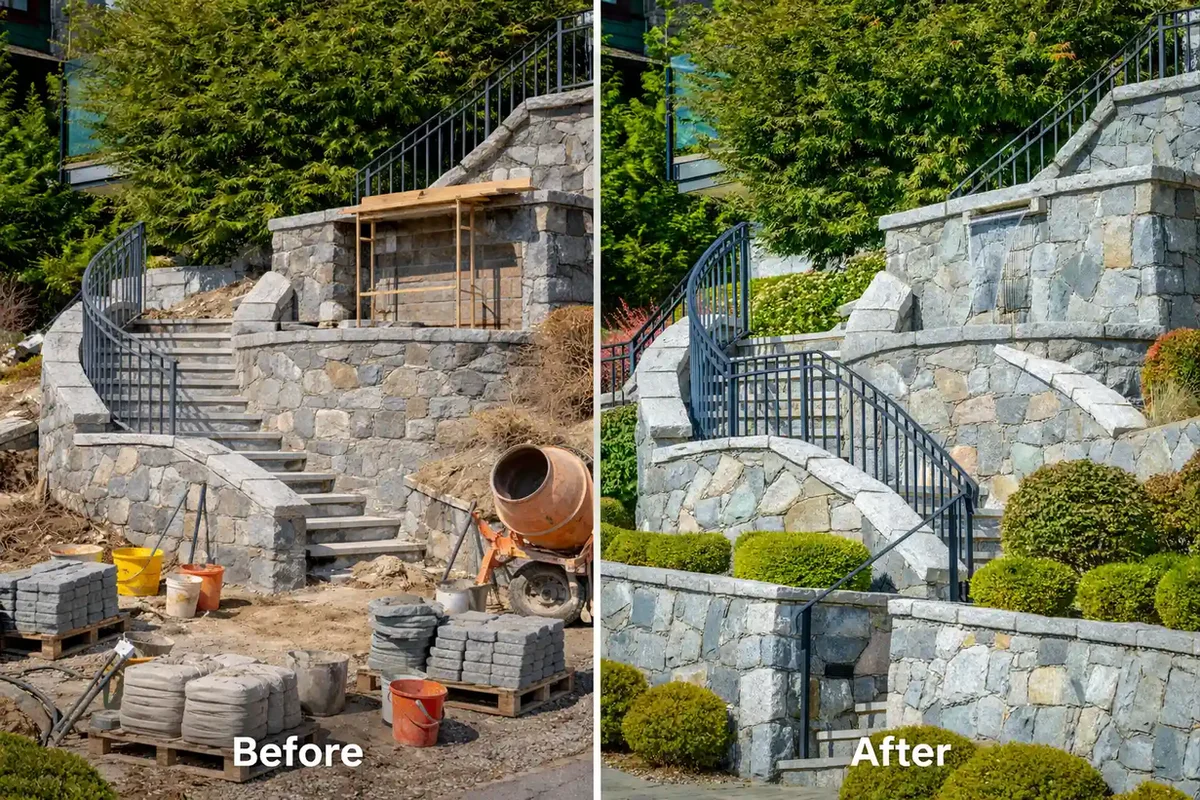
Towns across Bergen County have their own sidewalk specs and inspection rules. We build to the local standard so the work passes the first time.
This is one part of the masonry work we do across Bergen and Passaic County. Every job is quoted in writing after a hands-on inspection, performed by our own crew rather than subcontractors, and backed by our satisfaction guarantee. We are licensed under NJ HIC #13VH13359900 and fully insured.
What the work includes
- Trip hazard removal and slab replacement
- Full sidewalk replacement to town specification
- Apron, curb and driveway transition work
- Root cutting and base correction
Who is responsible for sidewalk repair in New Jersey?
In most New Jersey municipalities, the property owner is responsible for maintaining and repairing the sidewalk in front of their home, not the town. Wyckoff Township’s building department confirms this directly: the property owner repairs the sidewalk, and repairs need approval from the Township Engineer before work begins.
New Jersey does not set sidewalk maintenance responsibility at the state level — it is a municipal ordinance question, and most Bergen and Passaic County towns place that responsibility on the abutting property owner. Wyckoff’s building department states it plainly in its own homeowner FAQ: the property owner is responsible for the repair of the sidewalk in front of their home, and Section 165-2 of the township code requires the owner to keep the sidewalk clear of impediments, with any repair work needing sign-off from the Township Engineer before it starts.
Every town writes its own version of this ordinance, so the specification, the notice period, and who inspects the finished work vary by municipality even between neighboring towns in Wyckoff and elsewhere across our service area. We confirm your town’s specific requirements before we start.
Trip hazards: how uneven does a sidewalk have to be before it needs replacement?
There is no single New Jersey standard for how much a sidewalk slab can be off before it counts as a trip hazard; each municipality sets its own threshold and inspection process. As a general rule, any noticeable vertical lip between adjacent slabs is worth grinding down or replacing before someone catches a toe on it.
Towns vary in exactly how they define and enforce a trip hazard, which is one more reason the Township Engineer or construction official signs off on sidewalk work before and after it happens. A small lip can sometimes be ground down rather than replaced; a slab that has settled, heaved, or cracked through usually needs to come out and be repoured or reset.
Options short of a full replacement
- Grinding down a small vertical lip between two slabs
- Leveling a settled panel that is otherwise sound
- Root-pruning and monitoring where a tree root is the early cause
We inspect the full run of sidewalk, not just the panel someone complained about, since one settled slab is often an early sign its neighbors are heading the same way. See our masonry services overview for how a sidewalk repair fits alongside other work on the same property.
Tree roots: cut, route around, or replace the panel?
A tree root under a sidewalk gives you three options: cut and remove the root with an arborist’s guidance, route the sidewalk around it, or replace the affected panel on a root barrier that keeps the same root from lifting the new concrete again within a few seasons.
Cutting a large structural root without a plan can destabilize the tree, so we coordinate with an arborist or the municipality’s shade tree commission where a significant root is involved, especially on a town-owned street tree along the curb. For a smaller root, we can sometimes reroute the sidewalk’s path slightly or install a root barrier alongside the new panel to redirect future growth away from the slab.
Paver sidewalks handle minor root movement differently than poured concrete: individual pavers can be lifted, the base regraded, and the same pavers reset, while a poured panel over a growing root will crack again. It is one reason some homeowners choose pavers for a walkway that runs near mature trees, even though poured concrete remains the more common sidewalk material for the municipal frontage itself.
Street trees are common along older blocks in Bergen and Passaic County, and a root problem rarely stays confined to one panel. When we quote a root-related sidewalk repair, we walk the full frontage rather than just the cracked slab, since a root usually threatens the next panel over before it finishes lifting the one you called about.
Control joints: why sidewalks crack in a grid, not at random
Control joints are intentional weak points cut or tooled into a new sidewalk at regular intervals so it cracks along a straight, hidden line instead of a random crack across the middle of a panel. Concrete shrinks slightly as it cures, and a joint gives that shrinkage somewhere planned to go.
Every poured concrete sidewalk is going to crack somewhere as it cures and ages, and the point of a control joint is to decide where. We space joints to match the width of the sidewalk and the panel layout the municipality specifies, so any shrinkage crack that does form follows the joint line and stays close to invisible rather than opening up across the middle of a panel.
Expansion joints do a related but different job. Where a new sidewalk meets a driveway apron, a curb, or another fixed structure, a compressible expansion joint material absorbs the small amount of movement between the two without transferring stress into either slab. Skipping that joint, or filling it solid with mortar instead of a compressible filler, is a common reason a sidewalk cracks right at the point it meets the driveway.
Curing: why a new sidewalk needs time before salt, forms or traffic
New concrete needs time to gain strength before it faces foot traffic, forms coming off, or deicing salt. Concrete reaches most of its working strength within about a week and continues curing for close to a month, and chloride-based deicers are especially damaging to concrete that has not fully cured yet.
We keep new sidewalk sections protected and closed off while they cure, and we tell homeowners how long to hold off on regular foot traffic and, just as importantly, how long to hold off on deicing salt the first winter after a pour. Iowa State University Extension notes that chloride-based deicers such as rock salt and calcium chloride are corrosive to concrete, and new concrete is the most vulnerable to that damage before it has fully cured. Sand for traction, or a gentler product such as calcium magnesium acetate, is the safer choice on a new sidewalk through its first winter.
Permits and specifications: building to your town's standard
Sidewalks are not on New Jersey’s state list of exempt minor-work items, so most towns require a permit or at least a review before a sidewalk is replaced, and each municipality sets its own slab thickness, mix and finish specification. We build to that local standard so the work passes inspection the first time.
New Jersey’s Uniform Construction Code lists specific categories of exempt minor work in N.J.A.C. 5:23-2.17A, such as certain porch and stoop replacement. Patios, walkways and sidewalks are not on that list, which is why most Bergen and Passaic County towns route sidewalk replacement through their own permit or construction-office review rather than treating it as routine maintenance. We confirm your municipality’s slab thickness, mix design and finish requirements before we quote the job, and pull whatever permit that town requires.
If the sidewalk connects to a driveway apron, curb cut or a set of entry steps, we quote all of it together so the transitions line up. Request a free estimate to get started.
Related masonry services
Paver and natural stone patios built on a compacted stone base with proper pitch, edge restraint…
Front and side walkways in paver, bluestone or brick, laid on a compacted base with consistent j…
Repair of cracked, spalling and water-damaged foundation walls — repointing, parging, crack repa…
New and rebuilt front steps, stoops and multi-level stone staircases with consistent riser heigh…
Frequently asked questions
Am I responsible for the sidewalk in front of my house?
In most New Jersey municipalities, yes — maintenance falls to the property owner. Your town clerk can confirm the local ordinance.
Concrete or paver sidewalk?
Concrete matches most streetscapes and satisfies town specs; pavers look better and can be reset if roots move them. We build either.
Will the town tell me if my sidewalk needs to be replaced?
Many New Jersey municipalities do inspect and notify property owners when a sidewalk needs repair, often with a set number of days to complete the work once notified. Waiting for that notice is not required — you can have a sidewalk repaired proactively, and it is worth doing before it becomes a liability or a notice deadline.
Can I repair just one sidewalk slab instead of the whole run?
Often yes, if the surrounding panels are sound and at the correct grade. We replace or level the affected slab and match the joint pattern and finish to the rest of the run so it does not stand out. If several panels nearby are also failing, replacing them together usually costs less than repeated single-slab repairs over a few years.
Do you build paver sidewalks or only poured concrete?
We build both, though most municipalities specify poured concrete or approved flagstone for the public sidewalk itself. Where a town’s specification allows pavers, or for a private walk that is not the municipal sidewalk, pavers are an option — see our walkways page for that base and material discussion.
How long does a sidewalk replacement take?
A single-panel repair can often be done in a day. A full-run replacement along a typical residential lot usually takes two to four working days, including demolition, base correction, forming, the pour, and the curing period before the sidewalk reopens to regular foot traffic.
- Who is responsible for the repair of the sidewalk in front of my house or business? — Township of Wyckoff, NJ, Building, Zoning & Property Maintenance FAQ
- N.J. Admin. Code 5:23-2.17A – Permits (minor work) — Cornell Law School, Legal Information Institute (New Jersey Administrative Code)
- Deicers — helpful or harmful? — Iowa State University Extension and Outreach, AnswerLine
Updated September 2026 · Reviewed by Edgar Lopez Gonzalez, owner · NJ HIC #13VH13359900
Licensed & insured. 25+ years in North Jersey. We answer 24/7 for leaks and storm damage.
- Service
- Sidewalk Repair & Replacement
- Category
- Masonry
- Service area
- Bergen & Passaic County and surrounding North Jersey
- License
- NJ HIC #13VH13359900