Licensed & Insured — NJ HIC #13VH13359900
njgoldstarconstruction@yahoo.com · 24/7 Emergency · (862) 271-1225

Home › Areas We Serve › Paramus
Roofing, Chimney, Siding & Masonry Contractor in Paramus, NJ
NJ Gold Star Construction serves Paramus from our Totowa shop with roof repair and replacement, chimney work, siding, seamless gutters, masonry and decks. Licensed under NJ HIC #13VH13359900, insured, free written estimates, and 24/7 emergency response.
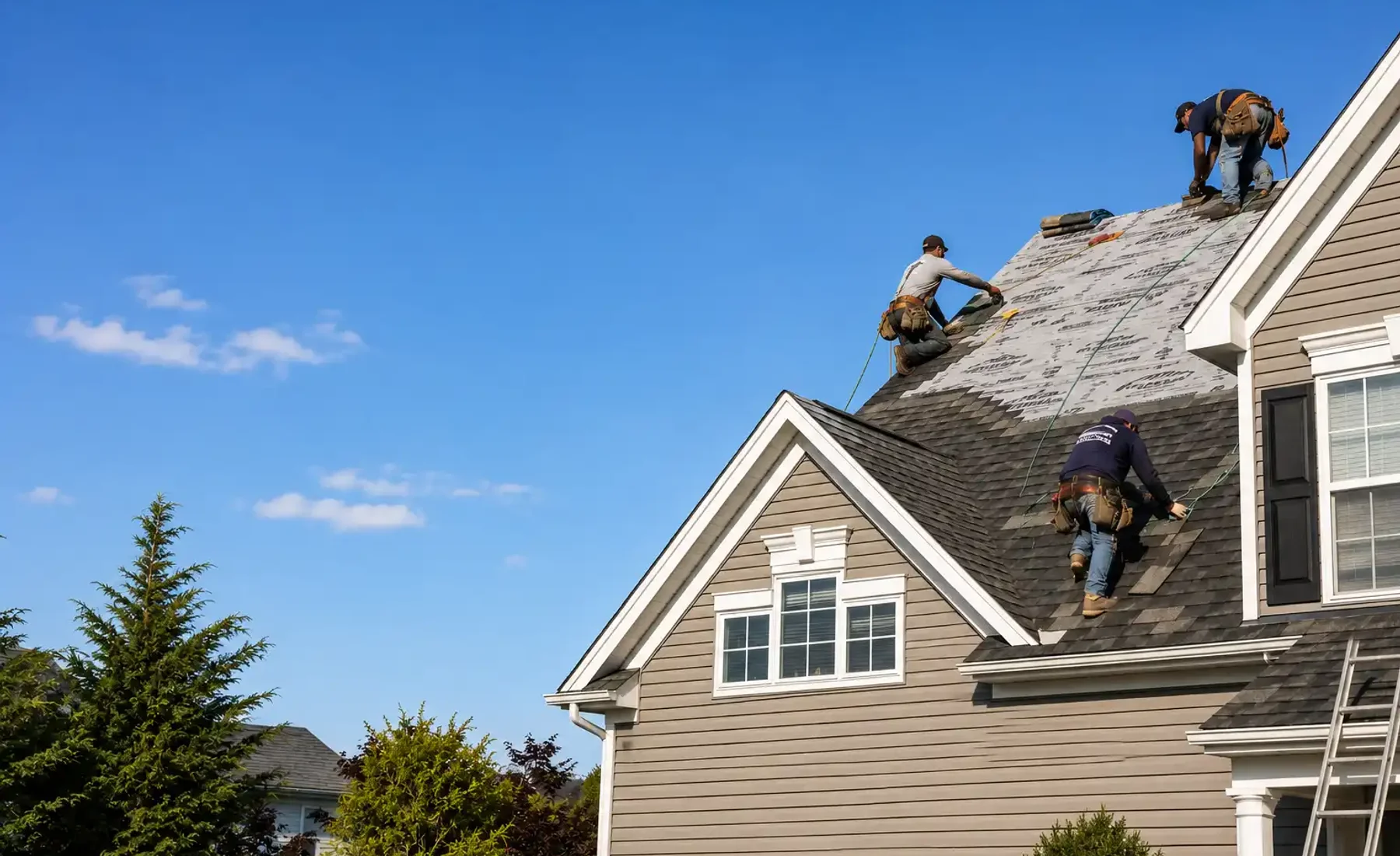
Paramus is heavy on 1950s and 60s ranches and split-levels, which means long low-slope roof planes, original attic ventilation that was never balanced, and aging front stoops. We do a lot of ventilation correction and paver driveway and walkway work in the borough.
Homeowners in Paramus get the same process we use everywhere: a hands-on inspection, a written itemized scope before anything starts, our own crew on site rather than subcontractors, and a satisfaction guarantee on the finished work. We have been doing this in North Jersey for more than 25 years.
If you are comparing quotes in Paramus, call (862) 271-1225 and we will tell you plainly what the work needs — repair when repair is the right answer, replacement when it is not.
What the work includes
- Roof repair, replacement and 24/7 emergency leak response in Paramus
- Chimney repair, repointing, rebuilds, liners and cleaning
- Siding installation and repair — vinyl and fiber cement
- Seamless gutters, guards, screens and cleaning
- Masonry: steps, walkways, patios, sidewalks and retaining walls
- Deck construction, structural repair and restoration
Permits Paramus requires before roofing, siding or deck work begins
Paramus requires a construction permit under the NJ Uniform Construction Code for a full roof tear-off, a siding replacement and a new or rebuilt deck. The Paramus Building Department reviews plans against each applicable subcode before work starts, and NJ Gold Star handles that paperwork as part of a free written estimate.
The Paramus Building Department’s construction permits page lists roofing, siding and decks among the project types that need a permit before work starts, reviewed against the New Jersey Uniform Construction Code. A full tear-off re-roof, a siding replacement and a new or rebuilt deck are on that list; a small patch repair generally is not. The borough asks for one set of plans for each applicable subcode on the state UCC-F100 form, and drawings for anything beyond a one-family owner-occupied home need to be signed and sealed by a New Jersey-licensed architect or engineer.
State rule backs this up. New Jersey’s construction code requires a permit before anyone may construct, enlarge, repair, renovate, alter, reconstruct or demolish a structure, with narrow exceptions for ordinary maintenance. We handle the Paramus paperwork as part of a free written estimate, whether the job is a full deck rebuild or a roof replacement.
Ice barrier and ventilation on Paramus's low-slope ranch and split-level roofs
Paramus’s 1950s and 60s ranches and split-levels typically carry long, low-pitched roof planes and stepped roof heights that make balanced attic ventilation harder than on a simple gable roof. New Jersey’s residential code requires an ice barrier at the eaves on these homes, and the U.S. Department of Energy notes that ice dams can start with as little as two inches of roof snow.
New Jersey’s residential code requires an ice barrier — a self-adhering membrane or two cemented layers of underlayment — running from the eave to at least 24 inches inside the exterior wall line on homes in our climate zone. On a Paramus ranch, that line often has to wrap a long, low-pitched plane with several valleys where snowmelt collects, so the detail work at hips and valleys matters as much as the overall barrier width.
Split-levels complicate the vent path
A split-level’s stepped roofline can leave the mid-level section without a clear run from soffit intake to ridge exhaust, since the upper roof interrupts the path. We size and place individual roof vents or a power vent where a continuous ridge vent cannot do the job, based on the attic floor area behind each roof section. Left unbalanced, warm attic air melts snow from beneath, and the meltwater refreezes at the cold overhang into an ice dam — a cycle the DOE’s Building America Solution Center notes can start with as little as two inches of snow on the roof. Our guide to common roof leaks and how to fix them covers how an ice dam leak differs from a shingle or flashing leak.
This is the same attic ventilation work we do on a full roof replacement, and we see the identical split-level pattern on ranches just over the line in Glen Rock.
Retaining walls and paver hardscape: the four-foot permit line
In Paramus, a retaining wall or a stepped series of walls needs a construction permit once the combined height reaches four feet, measured from the footing to the top of the wall, or at any height if the wall could affect a building’s foundation. Paver driveways and walkways sit lower on the priority list, but terraced yard walls often cross that four-foot line.
New Jersey’s construction code sets a specific trigger for retaining walls: a permit is required once a wall or a series of walls on the same slope reaches a combined height of four feet from the bottom of the footing to the top, and at any height if the wall could affect a foundation. On the rolling, terraced lots common in parts of Paramus, two or three shorter walls stepping down a slope can add up to that threshold even when no single wall looks large on its own.
What this means for paver and hardscape projects
- A single low wall edging a paver walkway or patio is usually straightforward.
- A tiered wall system holding back a sloped side or rear yard should be checked against the four-foot combined-height rule before work starts.
- Any wall near a house foundation gets reviewed regardless of height, because of its effect on drainage and lateral soil pressure.
We handle this the same way we handle paver patio and walkway work: measure first, then tell you plainly whether the borough needs to see plans before we start on the retaining-wall side of a foundation project.
Drainage and grading near the Saddle River and Sprout Brook
Paramus sits along two flood-mapped waterways, the Saddle River and Sprout Brook, and the U.S. Geological Survey has published flood-inundation maps for the Saddle River corridor through the borough. Low-lying sections near these streams need grading, gutter discharge and masonry work that moves roof and yard water away from the foundation, not toward it.
The U.S. Geological Survey, working with the New Jersey Department of Environmental Protection, mapped flood inundation along the Saddle River from Ho-Ho-Kus through Ridgewood and into Paramus Borough, using a streamgage and lidar elevation data to model how far water spreads at different flow levels. Sprout Brook, a smaller tributary that crosses the borough, adds a second flood-mapped corridor on the east side of town. Neither waterway floods every yard in Paramus, but homes closest to these corridors see the water table rise faster in a heavy storm than homes on higher ground elsewhere in the borough.
For roofing and exterior work, that reality changes a few decisions. Gutters need enough capacity and long enough downspout extensions to carry water well past the foundation rather than letting it pool at the base of a wall, and any foundation repair or waterproofing in these sections should account for a higher water table than a Paramus home on higher ground. We size gutter systems to the actual roof area rather than a standard formula, which matters most on exactly this kind of low-lying lot. The same Saddle River corridor runs north through Ridgewood and continues downstream toward Fair Lawn, and homeowners in both towns ask us the same drainage questions.
Deck footings and New Jersey's frost line
New Jersey’s residential code requires footings to sit at least 12 inches below undisturbed ground and below the local frost line, so a Paramus deck rebuild is not just a surface job. Footing depth and diameter, tied to post spacing and load, follow the same state foundation rules whether the deck is 80 square feet or wraps the back of the house.
A deck looks like carpentry, but the load path starts underground. New Jersey’s residential code, Section R403.1.4, requires exterior footings to sit not less than 12 inches below the undisturbed ground surface and below the frost line set for the area in the state’s frost-depth table, so a footing that is too shallow can heave as the soil around it freezes and thaws over a Bergen County winter. Footing diameter and depth then scale with post spacing and the load each post carries, following the same prescriptive tables builders use across the state.
On a full deck rebuild — the kind of project several Paramus homeowners come to us for once a 1960s-era deck has reached the end of its life — we dig to that depth rather than to whatever the old footings happen to sit at, since older decks built before current frost-depth rules were tightened are a common source of the heaving and racking we get called to fix. Ledger attachment, joist spacing and railing all follow from a sound footing, which is also where a deck’s new construction and repair or restoration work most often diverges.
Which Paramus exterior projects typically need a permit
Most exterior projects on a Paramus home need a construction permit, with a short list of exceptions for ordinary maintenance. The table below reflects the general Uniform Construction Code categories the Paramus Building Department applies; a specific project should still be confirmed with the department or as part of your estimate.
| Project | Permit generally needed | Why |
|---|---|---|
| Full roof tear-off and re-roof | Yes | Structural work on the roof assembly, reviewed under the building subcode |
| Shingle spot repair, no tear-off | Usually not | Falls under ordinary maintenance when materials match |
| Siding replacement, full elevation | Yes | Alters the exterior envelope |
| New or rebuilt deck | Yes | New structure with its own footings and loads |
| Deck board or railing swap, same footprint | Usually not | Ordinary maintenance if materials are the same or closely similar |
| Retaining wall under four feet, away from a foundation | Usually not | Below the state permit height threshold |
| Retaining wall four feet or taller, or near a foundation | Yes | Meets or exceeds the state height and foundation trigger |
None of this replaces a call to the borough. Our estimate process in Paramus always includes telling you plainly whether your project needs a permit before we put it on the schedule.
Services available in Paramus
NJ Gold Star Construction repairs and replaces asphalt shingle, flat and metal roofs across Berg…
We repair, repoint, reline and fully rebuild masonry chimneys throughout North Jersey, and we cl…
We install seamless aluminum and copper gutters, add guards and screens, and repair or clean exi…
We build and repair steps, walkways, patios, sidewalks, retaining walls and stone veneer across …
We install and repair vinyl, fiber cement and wood siding across North Jersey, including the wat…
We build new decks and repair existing ones across North Jersey — footings, framing, decking, ra…
Frequently asked questions
Do you serve Paramus?
Yes. Paramus is part of our regular service area for roofing, chimney, siding, gutter, masonry and deck work.
How fast can you get to Paramus for an emergency?
We answer 24/7 and reach active leaks in Paramus the same day whenever possible, tarping to stop water before the permanent repair is scheduled.
Are you licensed to work in Paramus?
Yes. We hold New Jersey Home Improvement Contractor license #13VH13359900, carry full insurance, and pull permits with your municipality where the work requires them.
Does a full roof replacement in Paramus require a building permit?
Yes. The Paramus Building Department lists roofing among the project types that need a construction permit, and a full tear-off replacement is reviewed under the state Uniform Construction Code. Spot repairs to a section of shingles usually fall under ordinary maintenance and do not need a separate permit, though we confirm this case by case before starting work.
Do paver patios and retaining walls need a permit in Paramus?
A retaining wall needs a permit once a wall or a stepped series of walls reaches a combined height of four feet, or at any height if it could affect a foundation. A single low wall bordering a paver patio or walkway usually falls below that line, but terraced walls on a sloped Paramus lot can add up to it quickly.
Why do split-level homes in Paramus get uneven ice dams?
A split-level roof steps up in stages, which can cut off part of the attic from a continuous ridge vent and leave that section under-ventilated. Trapped warm air melts snow from underneath, and the meltwater refreezes at the cold eave into an ice dam, often on the same section of roof year after year until the ventilation is corrected.
Is my Paramus home near the Saddle River or Sprout Brook flood-mapped area?
Sections of Paramus closest to the Saddle River and Sprout Brook sit within corridors the U.S. Geological Survey has flood-mapped with the state. If your yard is near either waterway, ask about gutter capacity, downspout extensions and grading as part of your estimate, since these lots see standing water sooner than higher ground elsewhere in the borough.
- Construction Permits — Paramus Borough, NJ
- N.J.A.C. 5:23-2.14 – Construction permits – when required — Legal Information Institute, Cornell Law School (New Jersey Administrative Code)
- Flood-Inundation Maps for the Saddle River in Ho-Ho-Kus Borough, the Village of Ridgewood, and Paramus Borough, New Jersey, 2013 — U.S. Geological Survey (with NJDEP)
- Chapter 4 Foundations: New Jersey UCC One- & Two-Family Dwelling Subcode 2021 (R403.1.4 Frost Protection) — UpCodes (New Jersey edition of the 2021 IRC)
- Attic Air Sealing, Insulating, and Ventilating for Ice Dam Prevention — U.S. Department of Energy, Building America Solution Center (PNNL)
Updated September 2026 · Reviewed by Edgar Lopez Gonzalez, owner · NJ HIC #13VH13359900
Licensed & insured. 25+ years in North Jersey. We answer 24/7 for leaks and storm damage.
- Town
- Paramus, Bergen County
- License
- NJ HIC #13VH13359900
- Emergency service
- 24/7 — call (862) 271-1225
- Estimates
- Free, written and itemized