Licensed & Insured — NJ HIC #13VH13359900
njgoldstarconstruction@yahoo.com · 24/7 Emergency · (862) 271-1225

Siding Repair in Bergen County, NJ
Siding repair for cracked, loose or storm-damaged panels — matched to the existing profile where possible, with the wrap and flashing behind it corrected.
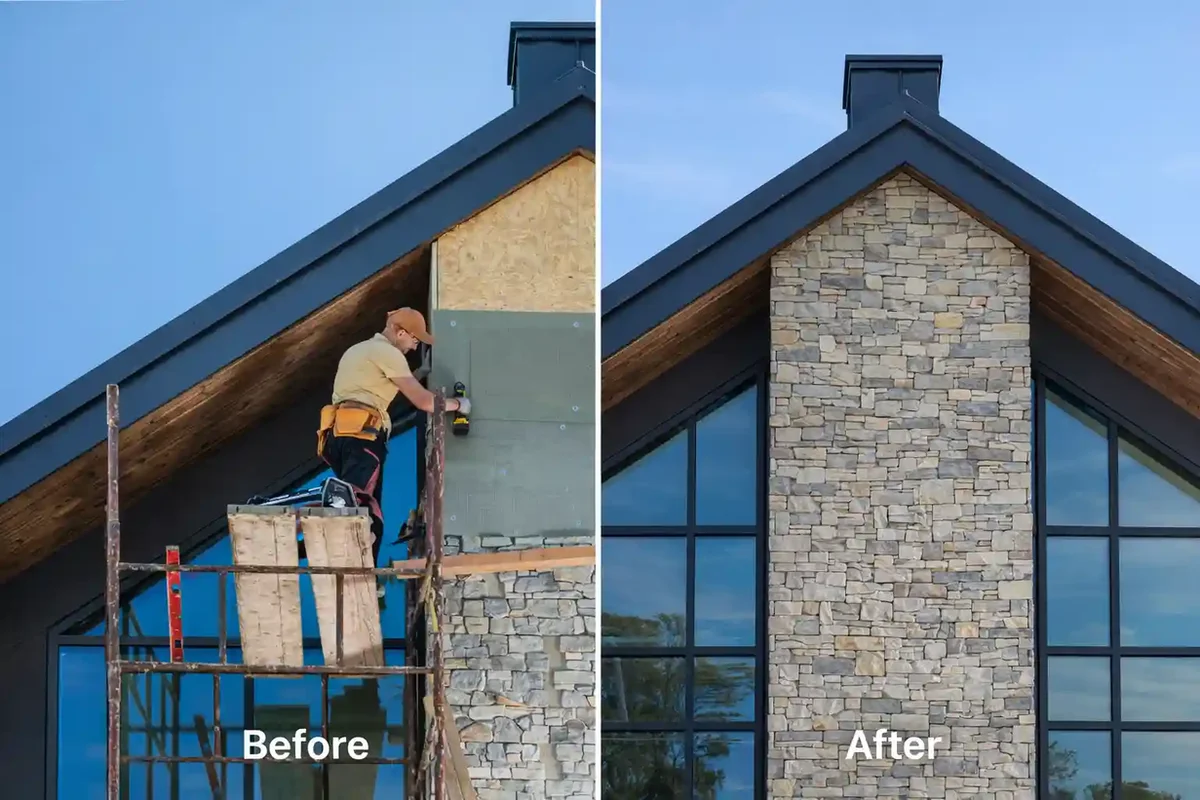
We open the wall where damage suggests water got behind the siding, dry and correct what we find, then close it back up. Panel swaps alone leave the real problem in place.
This is one part of the siding work we do across Bergen and Passaic County. Every job is quoted in writing after a hands-on inspection, performed by our own crew rather than subcontractors, and backed by our satisfaction guarantee. We are licensed under NJ HIC #13VH13359900 and fully insured.
What the work includes
- Panel and section replacement, profile matched
- Storm and impact damage repair
- House wrap and flashing correction behind the panel
- Trim, corner and J-channel repair
Loose, cracked or warped: what each type of panel damage tells us
A loose panel usually points to a failed or missing fastener at the nail hem; a cracked panel is often storm or impact damage; a warped or buckled panel almost always means it was fastened too tightly against expansion and contraction. Each type of damage has a different fix, and none of them is safely solved by simply caulking the panel back down.
Loose panels have usually pulled free of the wall because a fastener backed out, was missing to begin with, or the panel was never properly locked into the course below it. We re-hang the panel on its nailing hem with the correct clearance rather than face-nailing it, which would trap it and cause buckling the next time the temperature swings.
Cracked panels are typically the result of a direct impact — a ladder, a branch, hail — and get replaced rather than patched, since a crack compromises the panel’s ability to shed water at that spot for good. Warped or buckled panels are a fastening problem, not a material defect: the panel was driven tight against the nail hem instead of hung with clearance, so it could not move with the seasons and eventually bowed.
Matching the existing profile, color and exposure
Matching a repair to existing siding means finding the same profile, exposure (the visible course height) and, ideally, the same color, since manufacturers retire colors and profiles over the years and even a close match can look slightly different after years of UV fade on the original wall. We check availability before quoting a repair so you know upfront whether a seamless match is realistic.
Vinyl and fiber cement lines both change over time, so a panel bought new may not be identical to one installed years ago even from the same manufacturer. We look for the closest available match in profile and exposure first, since a mismatched profile is more visually obvious than a slightly different shade. Where the original color has faded unevenly across the wall, a perfectly new-colored patch can actually stand out more than a slightly imperfect match.
When a patch will not blend in
- The original profile or color line has been discontinued with nothing close enough to substitute.
- Damage is spread across more than one elevation rather than contained to a few panels.
- UV fade on the surrounding wall is severe enough that any new panel reads as a visible patch regardless of match quality.
In any of those cases, re-siding the affected wall or elevation through our siding installation service usually looks better than a technically correct but visually obvious repair.
Water damage we find behind cracked or loose siding
Water that gets behind damaged siding travels down the wrap and can reach the sheathing, framing and insulation long before any sign shows up inside the house. We open the wall wherever damage suggests water intrusion, check the wrap and flashing at that spot, dry and repair anything affected, then close it back up correctly rather than covering the same failure point again.
A cracked panel or a gap at a corner does not usually leak in a straight line; water tends to run down behind the barrier and show up lower on the wall, or inside at a header or sill well below where the damage is visible outside. That is why a siding repair on our jobs always includes opening the affected section, not just swapping the panel that is broken.
Once open, we check whether the house wrap behind that panel is torn, whether the flashing at a nearby window or corner failed first, and how far softening has spread into the sheathing. Repairs that skip this step tend to fail again at the same spot within a season or two, because the panel was never the actual problem.
Wind damage after a North Jersey storm
Wind-driven storms lift and tear vinyl siding where a course was under-fastened or where the panel’s locking leg never fully engaged the course below it, and repeated gusts work a marginal panel loose over several storms rather than one. After a wind event we check the whole elevation the damage faced, not just the panels that are visibly missing, since neighboring courses are often loosened without falling off yet.
The Office of the New Jersey State Climatologist reports that the state’s Northern climate zone sees roughly twice as many thunderstorms as the coastal zone, and those storms bring gusty, wind-driven rain that finds any panel not fully locked into the course below it. After a storm, we walk the full wall the wind hit, checking for panels that are loosened but still hanging as well as the ones that are obviously gone, since those loosened panels are next.
Storm repair often overlaps with other exterior damage on the same wall — a gutter torn loose from the same wind event, or roof shingles lifted along the same roofline. We look at all of it during the same inspection so nothing gets missed in a follow-up storm.
When a repair stops making sense and a re-side is the better call
A repair stops being the right answer once damage covers a large share of a wall, once the sheathing behind more than one section is compromised, or once the existing product line is discontinued with no reasonable match available. At that point, the labor of chasing multiple individual repairs across a wall usually costs more than a re-side that fixes the wrap and flashing at the same time.
We tell homeowners honestly when a repair is the wrong economics, not just the wrong look. Chasing five or six separate damaged spots across one elevation, each requiring its own opening and closing of the wall, adds up in labor faster than most people expect. A full re-side of that elevation, covered on our siding installation page, fixes every one of those spots at once and resets the wrap and flashing behind the entire wall rather than patching around old shortcuts panel by panel.
What to expect from a siding repair call
A siding repair with NJ Gold Star Construction starts with a call or text to (862) 271-1225 describing the damage, an on-site inspection to check how far it extends, a free itemized written estimate, the repair itself by our own crew, and a walk-through before we leave. Storm damage is prioritized so exposed wall sections are not left open to weather.
One customer described the process after a project that involved matching new work into an existing structure: “Edgar’s team rose to the challenge, addressing every structural issue with precision and expertise… Their attention to detail and dedication to quality gave me total peace of mind.” — Jwalin V., Google review.
We repair siding across Bergen and Passaic County, including Hackensack and Teaneck. Our guide to what drives a siding repair cost covers the factors behind the number; the figure for your wall comes from a free written estimate.
Related siding services
Full siding installation and re-siding in vinyl or fiber cement, including tear-off, water-resis…
Frequently asked questions
Can you match discontinued siding?
Often we can source close matches or pull panels from a hidden elevation. Where matching is impossible we re-side that elevation instead of leaving a patch.
Is siding damage covered by insurance?
Storm and impact damage frequently is. We document the damage with photos and scope so you can file with confidence.
Is storm-damaged siding usually covered by homeowners insurance?
Many homeowners policies cover siding damage from a covered peril such as wind or hail, but coverage details, deductibles and whether cosmetic-only damage is included vary by policy. We provide photo documentation and a written estimate that homeowners commonly submit with a claim, but the coverage decision is between you and your insurer.
How quickly should I get storm-damaged siding repaired?
As soon as reasonably possible. A cracked or missing panel leaves the house wrap and sheathing exposed to whatever weather comes next, and a second storm before the repair is made can turn a simple panel swap into a sheathing replacement. We prioritize inspections after wind events for that reason.
Can a few damaged panels really be matched invisibly?
Sometimes, when the color and profile are still available and the surrounding wall has not faded much from the sun. Other times a repair will be visible no matter how carefully it is done, because of discontinued products or UV fade on the original wall, and we tell you which situation you are in before quoting the job.
Do small siding repairs require a permit in New Jersey?
Most panel-level repairs are minor work and do not require a construction permit, but the answer depends on scope and your specific municipality’s interpretation of New Jersey’s Uniform Construction Code. If a repair grows into a larger re-side, that can change the answer, and we confirm requirements with your local construction office as needed.
- Vinyl Siding Installation Manual — Vinyl Siding Institute / Polymeric Exteriors
- Overview of the Climate of New Jersey — Office of the New Jersey State Climatologist, Rutgers University
- Fiber-Cement Siding — UpCodes (building code reference)
Updated September 2026 · Reviewed by Edgar Lopez Gonzalez, owner · NJ HIC #13VH13359900
Licensed & insured. 25+ years in North Jersey. We answer 24/7 for leaks and storm damage.
- Service
- Siding Repair
- Category
- Siding
- Service area
- Bergen & Passaic County and surrounding North Jersey
- License
- NJ HIC #13VH13359900