Licensed & Insured — NJ HIC #13VH13359900
njgoldstarconstruction@yahoo.com · 24/7 Emergency · (862) 271-1225

Chase Cover Installation in Bergen County, NJ
Replacement of rusted chase covers on framed chimney chases with stainless or copper covers, cross-broken to shed water and sealed at the collar.
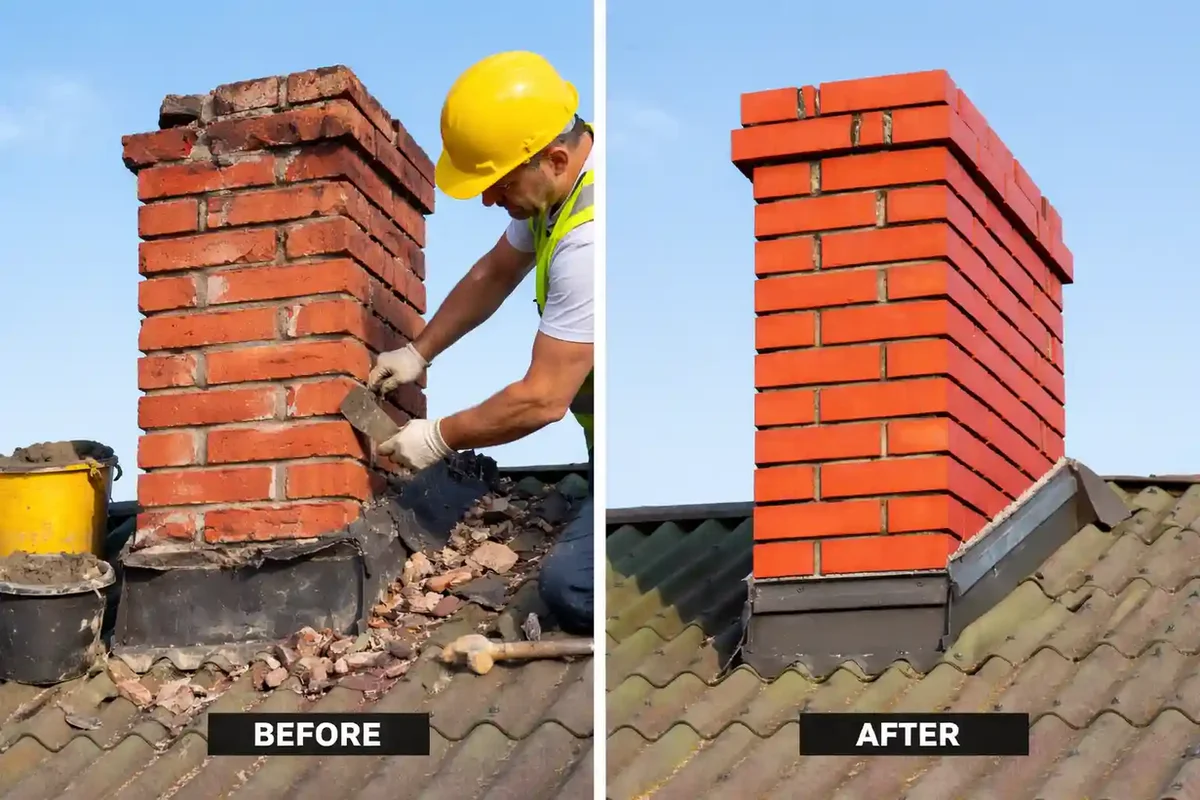
A rusted chase cover funnels every rainfall into the chase framing. Replacements are fabricated to your dimensions with a cross-break so water runs off instead of pooling.
This is one part of the chimney work we do across Bergen and Passaic County. Every job is quoted in writing after a hands-on inspection, performed by our own crew rather than subcontractors, and backed by our satisfaction guarantee. We are licensed under NJ HIC #13VH13359900 and fully insured.
What the work includes
- Custom-fabricated stainless and copper covers
- Cross-broken to drain, with drip edge
- Collar sealing and storm collar installation
- Chase framing inspection for water damage
What a chimney chase actually is, and why it's different from masonry
A chimney chase is a wood-framed, sided enclosure built around a factory-built metal flue rather than a solid masonry stack. It’s common on homes built since the 1970s and 80s with prefabricated fireplaces. The top of that enclosure is not a masonry crown at all — it’s a flat or gently pitched metal pan called a chase cover, and it takes a completely different kind of damage than a masonry chimney top.
Homeowners with a framed chase sometimes assume the maintenance is the same as a masonry chimney, but the failure points are different. There’s no mortar to repoint and no brick to spall — the entire top of the structure is a single metal cover doing the job a crown, cap and flashing collar would normally split between them. When that one component fails, water has a direct path into the framed chase below it, and from there into the siding, sheathing and sometimes the ceiling underneath.
Why so many chase covers rust through in the same predictable way
Most factory-installed chase covers are built from thin galvanized sheet metal, which is the cheapest option builders use and the first to fail. The galvanized coating wears through from years of standing water, freeze-thaw cycling and UV exposure, and once it breaches, the bare steel underneath corrodes quickly — often within seven to ten years of the home being built.
The pattern is consistent enough that we can often tell a chase cover has failed before we’re even on the ladder: rust streaks running down the siding directly below the chase are the giveaway, because rusting galvanized metal sheds reddish-brown staining with every rain. By the time that staining is visible on the siding, the cover itself has usually been leaking for a season or more.
Cross-broken covers: why a flat pan is the wrong replacement
A cross-broken chase cover has a slight ridge and slope built into the metal so water actively runs off toward the edges instead of sitting on the surface. A flat cover, even in durable material, collects standing water at the center every time it rains, and standing water is what drives corrosion, seam failure and eventual leaks no matter how good the metal underneath is.
We fabricate replacement covers to the exact dimensions of the chase, custom rather than off a shelf, with a cross-break pattern engineered into the metal so it sheds water actively instead of relying on the material alone to resist it. Combined with stainless steel or copper instead of galvanized, a properly cross-broken cover addresses both causes of failure at once — the pooling that damages any material over time, and the corrosion that specifically kills galvanized steel.
Where chase covers actually leak, beyond the metal itself
The metal pan is only part of the system — the collar where the flue pipe passes through the cover, the seams where multiple sheets join on a larger chase, and the overhang and drip edge at the perimeter are the three places we find active leaks even on covers that look intact from the ground. A cover can look solid and still be letting water in at any of these three points.
| Symptom | Likely failure point | Typical fix |
|---|---|---|
| Rust streaks straight down the siding | Corroded galvanized panel | Full replacement in stainless or copper |
| Water stains concentrated near the flue pipe | Failed collar or storm collar seal | Reseal or replace collar and storm collar |
| Leak appears only after heavy wind-driven rain | Insufficient overhang or drip edge | Refabricate cover with proper overhang |
| Staining along a seam on a wide chase | Seam separation on a multi-panel cover | Custom one-piece or properly lapped and sealed cover |
The collar around the flue pipe deserves particular attention because it’s the one moving joint in an otherwise static assembly — the metal flue expands and contracts with heat cycling, and the seal around it has to accommodate that movement without opening up. We seal it with a storm collar designed for that flexing rather than a bead of caulk that hardens and cracks within a season or two.
Wide chases built for larger prefab fireplaces sometimes need more than one sheet of metal to span the top, and every seam between panels is a potential leak point if it isn’t lapped and sealed correctly. Where the chase width allows it, we fabricate a single continuous cover rather than joining panels, which removes that failure point entirely. When a seam is unavoidable on a very wide chase, it is lapped in the direction water naturally runs off and sealed rather than simply butted and caulked.
What happens when a failed chase cover goes unaddressed
Water that gets past a failed chase cover doesn’t stop at the metal pan — it runs down inside the framed chase onto the wood framing and sheathing that support the flue, and from there it can migrate into the siding or an adjacent ceiling below. Left long enough, a chase leak causes wood rot and staining well beyond what the chase cover itself cost to replace in the first place.
This is the same water-intrusion logic that applies to a masonry chimney’s crown and flashing, just with framing and siding in place of brick: the top component is the whole line of defense, and once it fails, everything below it is exposed. Where a chase cover failure has already caused visible rot or staining on the siding, that repair sometimes overlaps with siding repair in addition to the chase cover itself.
The cost of catching a failed chase cover early is almost always smaller than the cost of the damage it eventually causes. A rusted-through cover replaced promptly is a contained, one-day job. The same failure left through two or three more wet seasons can mean replacing rotted sheathing, damaged insulation, and stained or warped siding around the base of the chase — work that has nothing to do with the chimney itself but exists only because the chase cover was never addressed.
Signs it's time to replace, and how the work proceeds
Visible rust streaking on the siding, standing water pooling on the cover after rain, a chase cover more than seven to ten years old that has never been replaced, or interior water stains near where the chimney passes through the ceiling are all reasons to have the chase cover inspected. Replacement is typically a one-day job once the chase is measured.
We measure the chase precisely, fabricate a custom cross-broken cover in stainless steel or copper, remove the failed cover, and install the new one with a properly sealed storm collar and drip-edge overhang on all sides. If your chimney is traditional masonry rather than a framed chase, see our chimney cap installation page instead — the two components solve the same water-and-animal-exclusion problem on two different chimney types. For the complete picture, visit our chimney services overview, or serving Franklin Lakes and Mahwah homeowners as well, contact us for a free written estimate.
Related chimney services
Full flue cleaning and creosote removal with drop-cloth protection and vacuum containment, plus …
Partial and full chimney rebuilds — taking the stack down to sound masonry and rebuilding with m…
Stainless steel liner installation for fireplaces, furnaces, boilers and water heaters, sized to…
Targeted chimney repair — repointing failed joints, replacing spalled brick, rebuilding a cracke…
Stainless and copper chimney cap installation and replacement to keep rain, debris, birds and sq…
Frequently asked questions
Chase cover or chimney cap?
A cap sits on a masonry flue. A chase cover is the metal lid over a framed, sided chimney chase. Many homes need both.
How do I know mine has failed?
Rust streaks running down the siding below the chase, or standing water on the cover, means it is time to replace.
Can a chase cover be patched instead of fully replaced?
Sometimes, if the damage is limited to a small area and the metal is otherwise sound, but patching a galvanized cover that is already corroding elsewhere is usually a short-term fix. Given how inexpensive a full custom replacement is relative to a masonry chimney repair, we typically recommend replacement once corrosion has started rather than patching a cover that will keep failing.
How much overhang should a chase cover have past the chase walls?
Enough that wind-driven rain can’t get pushed back underneath the drip edge — typically a small consistent overhang on all sides with the edge bent downward to form a drip that directs water clear of the siding. An undersized or flush-mounted overhang is a common reason a newer-looking cover still leaks during storms.
Does the seal around the flue collar need to be checked every year?
Yes, ideally as part of the same annual chimney inspection that covers the rest of the venting system. The collar seal is the one part of a chase cover that flexes with heat cycling, so it is more prone to gradual failure than the flat metal pan itself, even on a relatively new cover.
Should I try to install a chase cover myself?
We’d recommend against it. A cover that isn’t custom-fit, properly cross-broken and sealed at the collar with the right overhang will leak regardless of the material used, and roof-level work on a sloped chase carries real fall risk. Fabrication to the exact chase dimensions is most of what makes the difference between a cover that lasts and one that doesn’t.
- Overview of the Climate of New Jersey — Office of the New Jersey State Climatologist, Rutgers University
- Carbon Monoxide Fact Sheet — U.S. Consumer Product Safety Commission (CPSC)
- Chapter 18 Chimneys and Vents: New Jersey UCC One- & Two-Family Dwelling Subcode 2021 — UpCodes (New Jersey edition of the 2021 IRC)
Updated September 2026 · Reviewed by Edgar Lopez Gonzalez, owner · NJ HIC #13VH13359900
Licensed & insured. 25+ years in North Jersey. We answer 24/7 for leaks and storm damage.
- Service
- Chase Cover Installation
- Category
- Chimney
- Service area
- Bergen & Passaic County and surrounding North Jersey
- License
- NJ HIC #13VH13359900