Licensed & Insured — NJ HIC #13VH13359900
njgoldstarconstruction@yahoo.com · 24/7 Emergency · (862) 271-1225

Siding Installation & Repair in Bergen County, NJ
We install and repair vinyl, fiber cement and wood siding across North Jersey, including the water-resistive barrier, flashing and trim details behind it. Small repairs are matched to the existing profile where possible; full re-sides include wrap, window and door flashing, and new trim.
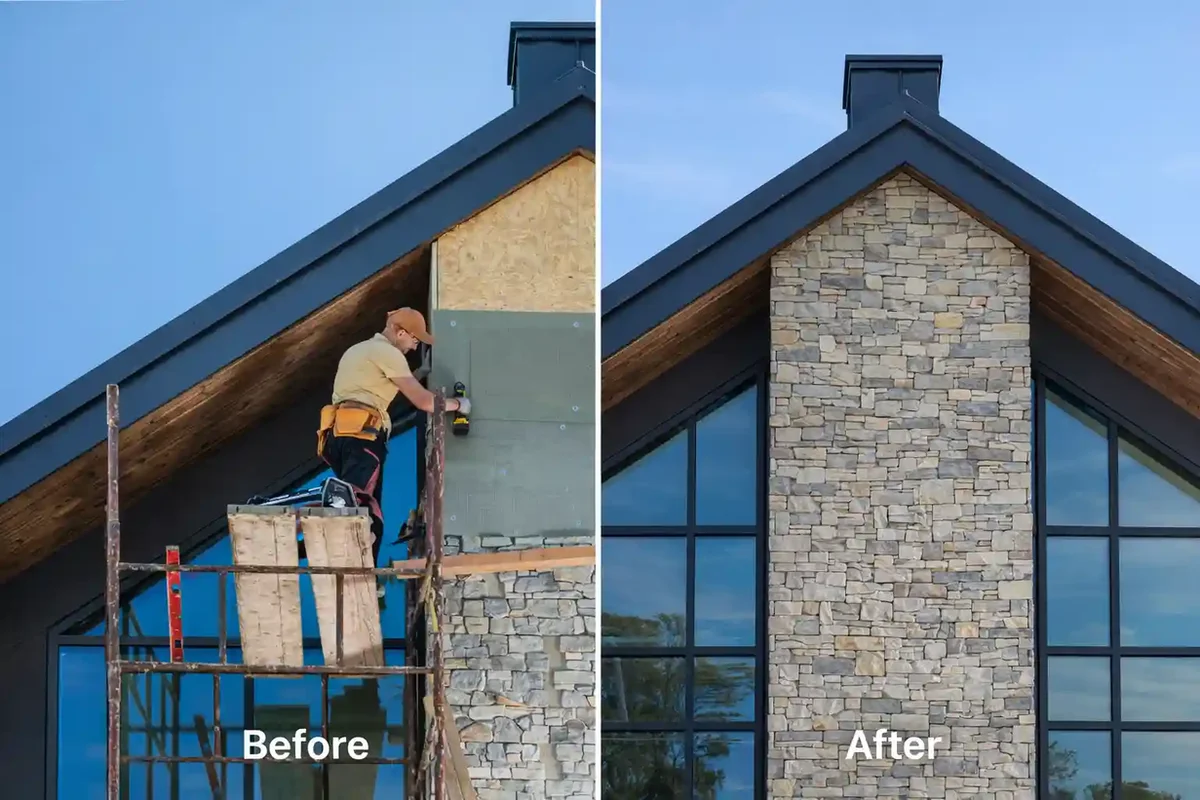
Siding is a rain screen, not just a finish. What keeps a wall dry is the layered detail behind the panel — house wrap lapped correctly, flashing over every window head and at every transition, and a path for incidental water to drain back out.
When siding cracks, warps, or pulls loose at the nail hem, water gets behind it and stays there. Sheathing softens, insulation packs down, and the damage shows up indoors long after it started.
We walk the whole exterior before quoting, talk through vinyl versus fiber cement for your exposure and budget, and detail the transitions — corners, soffit, band board, stone-to-siding — so the wall performs as a system.
What the work includes
- Vinyl siding installation and re-siding
- Fiber cement (James Hardie-style) installation and painting coordination
- Panel and section repair matched to existing profiles
- House wrap, window and door flashing, trim and corner detailing
- Soffit, fascia and stone-veneer accent integration
How the drainage plane behind the panel actually keeps a wall dry
A siding wall stays dry because of a water-resistive barrier and flashing layered behind the panel, not the panel itself. The Vinyl Siding Institute’s installation manual calls for a continuous barrier lapped shingle-style, with code-compliant flashing tied into it at every window, door and wall penetration before the siding goes on.
Every siding job we do starts underneath the finish material. House wrap or building paper goes on first, lapped so each course sheds water onto the one below it, never the reverse. Seams get taped or sealed, and the barrier runs continuously across the wall rather than stopping at each stud bay.
Flashing does the rest of the work. Window and door heads get a drip cap that carries water out over the barrier below, not behind it. Where two wall planes meet, at outside corners, or where a deck ledger or hose bib penetrates the sheathing, the flashing has to be integrated into the wrap in the correct shingle order — upper piece over lower piece — or the whole drainage plane fails at that one spot.
Why this matters more than the siding brand
- Most of the interior water damage we find during a siding repair traces to a flashing detail, not a defective panel.
- A re-side is the one point in a building’s life when every one of these details is fully exposed and correctable — see how that work is sequenced on our siding installation page.
- The same wrap-and-flashing logic protects the wall where a roof meets siding at a dormer or chimney chase.
Vinyl, insulated vinyl, fiber cement or wood: how the materials compare
Vinyl siding is the lowest-maintenance and lowest-cost option for North Jersey homes; insulated vinyl adds rigid foam backing for a straighter look and modest R-value; fiber cement resists fire, rot and impact but needs periodic painting; wood offers the most traditional look but demands the most upkeep against moisture.
| Material | Standard it meets | Maintenance | Where it fits best |
|---|---|---|---|
| Vinyl | ASTM D3679 | Rinse yearly, no painting | Most re-sides and additions where budget and low upkeep matter most |
| Insulated vinyl | ASTM D3679 plus foam backing | Same as standard vinyl | Walls with visible sheathing waves, or where a little extra R-value helps |
| Fiber cement | ASTM C1186 | Repaint on a cycle; caulk joints inspected | Homes wanting a wood look with better fire and impact resistance |
| Wood (cedar, etc.) | No single ASTM siding standard; graded lumber | Paint or stain regularly; most moisture-sensitive | Historic-district homes or additions matching original wood siding |
Vinyl siding sold in the U.S. is manufactured to ASTM D3679, which sets requirements for impact strength, wind-load resistance and dimensional stability. Fiber cement panels are manufactured to ASTM C1186, the standard covering flat fiber-cement sheets used as siding, and the material is noncombustible, which is part of why builders like it near property lines and chimneys. Insulated vinyl is the same D3679 panel with a rigid foam backer laminated on, which stiffens the panel and smooths out minor sheathing irregularities. Wood siding has no single governing ASTM product standard the way vinyl and fiber cement do; quality depends on the grade of lumber and how well it is primed on all six sides before installation. We install and repair all four, and match new panels to the existing wall’s profile and exposure wherever the product line allows.
Repair or re-side: what decides the answer on your wall
Whether a wall needs siding repair or a full re-side depends on how much of the wall shows water damage behind the panels, whether the damaged profile is still available to match, and the condition of the sheathing once it is opened up. Isolated cracked or loose panels are usually a repair; damage on multiple elevations usually is not.
We open the wall wherever damage suggests water got behind the siding, dry out and correct what we find, then close it back up — the full approach is on our siding repair page. That works well when the problem is contained to one wall or a handful of panels and the existing profile can still be matched or sourced close enough to blend in.
A full re-side becomes the better answer once damage shows up on more than one elevation, once the existing profile has been discontinued long enough that patches would visibly mismatch, or once we find soft or delaminated sheathing that needs to come off anyway. That is also the moment to correct any wrap or flashing shortcuts from the original installation — see our siding installation page for how a full re-side is sequenced. Either way, the decision starts with an on-site inspection, not a guess from the curb.
How North Jersey weather works on a sided wall
North Jersey siding takes wind-driven rain, UV exposure and repeated freeze-thaw cycles. The Office of the New Jersey State Climatologist reports the state’s Northern climate zone averages 40 to 50 inches of snow a year and sees roughly twice as many thunderstorms as the coastal zone, so both vinyl’s fastening and fiber cement’s caulk joints see real seasonal movement.
Vinyl siding is designed to expand and contract with temperature, which is why the Vinyl Siding Institute’s manual specifies hanging the panel on its nailing hem rather than fastening it tight — a detail we cover on our siding installation page. Skip that clearance and a hot August afternoon buckles the wall; a cold January night can crack a panel fastened without it.
What freeze-thaw and wind do to each material
- Vinyl: UV exposure over many seasons can fade color and make panels brittle at impact points, especially on south- and west-facing walls.
- Fiber cement: caulked joints and butt seams need inspection after repeated freeze-thaw cycles, since a failed joint is a direct path for water into the sheathing.
- Wood: the most exposure-sensitive of the group, needing a maintained paint or stain film to keep moisture out of the fibers.
Wind-driven summer thunderstorms push rain sideways under lifted or loose panels, which is one more reason the drainage plane behind the siding, not just the siding itself, has to be right.
Lead-safe work on pre-1978 siding and trim
Homes built before 1978 may carry lead-based paint under later coats, and EPA’s Renovation, Repair and Painting rule requires lead-safe work practices once a job disturbs more than six square feet of interior surface or 20 square feet of exterior surface, or involves any window replacement. Ask any contractor for their lead-safe certification before work starts on an older home.
Siding tear-off on an older house almost always crosses that 20-square-foot exterior threshold in the first section of wall, and a re-side that includes new window flashing counts as window-adjacent work regardless of area. Under EPA’s rule, the firm doing the work is required to be a certified firm, and at least one certified renovator must be on site or directly supervising, using containment to keep paint chips and dust inside the work area and following a documented cleanup and verification step before the job is considered done.
If your home was built before 1978, ask any contractor bidding a re-side for proof of RRP firm certification up front, not after the tear-off starts. It is a fair question and a reasonable contractor will have the paperwork ready.
What to expect from first call to finished wall
A siding project with NJ Gold Star Construction starts with a call or text to (862) 271-1225, moves to an on-site inspection of the wall and, where accessible, the sheathing behind it, then a free itemized written estimate, the scheduled work by our own crew, and a cleanup and walk-through before we leave.
Customers notice the same thing across very different jobs — a clear process from the first phone call. As one homeowner put it:
“the whole process was explained in depth before the job was started… Quality workmanship, a pleasure to do business with.” — Bill E., Google review
We work across Bergen and Passaic County and into Essex, Hudson, Morris and Union County, from siding work in Ridgewood to siding work in Wayne. A siding job often turns up related work at the same time — loose gutters pulling water behind the fascia, or stone veneer and steps that our masonry crew handles — and our estimate will flag anything we see. When you are ready, request a free estimate.
Siding services we provide
Siding repair for cracked, loose or storm-damaged panels — matched to the existing profile where…
Full siding installation and re-siding in vinyl or fiber cement, including tear-off, water-resis…
Frequently asked questions
What type of siding lasts longest in New Jersey weather?
Fiber cement holds up best against impact, moisture and temperature swings, and takes paint well. Quality insulated vinyl is the better value on most homes and performs fine for decades when it is installed with correct wrap and flashing.
Can you repair just a few panels instead of re-siding?
Usually yes. If the profile is still made, or we can pull matching panels from a less visible elevation, a section repair is the smart call. When color-matching is impossible or the wall behind is wet, re-siding that elevation is the honest answer.
Do I need a permit to re-side my house in New Jersey?
It depends on the scope of the job and your municipality. New Jersey’s Uniform Construction Code treats some siding replacement as ordinary maintenance and other jobs as work requiring a construction permit, and the line depends on the building and the extent of work. Describe your project to your local construction office before work starts so you know which category it falls under.
How long does vinyl siding typically last?
Vinyl siding manufactured to ASTM D3679 is generally rated by manufacturers for decades of service, though real-world life depends on sun exposure, storm impacts and how well the wrap and flashing behind it were installed. Fading and brittleness show up first on south- and west-facing walls. A properly installed wall with sound flashing is what protects that lifespan, not the panel alone.
Can new siding be installed directly over old siding?
Sometimes, but we generally recommend against it. Installing over existing siding hides the sheathing and wrap from inspection, buries any existing damage, and can trap moisture between the two layers. A tear-off costs more up front but lets us correct flashing, replace soft sheathing, and confirm the wall is sound before the new siding goes on.
What causes vinyl siding to warp, buckle or pull loose?
Warping and buckling usually come from panels fastened too tightly against the nail hem, which does not allow for the expansion and contraction the material is designed around. Pulled-loose panels often trace to failed or missing fasteners, storm wind uplift, or house wrap that was not properly integrated at the starter strip and corners.
- Renovation, Repair and Painting Program: Work Practices — U.S. Environmental Protection Agency
- If a project disturbs six square feet or less of interior surface or 20 square feet or less of exterior surface… — U.S. Environmental Protection Agency
- Vinyl Siding Installation Manual — Vinyl Siding Institute / Polymeric Exteriors
- Fiber-Cement Siding — UpCodes (building code reference)
- Overview of the Climate of New Jersey — Office of the New Jersey State Climatologist, Rutgers University
Updated September 2026 · Reviewed by Edgar Lopez Gonzalez, owner · NJ HIC #13VH13359900
Licensed & insured. 25+ years in North Jersey. We answer 24/7 for leaks and storm damage.
- Service area
- Bergen, Passaic, Essex, Hudson, Morris & Union County, NJ
- License
- NJ HIC #13VH13359900
- Estimates
- Free, written and itemized
- Emergency
- 24/7 response for active leaks and storm damage