Licensed & Insured — NJ HIC #13VH13359900
njgoldstarconstruction@yahoo.com · 24/7 Emergency · (862) 271-1225

Chimney Rebuilds in Bergen County, NJ
Partial and full chimney rebuilds — taking the stack down to sound masonry and rebuilding with matched brick, a new crown, cap and counterflashing.
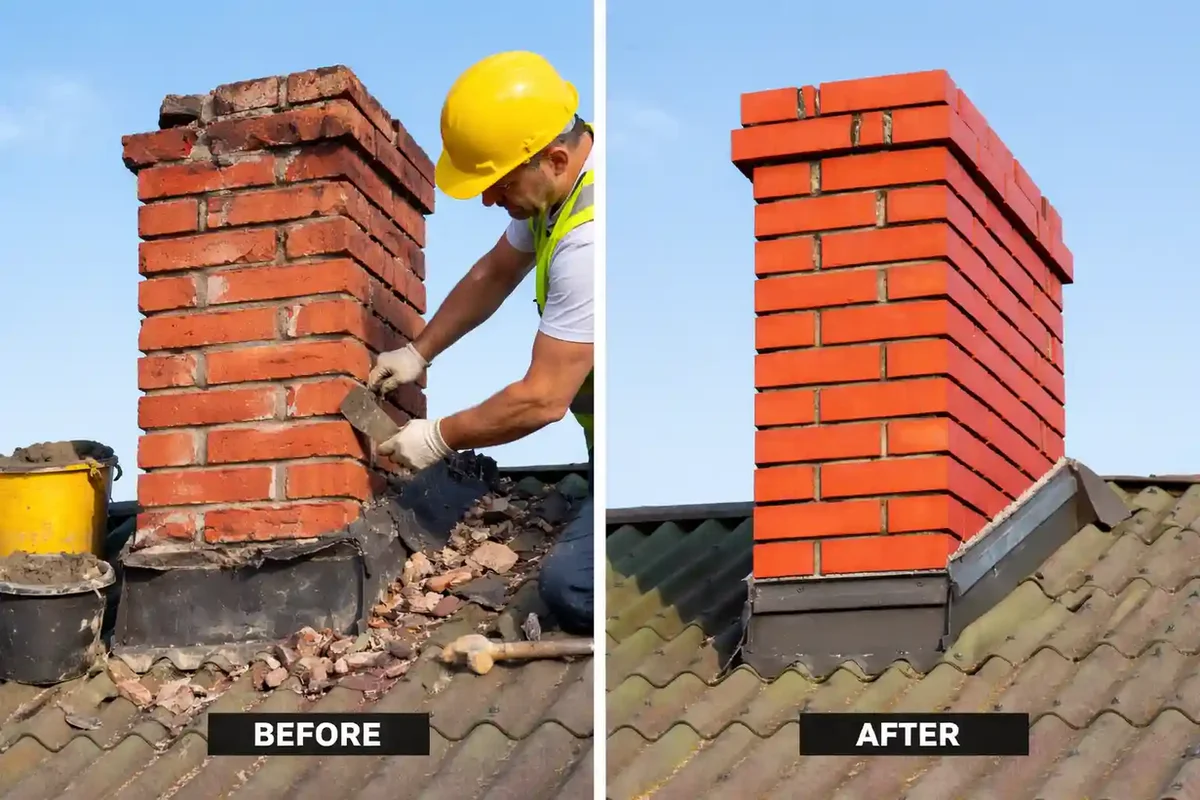
When mortar joints have gone soft through the stack, repointing only buys a season. A rebuild resets the whole assembly from a solid course up.
This is one part of the chimney work we do across Bergen and Passaic County. Every job is quoted in writing after a hands-on inspection, performed by our own crew rather than subcontractors, and backed by our satisfaction guarantee. We are licensed under NJ HIC #13VH13359900 and fully insured.
What the work includes
- Rebuild above the roofline or from the smoke chamber up
- Brick matched to the existing house
- New cast crown, cap and stainless liner as needed
- New step and counterflashing, roof re-shingled at the chase
Partial rebuild above the roofline vs. a full-height rebuild
Most chimney rebuilds only touch the section above the roofline, where weather exposure is worst and structural loads are lowest. A full-height rebuild, taking the stack down to the foundation or the smoke chamber, is reserved for chimneys with deterioration below the roof deck, a compromised firebox, or damage extending into the interior masonry.
| Partial (above roofline) | Full-height | |
|---|---|---|
| Typical trigger | Leaning stack, spalled brick, failed crown above the roof | Deterioration below the flashing, interior masonry damage, structural settling |
| Roof involvement | Roofing opened and re-flashed around the new masonry | Full roof penetration rebuilt along with interior chimney |
| Timeline | Commonly a few days for a typical residential stack | Longer, scoped after an interior inspection |
| Permit | Usually required as reconstruction/alteration work | Usually required as reconstruction/alteration work |
The roofline is a natural stopping point structurally as well as visually: below it, the chimney is protected and braced by the surrounding building; above it, the stack stands alone against wind, ice and direct sun on every face. That is why the large majority of the rebuilds we perform stop at or just below the roof deck rather than going all the way down.
Why a chimney starts to lean, and what to do about it
A leaning chimney usually comes from one of three sources: failed mortar joints that let the stack shift course by course, a settling or undersized foundation under the chimney base, or repeated freeze-thaw cycling that has progressively opened and widened joints over many winters. Each cause points to a different repair, so the lean itself is a symptom to investigate, not a diagnosis.
A chimney that has begun to visibly lean is not a cosmetic problem — it is a structural one, and it should be treated with more urgency than a cracked crown or a few spalled bricks. What we look for when assessing a leaning stack:
- Joint failure without foundation movement. Mortar has degraded badly enough for the stack to shift, but the base is stable. This is usually correctable with a rebuild from a solid course up.
- Foundation or footing settlement. The lean originates at the base, which changes the scope significantly and may call for foundation evaluation before any masonry work begins.
- Severity and direction. A slight, long-standing lean away from the house is a different situation from a lean toward it, or one that has visibly worsened recently.
If you are seeing a lean alongside other symptoms, our guide to signs you need brick and chimney repair is a useful checklist before you call.
Permits: what New Jersey requires for chimney rebuild work
New Jersey’s Uniform Construction Code requires a construction permit for the repair, alteration, reconstruction or enlargement of a structure, which covers chimney rebuild work — the code’s exception is only for ordinary maintenance and routine repair, a narrower category than a partial or full rebuild. We handle permit applications with the local construction office as part of the job.
Homeowners are sometimes surprised that a chimney rebuild needs the same kind of permit as an addition or a structural repair, but the state’s own guidance is direct about it: construction permits apply to structural work on existing buildings, and the exemption is limited to ordinary maintenance and routine repairs — not reconstruction of a masonry structure. In practice that means:
- A few repointed joints or a resealed crown is typically maintenance and does not trigger a permit.
- Taking a chimney down to a solid course and rebuilding it, partial or full height, is reconstruction and does require one.
Each municipality in Bergen and Passaic County administers its own fee schedule under the statewide code, and a licensed construction official signs off on the finished work. We factor the permit process into the project timeline rather than treating it as an afterthought.
Matching brick on a rebuild without an obvious seam
A rebuild that reads as original starts with matching the brick’s size, color range and surface texture to what is already on the house, not just its general shade. On older Bergen and Passaic County homes we also match mortar joint width and tooling profile, since a rebuilt section with the wrong joint style stands out even when the brick itself is a close color match.
Where the existing brick is still manufactured, sourcing an exact match is straightforward. Older homes sometimes carry brick that is no longer produced, in which case we work from salvaged face brick where the homeowner has it, or select the closest available match in size, color range and texture and tool the new joints to match the existing profile. The goal on every job is a rebuilt section that reads as part of the original chimney, not a visibly different patch.
Rebuilding the flashing along with the masonry
A chimney rebuild is the right moment to replace the flashing and counterflashing along with the masonry, since the old flashing is disturbed during the work regardless and rarely worth reusing. Skipping that step to save time is one of the more common reasons a freshly rebuilt chimney still leaks at the roofline within a season or two.
New step flashing and counterflashing get integrated into the roofing courses and set into the fresh mortar joints as the stack goes back up, rather than caulked over the old material afterward. Where the surrounding roofing itself needs attention, our roofing crews coordinate directly with the chimney work so the whole roof-to-chimney transition gets addressed once, not twice.
What a rebuild looks like from call to cleanup
A chimney rebuild with NJ Gold Star Construction follows five steps: inspection, a written scope, the permit filing, the teardown and rebuild itself, and new flashing with a final walk-through. Our own crew handles every step, and the same team that inspects the chimney is the one that rebuilds it.
Homeowners who have had both roof and chimney work done with us describe the same thing: a defined scope, a crew that shows up, and no surprises at the end. As one customer put it after a roof repair and chimney rebuild:
“NJ Gold Star, fixed part of my roof and rebuilt my Chimney as well. Fair price for both, the work was done on time and budget, no fuss and no mess.” — Walter G., Google review
See our full chimney services overview for how a rebuild compares to repointing or a liner replacement, or contact us for a free written estimate on your chimney.
Inspection
We assess the extent of the deterioration, whether the lean originates in the masonry or the foundation, and whether the flue liner needs replacement while the stack is open.
Written scope
You get an itemized estimate specifying partial or full-height rebuild, brick matching approach, liner work if needed, and flashing replacement.
Permit filed
We submit the construction permit application to the local enforcing agency before work begins.
Teardown and rebuild
The stack comes down to a solid, sound course and goes back up with matched brick, fresh mortar, a new crown and cap.
Flashing, cleanup and walk-through
New flashing is integrated, the roof around the work is re-shingled if it was opened, and we walk the finished chimney with you.
Related chimney services
Full flue cleaning and creosote removal with drop-cloth protection and vacuum containment, plus …
Stainless steel liner installation for fireplaces, furnaces, boilers and water heaters, sized to…
Targeted chimney repair — repointing failed joints, replacing spalled brick, rebuilding a cracke…
Stainless and copper chimney cap installation and replacement to keep rain, debris, birds and sq…
Replacement of rusted chase covers on framed chimney chases with stainless or copper covers, cro…
Frequently asked questions
How long does a chimney rebuild take?
Most above-roof rebuilds are two to four days. Full-height rebuilds and interior work take longer and are scoped after inspection.
Can you match hundred-year-old brick?
Usually close enough that it reads as original — we match size, color range and texture, and can salvage face brick where available.
Is a leaning chimney actually dangerous?
It can be, depending on severity and cause. A chimney leaning from foundation movement or advanced structural failure poses a real risk of partial collapse and should be evaluated promptly. A slight, stable lean from long-term mortar weathering is less urgent but still worth assessing, since it typically worsens over time rather than staying the same.
Do I need a permit to rebuild a chimney in New Jersey?
In almost all cases, yes. New Jersey’s Uniform Construction Code requires a permit for reconstruction and structural alteration work, and a chimney rebuild falls into that category rather than the narrower ordinary-maintenance exemption. We handle the permit application with your municipality’s construction office as part of the project.
Will rebuilding my chimney change how my furnace or fireplace vents?
It can, if the flue liner is replaced or resized during the rebuild, which we sometimes recommend if the existing liner is damaged or was never correctly sized for the appliance it serves. We flag this during the inspection and estimate stage so there are no surprises about what the finished chimney will vent and how.
How much of my existing chimney gets reused in a rebuild?
As much sound masonry as possible. We take the stack down only to the point where the brick and mortar are structurally solid, then rebuild from that course up with matched brick. A full-height rebuild is only used when deterioration runs below the roofline or the foundation itself is compromised.
- Building Regulatory Requirements: General Information — New Jersey Department of Community Affairs, Division of Codes and Standards
- Overview of the Climate of New Jersey — Office of the New Jersey State Climatologist, Rutgers University
- Homeowner Resources — Chimney Safety Institute of America (CSIA)
Updated September 2026 · Reviewed by Edgar Lopez Gonzalez, owner · NJ HIC #13VH13359900
Licensed & insured. 25+ years in North Jersey. We answer 24/7 for leaks and storm damage.
- Service
- Chimney Rebuilds
- Category
- Chimney
- Service area
- Bergen & Passaic County and surrounding North Jersey
- License
- NJ HIC #13VH13359900