Licensed & Insured — NJ HIC #13VH13359900
njgoldstarconstruction@yahoo.com · 24/7 Emergency · (862) 271-1225

Deck Builders in Bergen County, NJ — New Decks & Repairs
We build new decks and repair existing ones across North Jersey — footings, framing, decking, railings and stairs. Repairs start with a structural check of ledger, joists and posts, because that is where unsafe decks usually fail, not at the boards you can see.
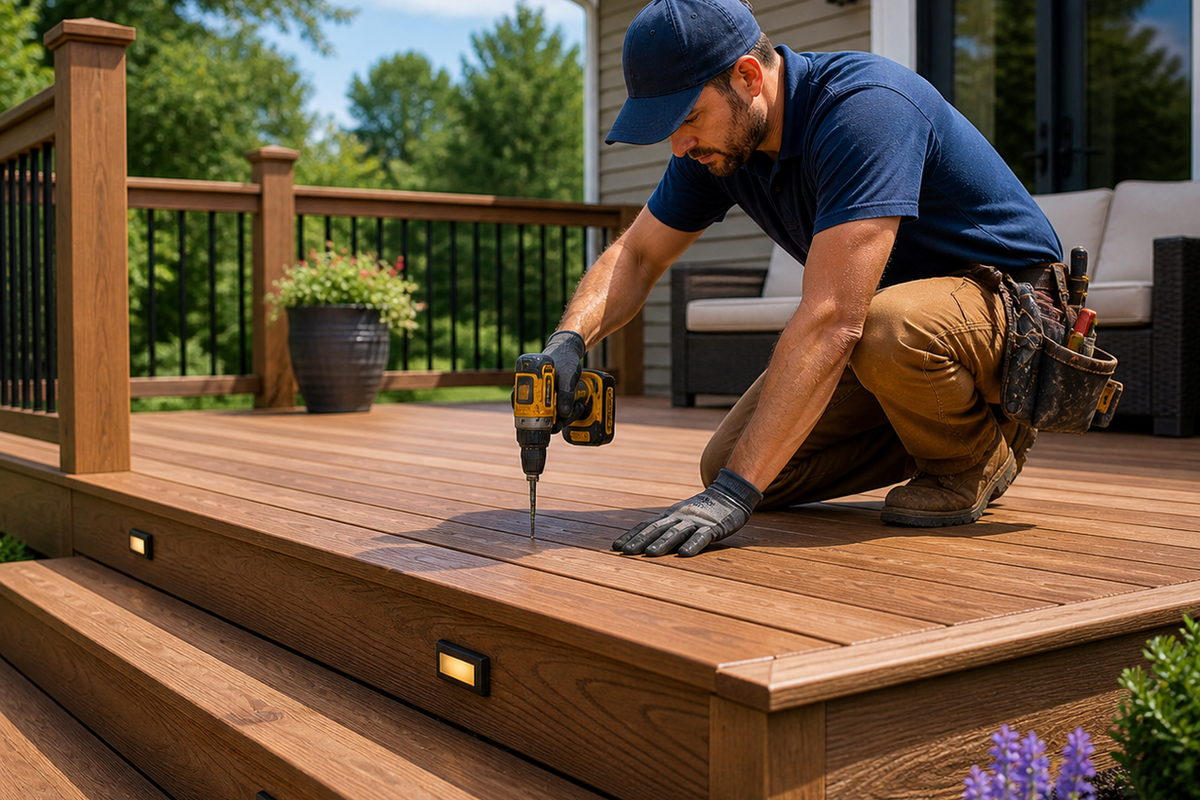
The parts of a deck that make it safe are the parts nobody looks at: how the ledger is fastened and flashed to the house, how the posts bear on footings below frost depth, and how the guard rails are anchored.
On repairs we check those first. Soft ledger boards, nailed-only connections, undersized footings and rotted post bases are common on decks built twenty or more years ago, and all of them are fixable without starting over.
New builds are laid out around how you actually use the space — grill zone, table clearance, traffic path to the yard — then framed for the long haul with proper hardware, flashing and drainage.
What the work includes
- New deck design and construction, single or multi-level
- Structural repair of ledgers, joists, beams and posts
- Board replacement in pressure-treated, cedar or composite
- Railing, stair and landing rebuilds to current code
- Cleaning, sanding, sealing and full restoration
Ledger attachment, footings and guards: the parts that make a deck safe
A deck’s safety depends on three connections most homeowners never inspect: the ledger board bolted and flashed to the house rim joist, footings that bear below the local frost depth, and guard posts anchored to resist an outward load, not just nailed in place. A deck can look solid on the surface while any one of these is failing underneath.
Deck collapses almost never start with the decking boards. They start at the ledger, where a deck is supposed to be lag-bolted or through-bolted to the house’s rim joist and flashed so water cannot get between the ledger and the wall — a nailed-only ledger is one of the most common failures we find on older decks. They start at footings poured too shallow to resist frost heave, which slowly tilts posts out of plumb over several winters. And they start at guard posts that were only toe-nailed to the framing instead of bolted with hardware rated for a lateral load.
Every deck we build or repair gets checked at these three points first, because that is where the structure either holds or does not.
Pressure-treated, cedar or composite: choosing a decking material
Pressure-treated lumber is the least expensive decking material and requires periodic cleaning and sealing; cedar costs more, weathers to a silver-gray naturally, and still benefits from sealing to control checking; composite decking costs the most upfront but needs no staining or sealing over its service life, only periodic washing.
| Material | Upfront cost | Maintenance | Notes |
|---|---|---|---|
| Pressure-treated lumber | Lowest | Clean and reseal every one to two years | Chemically treated to resist rot and insects; needs corrosion-resistant fasteners |
| Cedar | Mid-range | Periodic sealing or staining recommended | Naturally rot-resistant; grays without treatment |
| Composite (wood-plastic) | Highest | Occasional wash, no staining or sealing | Manufactured board; color and grain options like Trex Clam Shell |
Pressure-treated southern yellow pine is the framing standard on almost every deck we build regardless of what decking material sits on top, since treated lumber’s rot and insect resistance is what the structure underneath relies on. For the visible decking surface, the choice usually comes down to budget versus maintenance: pressure-treated boards cost the least but need the most upkeep, cedar sits in the middle with a natural look that grays over time, and composite decking costs more upfront but is effectively maintenance-free beyond washing. One recent project used Trex Clam Shell composite decking with a picture-frame border and vinyl railings — see how that combination came together on our new deck construction page.
Getting a deck permit through your municipal construction office
New deck construction in New Jersey generally requires a construction permit from the municipal construction office, which reviews footing depth, ledger attachment, guard height and stair dimensions against the state’s adopted residential code before and during the build. Permit specifics vary by town, so we confirm requirements with your local office as part of every new-deck estimate.
Every municipality in our service area runs its own construction office, and while the underlying code is the New Jersey edition of the IRC, individual towns publish their own permit checklists and inspection schedules. Morris County’s Mendham Borough, for example, publishes residential wood deck guidelines that spell out footing depth, ledger bolt spacing, guard height and stair dimensions in one document for homeowners and contractors alike — the kind of checklist most towns in our area keep in some form.
We pull permits, schedule the required inspections, and build to whatever that municipality’s adopted code calls for rather than a one-size-fits-all approach.
The prescriptive path most residential decks are built to
Most single-level, house-attached residential decks are built to prescriptive tables covering joist spans, footing size, ledger fasteners and guard construction, rather than a full engineered design for each project. Those tables assume typical residential loads and wet-service lumber, and they cover the great majority of decks we build; anything outside their limits gets engineered separately.
The American Wood Council publishes a widely used prescriptive deck guide that translates the residential code’s more general requirements into ready-to-use span and connection tables for typical single-level decks. For a standard attached deck at typical heights and spans, that prescriptive approach covers ledger fastening, joist and beam sizing, footing dimensions and guard construction without requiring a stamped engineering drawing for every project. Decks with unusual spans, multiple levels, or a ledger that cannot attach directly to solid framing fall outside those tables and get engineered on their own.
Maintenance that actually extends a deck's life
A deck’s life depends more on what happens between builds than on the material chosen: keeping the gap between boards clear of trapped leaves and debris, resealing wood decking on a regular cycle, checking hardware for rust or loosening, and probing the ledger and post bases for soft wood each spring. Composite decking skips the sealing step but still needs the same hardware and structural checks.
Most of the deck failures we get called out for started small and went unnoticed for a season or two — a ledger bolt that backed out, a post base sitting in standing water because debris never got cleared, a guard post that loosened just enough to wobble. A short annual check catches all of that early. Where we find it has already gone further, our deck repair service covers everything from board replacement to full structural rebuilds.
What to expect from a deck project with NJ Gold Star Construction
A deck project starts with a call or text to (862) 271-1225, an on-site look at the space and the house’s rim joist, a free itemized written estimate covering the structure and decking material, the scheduled build or repair by our own crew, and a walk-through before we leave. New builds include pulling the municipal permit.
One customer summed up a recent deck project this way: “the attention to detail is exceptional. The quality of the Trex Clam Shell flooring with its custom ‘picture-frame’ border, the crisp white vinyl railings with custom flat caps, and the clean finish on the stairs looks incredible.” — Justin F., Google review.
We build and repair decks across Bergen and Passaic County and into Essex, Hudson, Morris and Union County, including Franklin Lakes and Mahwah. A deck project often pairs naturally with a paver patio below it or steps connecting the two levels. When you are ready, request a free estimate.
Decks services we provide
New deck construction from footings up — flashed ledger connection, code-compliant framing hardw…
Deck repair and restoration — structural fixes at ledger, joists and posts, board and railing re…
Frequently asked questions
How do I know if my deck is still safe?
Check where the deck meets the house for soft or stained wood, probe post bases at grade, push firmly on the railings, and look for rusted or missing hardware. Any movement at the ledger or a spongy post base should be looked at before you use the deck again.
Composite or wood decking?
Composite costs more up front and gives back the annual sanding and sealing. Pressure-treated and cedar cost less and can be refinished to look new. The framing underneath matters more than the surface either way.
How deep do deck footings need to be in North Jersey?
Footing depth is set by the local frost line and your municipality’s adopted code, and it is enforced during the permit inspection before concrete is poured. Many North Jersey construction offices, including Mendham Borough in Morris County, set a minimum footing depth of 36 inches below grade for residential decks. Your specific town’s requirement should be confirmed before digging.
Can I build a deck without a permit in New Jersey?
Most new decks attached to a house require a construction permit, though some very small, low, freestanding structures may be exempt depending on size and height above grade. Requirements are set by your municipality’s construction office, and we confirm what applies to your project rather than assuming an exemption.
How often should deck hardware be inspected?
Once a year is a reasonable minimum, ideally in spring after winter freeze-thaw cycles have had a chance to work on connections. Check ledger bolts, guard post fasteners, and joist hangers for rust, looseness or corrosion, and probe the ledger and post bases for soft or spongy wood, which signals moisture getting into the connection.
What is the best time of year to build a new deck in New Jersey?
Spring through fall gives the widest working window, since footing excavation is easier before the ground freezes and lumber and composite materials handle better in mild weather. Builds can still happen in cooler months when the ground is not frozen; the main constraint is footing excavation depth, not the decking work itself.
- Residential Wood Deck Guidelines — Borough of Mendham, NJ, Construction Department
- Guards and Window Fall Protection — UpCodes (International Residential Code reference)
- Chapter 4 Foundations: New Jersey UCC One- & Two-Family Dwelling Subcode 2021 — UpCodes (New Jersey edition of the 2021 IRC)
Updated September 2026 · Reviewed by Edgar Lopez Gonzalez, owner · NJ HIC #13VH13359900
Licensed & insured. 25+ years in North Jersey. We answer 24/7 for leaks and storm damage.
- Service area
- Bergen, Passaic, Essex, Hudson, Morris & Union County, NJ
- License
- NJ HIC #13VH13359900
- Estimates
- Free, written and itemized
- Emergency
- 24/7 response for active leaks and storm damage