Licensed & Insured — NJ HIC #13VH13359900
njgoldstarconstruction@yahoo.com · 24/7 Emergency · (862) 271-1225

Home › Areas We Serve › Lodi
Roofing, Chimney, Siding & Masonry Contractor in Lodi, NJ
NJ Gold Star Construction serves Lodi from our Totowa shop with roof repair and replacement, chimney work, siding, seamless gutters, masonry and decks. Licensed under NJ HIC #13VH13359900, insured, free written estimates, and 24/7 emergency response.
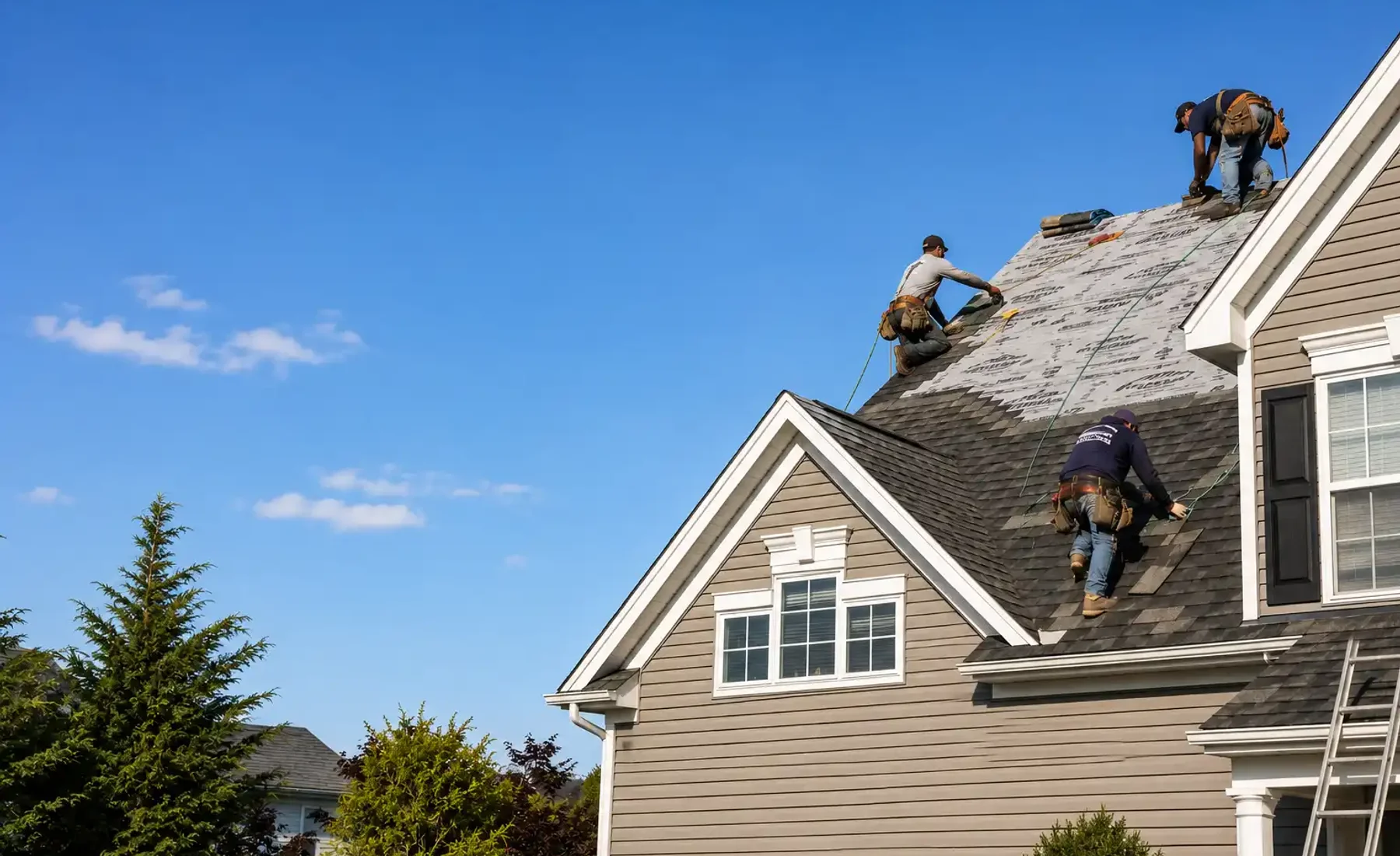
Lodi’s two-family and mixed-use housing stock takes hard use, and much of it still has original gutters and unlined masonry flues. We do a steady volume of roof repair, gutter replacement and chimney liner work in the borough.
Homeowners in Lodi get the same process we use everywhere: a hands-on inspection, a written itemized scope before anything starts, our own crew on site rather than subcontractors, and a satisfaction guarantee on the finished work. We have been doing this in North Jersey for more than 25 years.
If you are comparing quotes in Lodi, call (862) 271-1225 and we will tell you plainly what the work needs — repair when repair is the right answer, replacement when it is not.
What the work includes
- Roof repair, replacement and 24/7 emergency leak response in Lodi
- Chimney repair, repointing, rebuilds, liners and cleaning
- Siding installation and repair — vinyl and fiber cement
- Seamless gutters, guards, screens and cleaning
- Masonry: steps, walkways, patios, sidewalks and retaining walls
- Deck construction, structural repair and restoration
How Lodi's Building Department handles roofing, siding and deck permits
Lodi’s Building Department reviews permit applications for roofing, siding, deck and masonry work under the New Jersey Uniform Construction Code, and the borough will not issue a construction permit to an unlicensed contractor. NJ Gold Star Construction pulls the permit with the borough on Lodi jobs that require one, rather than leaving that step to the homeowner.
The Borough of Lodi’s Building Department issues permits for residential construction and inspects the work against the Uniform Construction Code of New Jersey. Two forms come up on almost every exterior job: a Local Permit Application for the scope of work, and proof that the contractor doing the work is properly licensed — the department will not issue a permit for construction, reconstruction or structural alteration to anyone who isn’t a duly licensed contractor or an authorized agent. Questions about whether a specific roof repair, siding job or deck needs a permit go to the Construction Official’s office before work is scheduled.
What that means for your project
- A full roof replacement or a new deck in Lodi needs a permit and a scheduled inspection; a small roof repair patching a section of flashing usually does not.
- Ask any contractor bidding your job for their New Jersey HIC registration number before signing anything — the borough can’t issue a permit without it, and you shouldn’t sign a contract without it either.
- We handle the borough paperwork on jobs that need it, so you aren’t tracking down forms in the middle of a roof or siding installation.
Flat roofs above Lodi's Main Street storefronts
Lodi has a run of mixed-use buildings along Main Street with retail or offices at street level and apartments above, and those buildings usually carry a low-slope membrane roof over the storefront section even where the residential portion above is pitched and shingled. Ponding water and failed parapet flashing are the two problems that show up first on that kind of roof.
A membrane roof over a storefront behaves differently from the shingled roof over the apartments above it. Water has to drain off a flat or low-slope section through scuppers or interior drains rather than running straight off an eave, so a section that has settled even slightly will pond after every rain. Standing water works at seams and flashing far longer than water running off a pitched roof does, which is why ponding is usually the first thing we check on a mixed-use building.
The other weak point is where the membrane turns up a parapet wall or butts against the brick of the residential floors above. That transition gets recaulked and re-flashed on a maintenance cycle most single-family roofs never need. A roof maintenance visit that catches a lifted parapet flashing or a clogged scupper before the next storm is usually far cheaper than the ceiling repair on the commercial space below it.
A Saddle River streamgage has tracked Lodi's flood stage since the 1920s
A USGS streamgage on the Saddle River at Lodi has recorded peak flows since 1924 and reports real-time stage over a 54.6-square-mile drainage area, feeding National Weather Service flood forecasts and a published inundation map for the 2.75-mile reach from Rochelle Park through Lodi. That long record is why gutter capacity and grading matter more here than on higher ground.
USGS streamgage 01391500, Saddle River at Lodi, sits within the borough and has measured peak high-water events since 1924, with continuous stage and discharge data going back to 1981 and daily records to 1923. It is operated jointly with the New Jersey Department of Environmental Protection and the U.S. Army Corps of Engineers’ New York District as part of the USGS Federal Priority Streamgages network. The National Weather Service uses that gauge for its Saddle River at Lodi forecast point, and USGS built a companion flood-inundation study mapping a 2.75-mile stretch of the river from just above the Interstate 80 bridge in Rochelle Park to 1.5 miles below the Route 46 bridge in Lodi — designed so emergency managers can match a forecast stage to the streets it will actually reach.
What it means for exterior work
- Gutters and downspouts on Lodi properties near the river corridor are worth sizing for real volume, not the smallest system that clears code — ask about this when we scope a new gutter installation.
- Grading that carries downspout discharge away from the foundation matters more on low-lying lots, and it’s something we flag during a foundation repair or patio estimate.
Flue liner signs to watch for in Lodi's two-family homes
In Lodi’s two-family houses with original masonry chimneys, warning signs of a failing or unlined flue include white staining on the brick, crumbling mortar in the attic where the chimney passes through, and a sooty smell after the furnace or a fireplace runs. The Chimney Safety Institute of America says even a rarely used chimney needs a yearly check for soundness and clearances.
| What you notice | Likely cause | Typical fix |
|---|---|---|
| White, flaky staining on exterior brick | Efflorescence from moisture moving through unlined or damaged masonry | Crown, cap and flashing repair; evaluate for a liner |
| Crumbling mortar joints in the attic chase | Water intrusion at the flashing or a missing rain cap | Repointing plus a properly installed chimney cap |
| Sooty or acrid smell after the furnace runs | Flue gases leaking through cracked or unlined masonry | Chimney liner sized to the appliance |
| Two flues sharing one chase on a two-family house | Older shared-chimney construction common on Lodi’s attached homes | Independent liners so each unit vents correctly |
A lot of Lodi’s two-family housing was built with a single masonry chimney chase serving both units, sometimes with two flues run side by side and sometimes with a shared, unlined flue from the era before liner requirements were standard. CSIA’s guidance notes that confirming an existing unlined flue actually meets modern construction requirements is nearly impossible without opening up the chimney, which is why a liner is usually the more practical answer once a flue shows any of the signs above. We evaluate the whole chase — both units’ venting, the crown, the cap and the flashing where it meets the roof — rather than patching one symptom at a time.
Foundation and retaining wall work on Lodi's attached lots
Lodi’s two-family homes are often built close to the property line with a shared or nearly touching foundation wall, so masonry repair here has to account for drainage and grading on a narrow side yard rather than open ground. Keeping roof and gutter water moving away from that wall is usually the difference between a dry basement and a recurring damp-wall problem.
On a typical Lodi two-family lot, the side yard between houses is often only a few feet wide, which limits where a downspout can discharge and how a retaining wall or a drainage swale can be graded. When we handle foundation repair on a house like this, the scope usually includes checking where the nearest downspouts empty and whether the grade actually slopes away from the wall, not just patching the visible crack. A patio or walkway built too close to the foundation with the wrong pitch can send water straight back at the wall it was supposed to be nowhere near.
We see the same tight-lot layout on the two-family blocks in neighboring Garfield, and on attached housing across the border in Hackensack. If you’re comparing quotes for exterior work in Lodi, request a free written estimate and we’ll walk the property line issues with you before anything is scheduled.
Services available in Lodi
NJ Gold Star Construction repairs and replaces asphalt shingle, flat and metal roofs across Berg…
We repair, repoint, reline and fully rebuild masonry chimneys throughout North Jersey, and we cl…
We install seamless aluminum and copper gutters, add guards and screens, and repair or clean exi…
We build and repair steps, walkways, patios, sidewalks, retaining walls and stone veneer across …
We install and repair vinyl, fiber cement and wood siding across North Jersey, including the wat…
We build new decks and repair existing ones across North Jersey — footings, framing, decking, ra…
Frequently asked questions
Do you serve Lodi?
Yes. Lodi is part of our regular service area for roofing, chimney, siding, gutter, masonry and deck work.
How fast can you get to Lodi for an emergency?
We answer 24/7 and reach active leaks in Lodi the same day whenever possible, tarping to stop water before the permanent repair is scheduled.
Are you licensed to work in Lodi?
Yes. We hold New Jersey Home Improvement Contractor license #13VH13359900, carry full insurance, and pull permits with your municipality where the work requires them.
Does NJ Gold Star pull the permit for roofing or siding work in Lodi?
Yes, on jobs that need one. Lodi’s Building Department requires a permit for most roof replacements, deck construction and structural siding work, and will not issue it to an unlicensed contractor. We handle that paperwork with the borough as part of the job rather than leaving it for you to file.
Should I worry about Saddle River flooding before roofing or gutter work in Lodi?
It depends on where your property sits relative to the river corridor. The USGS streamgage in Lodi and its companion flood-inundation maps are public tools worth checking for your address. Even outside the mapped reach, we size gutters and grade downspout discharge with drainage in mind on low-lying Lodi lots.
Do two-family homes in Lodi need separate chimney liners for each unit?
Usually, yes, when both units vent through the same masonry chase. A shared, unlined flue makes it hard to confirm each appliance is venting safely, so we typically recommend independent liners sized to each unit’s furnace or fireplace rather than relying on the original shared flue.
Is a permit needed to replace a flat roof on a Lodi mixed-use building?
Re-roofing a low-slope membrane over a storefront in Lodi generally requires a construction permit through the borough, the same as a pitched residential roof. We confirm the exact requirement with the Building Department and handle the filing before scheduling the work.
- Building Department — Borough of Lodi, NJ
- Saddle River at Lodi NJ (USGS 01391500) — USGS Water Data for the Nation
- Flood-Inundation Maps for the Saddle River, Rochelle Park to Lodi, New Jersey, 2012 — U.S. Geological Survey
- Homeowner Resources — Chimney Safety Institute of America
Updated September 2026 · Reviewed by Edgar Lopez Gonzalez, owner · NJ HIC #13VH13359900
Licensed & insured. 25+ years in North Jersey. We answer 24/7 for leaks and storm damage.
- Town
- Lodi, Bergen County
- License
- NJ HIC #13VH13359900
- Emergency service
- 24/7 — call (862) 271-1225
- Estimates
- Free, written and itemized