Licensed & Insured — NJ HIC #13VH13359900
njgoldstarconstruction@yahoo.com · 24/7 Emergency · (862) 271-1225

Home › Areas We Serve › Garfield
Roofing, Chimney, Siding & Masonry Contractor in Garfield, NJ
NJ Gold Star Construction serves Garfield from our Totowa shop with roof repair and replacement, chimney work, siding, seamless gutters, masonry and decks. Licensed under NJ HIC #13VH13359900, insured, free written estimates, and 24/7 emergency response.
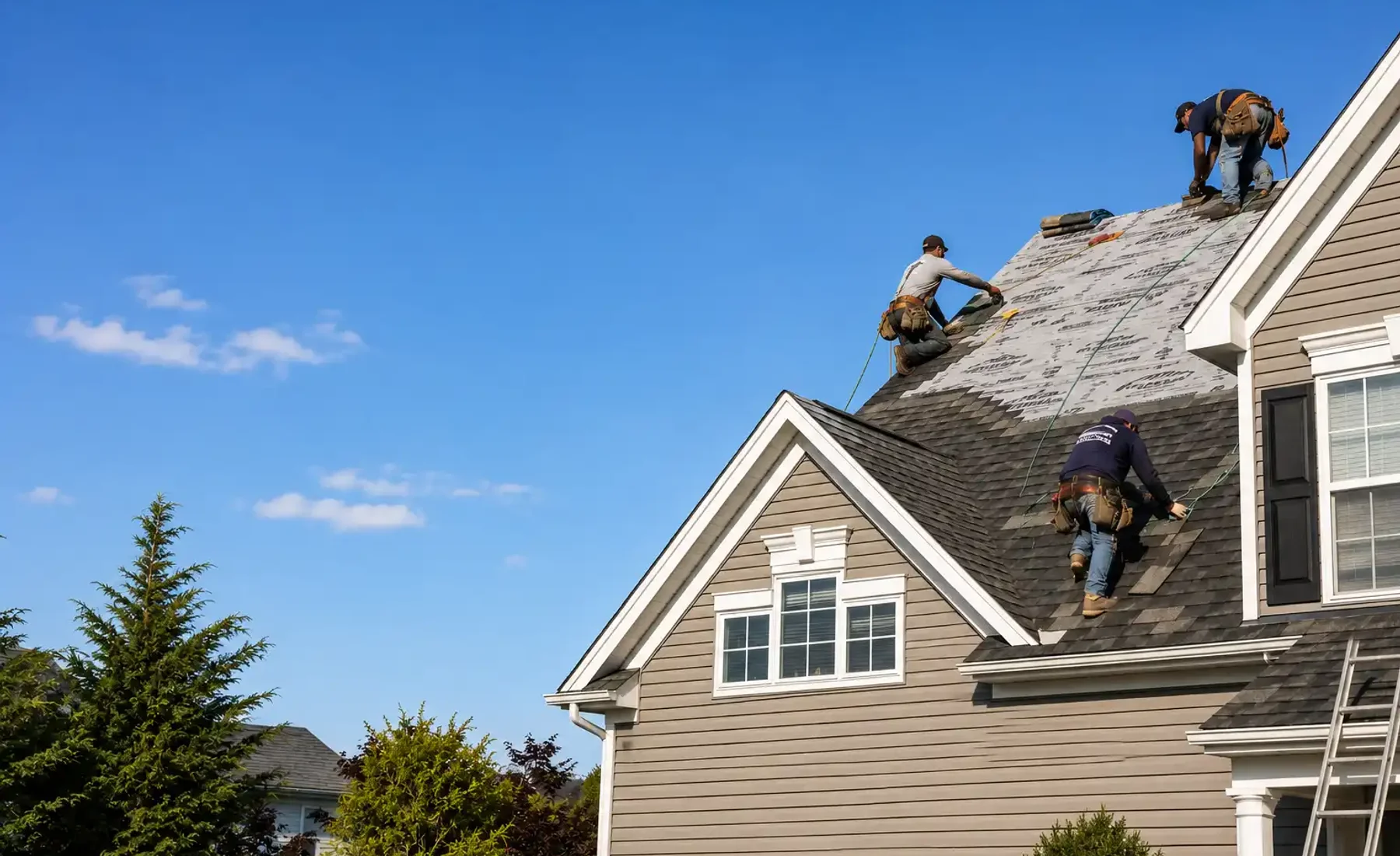
Garfield’s older frame houses sit close together with tall brick chimneys and original siding on many blocks. Siding repair, chimney repointing and roof replacement make up most of our work in the city.
Homeowners in Garfield get the same process we use everywhere: a hands-on inspection, a written itemized scope before anything starts, our own crew on site rather than subcontractors, and a satisfaction guarantee on the finished work. We have been doing this in North Jersey for more than 25 years.
If you are comparing quotes in Garfield, call (862) 271-1225 and we will tell you plainly what the work needs — repair when repair is the right answer, replacement when it is not.
What the work includes
- Roof repair, replacement and 24/7 emergency leak response in Garfield
- Chimney repair, repointing, rebuilds, liners and cleaning
- Siding installation and repair — vinyl and fiber cement
- Seamless gutters, guards, screens and cleaning
- Masonry: steps, walkways, patios, sidewalks and retaining walls
- Deck construction, structural repair and restoration
Permits and inspections through Garfield's Building Department
Garfield’s Building Department issues roofing, siding, deck and masonry permits through an online FastTrack portal and publishes a separate checklist just for deck permits, in addition to its general construction permit application. Every permit still has to go to a properly licensed contractor, so we file directly with the city on jobs in Garfield that require one.
Garfield runs its construction permitting online through the FastTrack portal, where residents and contractors can apply for and pay for building permits, dwelling certificates and certificates of occupancy. Deck construction gets its own published requirements separate from the general permit form, which is one sign of how often deck work comes up in the city’s older neighborhoods with detached garages and narrow rear yards. As in every New Jersey municipality, the city cannot issue a construction permit to a contractor who isn’t properly licensed.
Before work starts in Garfield
- A new deck needs a permit filed with a property survey; a small deck repair typically does not.
- A full roof replacement or a structural siding job on one of Garfield’s older frame houses is a permitted job we file for you.
- Ask to see a contractor’s New Jersey HIC registration before signing — the city’s own contractor compliance guidance points homeowners to check this before work begins.
Original wood siding and lead-safe practices on Garfield's older frame houses
Garfield’s older frame housing stock means a lot of exterior work here runs into paint applied before 1978, and EPA’s Renovation, Repair and Painting rule requires lead-safe certified work practices whenever a job disturbs more than about 20 square feet of exterior painted surface on a pre-1978 home. That applies to siding tear-off, trim replacement and some chimney and window work.
Sanding, cutting or prying off old painted siding on a house built before 1978 can release lead dust, and EPA’s rule exists because that dust is hazardous even in small amounts, especially to children. The requirement isn’t limited to full siding replacement — replacing a window, tearing out damaged trim around a chimney, or scraping a section of original clapboard before a repair can all disturb enough painted surface to trigger it. Homeowners doing the work themselves in their own residence are generally exempt, but a contractor performing the same work is not.
We treat that as standard practice rather than an add-on cost surprise on Garfield’s older homes: containment, careful removal, and cleanup practices sized to the amount of surface being disturbed on that specific siding repair or replacement.
The stalled Lower Saddle River flood project and what it means for Garfield homeowners
Garfield sits along the Saddle River and is one of the municipalities named in the Army Corps of Engineers’ Lower Saddle River flood management study, a decades-old project that has stalled over contaminated sediment in the waterway rather than engineering disagreement. Until that regional fix moves forward, drainage and grading on individual Garfield properties do the day-to-day work of keeping storm water away from foundations.
Federal representatives have pushed the Army Corps to restart the Lower Saddle River project, which covers Garfield along with Wallington, South Hackensack, Lodi, Saddle Brook and Rochelle Park. The holdup has been contamination in the riverbed sediment and who is responsible for cleaning it up before construction can proceed, not a dispute over whether the flood-reduction work is needed. That regional timeline is outside any homeowner’s control, which is exactly why the drainage details on an individual Garfield property carry more weight than they might in a town without a stalled flood-control project on the books.
On the ground, that means gutters and downspouts that actually clear water away from the foundation, and grading around a foundation repair or new walkway that doesn’t pitch water back toward the house.
Footing depth for a new deck on a Garfield lot
New Jersey’s residential code sets a minimum frost-line footing depth of 3 feet for Bergen County and the rest of northern New Jersey, and that depth applies to new deck footings in Garfield the same as it does to a house foundation. A footing poured shallower than that can heave as the ground freezes and thaws, which shows up later as a deck that racks or pulls away from the house.
A deck footing that’s a few inches shallow rarely fails the first winter. It shows up two or three freeze-thaw cycles later as a post that has heaved slightly out of level, a ledger board pulling away from the house, or stairs that no longer sit flush. New Jersey’s Uniform Construction Code ties footing depth to the state’s climatic design table, and northern New Jersey — Bergen County included — falls in the zone requiring a minimum of 3 feet below finished grade.
Survey and layout
We confirm property lines and setbacks against the survey the city’s deck permit process requires before digging a single footing.
Footings to code depth
Footings go to the 3-foot frost line New Jersey’s residential code sets for this part of the state, not just deep enough to look solid.
Framing and ledger
The ledger attaches to sound framing with proper flashing where it meets the house, since that’s the connection most existing decks fail at first.
Decking and railings
Decking, stairs and railings go on to the scope in your written estimate, with a final walk-through before we consider the job finished.
Repointing and liners for Garfield's tall brick chimneys
Garfield’s frame houses commonly carry tall, narrow brick chimneys that were built for a coal or oil-fired system decades before the current heating appliance was installed, and mortar joints on that kind of chimney weather faster than the brick itself. The Chimney Safety Institute of America recommends a yearly inspection of every chimney, even one that sits unused most of the year.
A brick chimney that was sized and lined for an old coal-fired boiler is usually the wrong flue diameter for a modern gas furnace or a wood-burning insert added later, which is part of why so much of our chimney work in Garfield is repointing paired with a properly sized liner rather than either one alone. Mortar joints on a tall, exposed chimney take the brunt of freeze-thaw cycling and weather faster than the brick units around them, so repointing on its own without addressing what’s happening inside the flue only solves half the problem.
What we check on a tall Garfield chimney
- Mortar joint condition from the roofline to the crown, where weathering shows up first.
- Liner sizing against the current heating appliance, not the one the chimney was originally built for.
- Crown and cap condition, since a cracked crown on a tall chimney lets water travel a long way down before it shows up as a stain.
We see the same tall-chimney, frame-house pattern just over the city line in Clifton and Elmwood Park.
Services available in Garfield
NJ Gold Star Construction repairs and replaces asphalt shingle, flat and metal roofs across Berg…
We repair, repoint, reline and fully rebuild masonry chimneys throughout North Jersey, and we cl…
We install seamless aluminum and copper gutters, add guards and screens, and repair or clean exi…
We build and repair steps, walkways, patios, sidewalks, retaining walls and stone veneer across …
We install and repair vinyl, fiber cement and wood siding across North Jersey, including the wat…
We build new decks and repair existing ones across North Jersey — footings, framing, decking, ra…
Frequently asked questions
Do you serve Garfield?
Yes. Garfield is part of our regular service area for roofing, chimney, siding, gutter, masonry and deck work.
How fast can you get to Garfield for an emergency?
We answer 24/7 and reach active leaks in Garfield the same day whenever possible, tarping to stop water before the permanent repair is scheduled.
Are you licensed to work in Garfield?
Yes. We hold New Jersey Home Improvement Contractor license #13VH13359900, carry full insurance, and pull permits with your municipality where the work requires them.
Does a new deck in Garfield need a survey to get a permit?
Garfield’s Building Department publishes deck permit requirements separately from its general permit application, and a current property survey is part of what the city asks for on deck projects. We confirm the exact paperwork with the department and handle the filing as part of a new deck build.
Does lead-safe work add cost to a siding job on an older Garfield house?
It can, when the home was built before 1978 and the work disturbs enough painted surface to trigger EPA’s rule — typically replacement siding, trim removal or some window work. We factor lead-safe containment and cleanup into the estimate up front rather than adding it as a surprise once work starts.
How deep do deck footings need to be in Garfield?
New Jersey’s residential code sets a 3-foot minimum frost-line depth for footings in Bergen County and the rest of northern New Jersey. We dig every deck footing in Garfield to that depth regardless of how the ground looks on the surface, since frost heave damage shows up over several winters, not the first one.
Why does a tall brick chimney in Garfield need both repointing and a liner?
Many of Garfield’s older chimneys were built for a heating system that’s since been replaced, so the flue is often the wrong size for the current furnace while the mortar joints have weathered from decades of exposure. Repointing without checking the liner, or lining without fixing failing mortar, only addresses one half of the chimney.
- Building Department — City of Garfield, NJ
- Renovation, Repair and Painting Program: Consumers — U.S. Environmental Protection Agency
- Pou Pushes Administration on North Jersey Flood Management — Office of Rep. Nellie Pou
- Chapter 3 Building Planning: New Jersey UCC One- & Two-Family Dwelling Subcode 2021 — UpCodes (New Jersey edition of the 2021 IRC)
- Homeowner Resources — Chimney Safety Institute of America
Updated September 2026 · Reviewed by Edgar Lopez Gonzalez, owner · NJ HIC #13VH13359900
Licensed & insured. 25+ years in North Jersey. We answer 24/7 for leaks and storm damage.
- Town
- Garfield, Bergen County
- License
- NJ HIC #13VH13359900
- Emergency service
- 24/7 — call (862) 271-1225
- Estimates
- Free, written and itemized