Licensed & Insured — NJ HIC #13VH13359900
njgoldstarconstruction@yahoo.com · 24/7 Emergency · (862) 271-1225

Roof Repair in Bergen County, NJ
Same-week roof repair for leaks, wind-lifted shingles, failed flashing and storm damage across Bergen and Passaic County, with 24/7 response for active leaks.
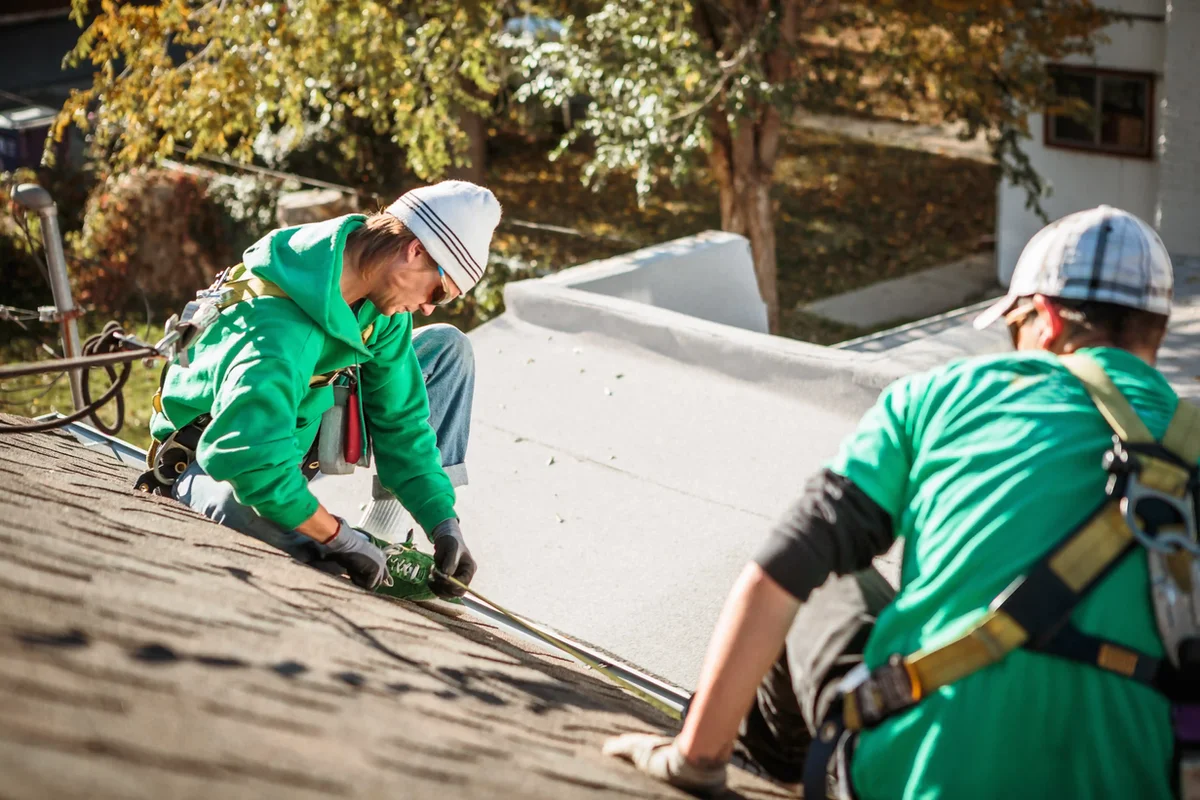
Most leaks we chase are not shingle failures — they are flashing details at chimneys, sidewalls, skylights and pipe boots. We find the entry point with a hands-on inspection rather than patching the stain below it.
This is one part of the roofing work we do across Bergen and Passaic County. Every job is quoted in writing after a hands-on inspection, performed by our own crew rather than subcontractors, and backed by our satisfaction guarantee. We are licensed under NJ HIC #13VH13359900 and fully insured.
What the work includes
- Leak diagnosis and permanent repair, not surface patching
- Wind and hail damage repair with insurance documentation
- Step, valley and chimney counterflashing replacement
- Emergency tarping to stop water the same day
Flashing failures vs. shingle failures: how to tell them apart
Active roof leaks in Bergen County more often trace to flashing at chimneys, sidewalls, skylights and pipe boots than to the shingle field itself. The National Roofing Contractors Association names flashing failure as a leading cause of leaks nationwide, because a chimney cricket, step flashing or pipe boot collar can fail years before the shingles around it wear out.
A shingle in the open field of a roof has the simplest job on the house: shedding water down a slope. Flashing has the hard job, at every place the roof changes plane or has something poking through it — chimneys, sidewalls, skylights and pipe boots. Those are also the places we start when a customer calls about a stain on the ceiling.
A chimney wider than roughly 30 inches on the upslope side needs a cricket, a small secondary ridge that splits water around the chimney instead of letting it pool against the brick. Skip the cricket, or build it too small, and debris and rain collect behind the chimney until the step flashing and counterflashing are overwhelmed. Skylights fail differently: most come with a factory flashing kit, but a kit is only as good as the sealant and fastening around it, and both degrade with age.
What we check before we touch a shingle
- Counterflashing at the chimney for lifted or missing sections
- Step flashing along sidewalls, dormers and additions
- The rubber collar on every pipe boot, which cracks from sun exposure years before the shingles fail
- Valley metal and the shingle nailing pattern that crosses it
Once we find the actual entry point, we repair that detail specifically rather than blanket-coating the roof or replacing shingles that were never the problem.
What wind and hail leave behind on a North Jersey roof
Wind and hail damage on a Bergen County roof rarely looks dramatic. Wind creases and lifts shingle tabs at the edges, breaking the factory seal strip, while hail bruises the mat under the granules without punching through it. New Jersey’s northern climate zone sees about twice as many thunderstorms as the coast, per the state climatologist.
| What you see | Likely cause | Why it matters |
|---|---|---|
| Creased or torn shingle tabs | Wind uplift breaking the seal strip | The tab can keep lifting in every wind event after this |
| Bare or thin granule patches | Hail impact bruising the mat | Accelerated aging even without an active leak |
| Lifted or missing ridge cap | High gusts along the roof’s most exposed line | Exposes the ridge nailing and the attic below it |
| Dented gutters or downspouts | Hail or wind-driven debris | Often the first thing an adjuster looks for on a claim |
Most wind damage starts at an edge or corner, where uplift pressure is highest. A shingle that loses its seal strip can flap in every subsequent wind event, working the nail holes wider until it tears free. Hail is quieter: it can bruise the fiberglass mat under the granules without breaking through, so the shingle looks intact but loses years of expected service on the spot.
Because storm damage is often about degraded service life rather than an obvious hole, a hands-on inspection after any significant wind or hail event is worth scheduling even if nothing is visibly leaking yet. We check the gutters at the same time, since dented or detached sections are frequently the first visible sign of the same storm.
Documenting roof damage before you file an insurance claim
Before repairs begin, photograph every damaged area of the roof from multiple angles and keep any torn-off material until your insurer says you can dispose of it. New Jersey’s Department of Banking and Insurance advises consumers to document damage with photos before discarding anything and to keep the property available for the adjuster to inspect.
An emergency tarp stops the water, but photos taken before that tarp goes on are what support an insurance claim. Shoot each affected slope from at least two angles, get a wide shot that shows the whole roof plane and a close shot of the specific damage, and photograph any shingles or flashing pieces that came off before they end up in the dumpster.
The New Jersey Department of Banking and Insurance’s guidance on storm-related claims is specific on this point: consumers should photograph damaged property before disposing of it and, where possible, hold onto the damaged material until the insurance company has inspected it or says it can be thrown out. A written estimate from us documents the scope, and we can hold debris for a scheduled adjuster visit when a customer asks.
If the loss involves more than the roof — a downed limb or wind-driven water at a sidewall, for example — the same rule applies to that damage too.
Emergency tarping: what it buys you, and what it doesn't
Emergency tarping is a temporary measure that keeps water out of the attic and living space until a permanent repair can be scheduled. It does not replace the shingles, seal the flashing or fix the underlying problem, and a tarp left on through multiple storms can itself trap moisture against the deck.
We answer calls and texts 24 hours a day for active leaks, and tarping gets priority over other scheduled work. When the damage traces to a detail we can permanently fix that day, we do; tarping is for when the repair has to wait on parts, a roof that’s too wet or icy to work safely, or a scope that needs daylight to diagnose correctly.
Stop the active water
We tarp the affected slope the same day whenever possible, working from a ladder or the roof where it’s safe to walk, and weight the tarp edges so wind can’t get under it.
Protect the interior
Where water has already reached the attic or ceiling, we point out what to watch for inside, such as a sagging ceiling or a musty smell, while the permanent repair is scheduled.
Schedule the permanent fix
A tarp is not a repair. We follow up with a written estimate and get the actual flashing or shingle work done as soon as materials and weather allow.
When a repair isn't the right call anymore
A repair stops making sense when the roof covering is water-soaked or deteriorated, when it already carries two or more layers, or when leaks are showing up at several unrelated points on different slopes. New Jersey’s adopted residential code blocks roofing over a deck in that condition, which is when we recommend a full roof replacement instead.
We give every customer an honest answer, even when it isn’t the one that keeps us on the roof the longest. If the deck under the shingles has gone soft or delaminated, if this would be a third layer of roofing, or if you’re chasing leaks in three different rooms that don’t trace to one flashing detail, patching that roof would be spending money to delay a replacement rather than solve the problem.
New Jersey’s version of the International Residential Code is direct about two of those situations: a roof cannot be recovered where the existing covering is water-soaked or deteriorated, and it cannot be recovered where two or more layers of roofing already exist. At that point, full roof replacement is the only code-compliant path, and a proper tear-off also gives us the chance to fix the attic ventilation that’s often part of why the roof wore unevenly in the first place.
Customers notice that same directness. After a skylight leak and roof repair, one reviewer wrote:
“Very professional, expedited service, always available and always gets the job done quickly and efficiently.” — Joanna L., Google review
Roof repair across Bergen, Passaic and the surrounding counties
NJ Gold Star Construction repairs roofs throughout Bergen and Passaic County and into neighboring Essex, Hudson, Morris and Union counties, working from our base in Totowa. Every repair starts with a hands-on inspection and a free written estimate before any work begins, and our own crew, not subcontractors, does the work.
Leak calls come in from across North Jersey, from older homes near downtown Paterson with original flashing details to newer construction near Wayne, where a builder-grade pipe boot is a frequent culprit. The diagnosis changes with the house; the process doesn’t: inspect, document, quote in writing, repair.
If the roof also needs attention at the gutters or a seasonal check, see our roof maintenance page for catching problems like these before they become an active leak. When you’re ready, request a free estimate and we’ll get someone out to look at it.
Related roofing services
Full tear-off roof replacement with deck inspection, ice and water shield, synthetic underlaymen…
Balanced attic ventilation — ridge vent, soffit intake and box or powered vents — to clear moist…
Annual roof inspection and maintenance — sealing exposed fasteners, resetting flashing, clearing…
Frequently asked questions
How fast can you get out for an active leak?
We answer 24/7 and get to active leaks the same day whenever possible, tarping to stop water before the permanent repair is scheduled.
Will a repair void my roof's warranty?
No. Repairs done to manufacturer specification with matching materials keep a shingle warranty intact, and we document what was replaced.
Does homeowners insurance typically cover roof leak repair?
Coverage depends on the cause and your specific policy. Sudden, storm-related damage such as a wind-lifted shingle or a hail-bruised valley is typically the kind of loss homeowners policies are written to cover; gradual wear, neglected maintenance or age-related failure usually is not. Your adjuster makes the final call, and a written repair estimate from us supports whichever way that determination goes.
Can a small roof leak wait until better weather?
No. A small leak rarely stays small; water tracks along rafters and sheathing to the lowest point it can find, often well away from where it entered, and wets insulation and framing along the way. We prioritize tarping active leaks the same day whenever possible and schedule the permanent repair as soon as conditions allow, rather than waiting for a dry stretch to even look at it.
Do you repair flashing and roofing work that another contractor installed?
Yes. We regularly diagnose and repair flashing, valleys and pipe boots that were installed by someone else, including recent work that’s already failing. We inspect the detail on its own merits rather than assuming the original installation was correct, and we’ll tell you plainly if the issue is isolated or points to a wider problem.
How long does a typical roof repair take?
Most single-detail repairs, such as one section of flashing or a run of shingles, are finished in a few hours once we’re on the roof. Repairs involving multiple leak points, deck replacement or matching a discontinued shingle profile take longer, and we’ll give you a realistic window in the written estimate rather than a guess at the door.
- Flashing and Vents (Roof Builders Handbook) — National Roofing Contractors Association
- Filing Insurance Claims for Storm-Related Damage — New Jersey Department of Banking and Insurance
- R908.3.1.1 Roof Recover Not Allowed (2021 IRC) — UpCodes
- Overview of the Climate of New Jersey — Office of the New Jersey State Climatologist, Rutgers University
Updated September 2026 · Reviewed by Edgar Lopez Gonzalez, owner · NJ HIC #13VH13359900
Licensed & insured. 25+ years in North Jersey. We answer 24/7 for leaks and storm damage.
- Service
- Roof Repair
- Category
- Roofing
- Service area
- Bergen & Passaic County and surrounding North Jersey
- License
- NJ HIC #13VH13359900