Licensed & Insured — NJ HIC #13VH13359900
njgoldstarconstruction@yahoo.com · 24/7 Emergency · (862) 271-1225
Chimney Repair, Rebuilds & Cleaning in Bergen County, NJ
We repair, repoint, reline and fully rebuild masonry chimneys throughout North Jersey, and we clean flues and remove creosote to NFPA 211 standards. Chimney work is quoted after a hands-on inspection of the crown, joints, flashing and flue — not from the driveway.
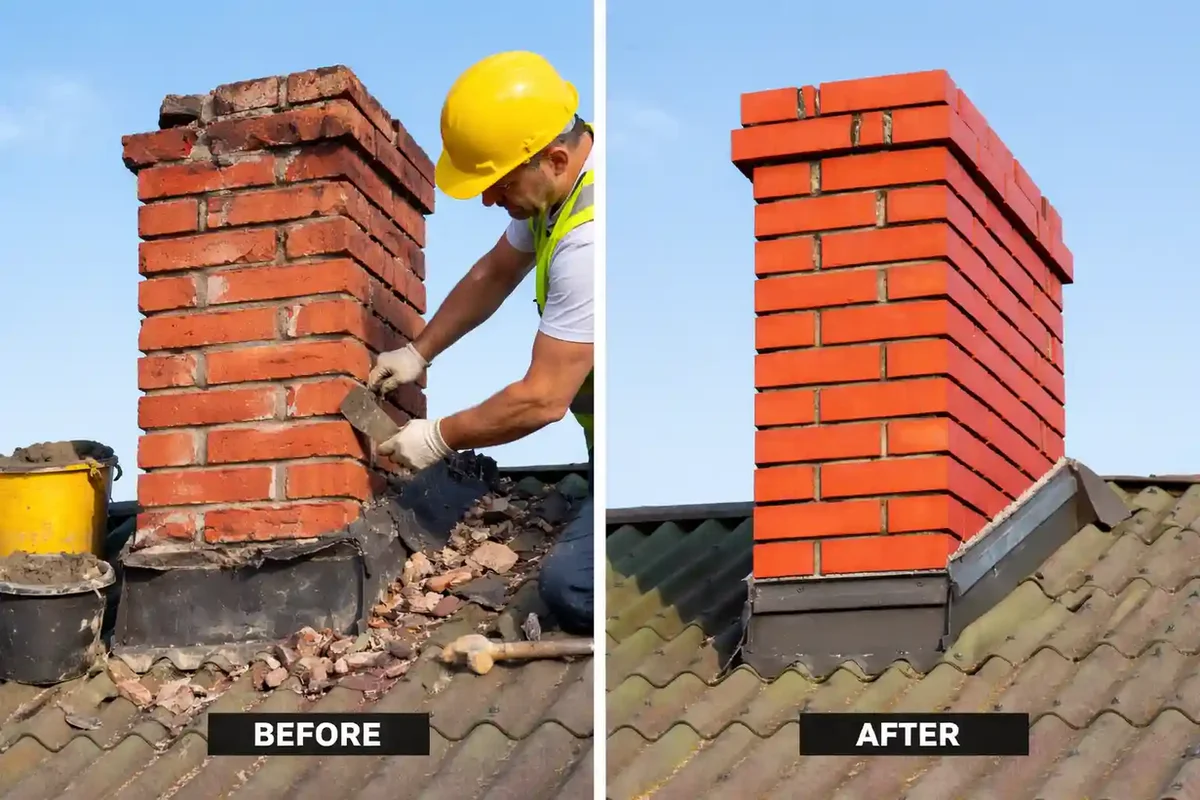
A chimney takes more weather than any other part of the house. It stands above the roofline, exposed on four sides, and every freeze-thaw cycle drives water deeper into open mortar joints. Left alone, a hairline crack becomes spalling brick, then a leaning stack, then water in the ceiling below.
Our chimney work starts at the top and works down — crown, cap, brick and joints, counterflashing at the roof, and the flue itself. Where the masonry is sound we repoint and waterproof. Where it has gone soft, we take the stack down to a solid course and rebuild it with matched brick.
We follow New Jersey fire-safety regulations and National Fire Protection Association standards on liners, clearances and cleaning, so the chimney you burn in is safe as well as watertight.
What the work includes
- Repointing and tuckpointing of failed mortar joints
- Partial and full chimney rebuilds above and below the roofline
- Crown repair and rebuild, cap and chase cover installation
- Stainless liner installation for fireplaces, furnaces and boilers
- Deep cleaning, creosote removal and flue inspection
What a masonry chimney is actually made of
A masonry chimney is a stack of separate parts working together: the crown sheds water off the top, the cap and mesh keep out rain and animals, the flue liner carries combustion gases safely, the smoke chamber and firebox handle the fire below, and flashing seals the roof line. Any one part can fail on its own.
Homeowners tend to think of “the chimney” as one object, but a technician looking at the same stack sees five or six separate assemblies stacked on top of each other, each with its own failure mode:
- Crown. The sloped concrete cap at the very top that sheds rain away from the flue and the brick below it.
- Cap and spark screen. The metal cover over the flue opening that keeps out rain, birds, squirrels and embers — see our chimney cap installation page.
- Flue liner. The clay tile, stainless steel or poured lining that actually carries smoke and combustion gases up and out — covered on our chimney liner page.
- Smoke chamber and firebox. The interior masonry that funnels smoke from the fire into the flue.
- Brick, mortar joints and the chase. The visible stack itself, whether traditional masonry or a framed, sided chase topped with a metal chase cover.
- Flashing. The metal seal where the chimney meets the roof deck, tied into the same water path our roof repair crews handle.
Most “the chimney is leaking” calls turn out to be one of these parts, not the whole assembly, which is why an accurate diagnosis matters more than a guess from the driveway.
Why North Jersey winters are hard on masonry chimneys
A chimney is a masonry structure standing fully exposed on all four sides above the roofline, so it takes the brunt of the region’s winter weather. New Jersey’s Northern climate zone, which covers Bergen and Passaic County, runs noticeably colder than the rest of the state and carries the heaviest snow load, and that cold drives water deeper into open mortar joints every season.
The Office of the New Jersey State Climatologist describes the Northern climate zone — the zone that covers Bergen and Passaic County — as consistently colder in winter than the rest of the state, with annual snowfall in the 40 to 50 inch range. That matters for a chimney because water is the mechanism behind nearly every failure we see:
How the damage actually happens
- Rain and melting snow soak into hairline cracks in the crown or open mortar joints.
- Overnight cold drives that water down into the brick and mortar and freezes it.
- Ice expands roughly 9% in volume, and that expansion has nowhere to go but outward against the masonry.
- Each freeze-thaw cycle widens the crack a little more, and a North Jersey winter delivers dozens of them between the first hard frost and the spring thaw.
Left alone, that cycle turns a hairline crown crack into spalling brick and open joints, and eventually into a stack that needs a full or partial rebuild. Our guide on signs you need brick and chimney repair covers what to look for before it gets that far.
Repair, reline or rebuild: how we make the call
The right fix depends on where the damage sits and how deep it goes: surface mortar and a cracked crown are usually a repair, a damaged or undersized flue is a liner job regardless of the outside brick, and masonry that has gone soft or the stack leaning is a rebuild. We only know which one your chimney needs after a hands-on inspection.
| What you see or notice | Likely component | Typical service |
|---|---|---|
| Crumbling mortar joints, a few loose bricks | Repointing / brick | Chimney repair |
| Cracked, flaking crown; white staining on brick | Crown and masonry surface | Chimney repair |
| Smoke smell, stains near the chimney chase, no liner or a cracked tile liner | Flue liner | Chimney liner |
| Visibly leaning stack, wide stair-step cracks, missing sections of brick | Structure | Chimney rebuild |
| Rust streaks below a metal-topped chase, standing water on the cap | Chase cover | Chase cover |
| Strong campfire odor, reduced draft, glassy black buildup in the flue | Creosote | Deep chimney cleaning |
These are starting points, not a diagnosis — a stack that looks like a simple repointing job from the ground sometimes turns up soft masonry below the flashing line once we’re actually on the roof. That is why every job on this page starts with a hands-on look at the crown, joints, flue and flashing before we quote anything.
What an NFPA 211 chimney inspection actually covers
NFPA 211, the national fire code that governs chimneys, fireplaces and venting systems, calls for at least a Level 1 inspection every year to confirm the chimney is structurally sound, clear of blockages and free of hazardous deposits. A Level 2 inspection adds a video scan of the flue interior and is called for at a change of appliance, fuel type or ownership.
An inspection is not a sales pitch dressed up with a flashlight. NFPA 211 exists because a chimney is a fire-safety component as much as a weatherproofing one, and skipping the annual check is how small, cheap problems turn into expensive ones. Our guide on why you should get an annual chimney inspection goes into more detail on what triggers a Level 2 versus a routine Level 1 visit.
Schedule the visit
Call or text (862) 271-1225. We ask what fuel the chimney serves and whether you’ve noticed leaks, odor or draft problems.
Level 1 walkthrough
We check the accessible chimney, crown, cap, flashing and firebox for soundness, clearances and obstructions or deposits.
Camera scan where needed
If the liner condition is in question, or the situation calls for it, we run a video inspection of the full flue interior.
Written findings and options
You get a plain description of what we found, photos where useful, and a written, itemized estimate for whatever repair fits.
Scheduled work
Our own crew does the work — no subcontractor handoff — and we clean up and walk the finished job with you.
Creosote, chimney fires and why cleaning is a safety item
Chimney fires are not rare: national fire data shows fires confined to chimneys and flues account for the large majority of residential heating fires, and the leading cause is creosote buildup left in the flue from wood burning. A cleaning removes that fuel before it ignites, which is why it belongs on the same annual schedule as the inspection, not as an occasional extra.
Creosote forms as wood smoke condenses on the cooler interior of the flue, and it does not stay the same substance the longer it sits — light soot hardens into a harder, tar-like glaze that resists a standard brush and burns hotter than the wood that produced it. Our deep chimney cleaning and creosote removal page covers what a full cleaning actually removes, and how we document the flue before and after. Gas appliances are not creosote-free either: corrosion and blocked or nesting-filled flues are their own hazard, which is one more reason the annual visit covers every fuel type we service, not only wood.
Carbon monoxide risk and the fire-code basics homeowners should know
A cracked, blocked or undersized flue liner is one of the ways combustion gases end up inside the living space instead of outside the house, and federal safety guidance recommends a professional inspection of chimneys, flues and vents every year specifically to catch that before it becomes a carbon monoxide problem. This is a life-safety issue, not a cosmetic one.
The U.S. Consumer Product Safety Commission’s guidance on carbon monoxide names blocked or corroded flues and cracked liners among the venting failures that let combustion gases spill back into a home instead of exhausting outside. A chimney that looks fine from the yard can still have a compromised liner, which is exactly the kind of defect a Level 1 or Level 2 inspection is built to catch. If you’re replacing a furnace or water heater, ask whether the change affects how the chimney is sized — see our chimney liner page for what happens when an appliance swap leaves a flue oversized for what is left venting through it. When you’re ready for an inspection or a free written estimate, contact us and we’ll get a crew out.
Chimney services we provide
Full flue cleaning and creosote removal with drop-cloth protection and vacuum containment, plus …
Partial and full chimney rebuilds — taking the stack down to sound masonry and rebuilding with m…
Stainless steel liner installation for fireplaces, furnaces, boilers and water heaters, sized to…
Targeted chimney repair — repointing failed joints, replacing spalled brick, rebuilding a cracke…
Stainless and copper chimney cap installation and replacement to keep rain, debris, birds and sq…
Replacement of rusted chase covers on framed chimney chases with stainless or copper covers, cro…
Frequently asked questions
What signs tell you a chimney needs repair?
Crumbling or missing mortar, loose or spalling brick, a cracked crown, white efflorescence staining, rust on the damper or firebox, and water stains on the ceiling near the chimney chase. Any one of those means water is already getting in.
How often should I have my chimney cleaned and creosote removed?
Once a year for a chimney in regular use, and always before the first fire of the season. Heavy wood burners may need it twice. Creosote is the fuel behind most chimney fires, so cleaning is a safety item, not maintenance.
Can a chimney be rebuilt without touching the roof?
Often yes — most rebuilds start at the roofline and go up. If the deterioration runs below the flashing we open the surrounding shingles, rebuild, then re-flash and re-shingle the area so the roof stays watertight.
Is chimney repair usually covered by homeowners insurance in New Jersey?
It depends on the cause. Sudden damage from a storm, lightning or a falling limb is typically covered; deterioration from age, neglect or ordinary freeze-thaw weathering usually is not. Ask your insurer directly and keep our written estimate and photos on file — they’re useful either way when you file a claim.
Can a chimney be repaired without opening up the roof?
Often, yes. Repointing, crown repair, cap and chase-cover replacement, and most liner work are done from the top or the exterior face of the stack. Roof access only becomes necessary when the deterioration runs below the flashing line, which is something we confirm during the inspection, not guess at in advance.
How long does a chimney inspection take?
A Level 1 inspection of an accessible chimney typically takes well under an hour. A Level 2 inspection, which adds a video scan of the full flue and a look at attic, crawlspace or basement sections the chimney passes through, takes longer and is usually scheduled as its own appointment.
Does a gas fireplace chimney need the same attention as a wood-burning one?
Yes, though for different reasons. Gas appliances produce far less creosote, but their liners can still corrode, and the flue can still become blocked by debris, nesting material or a failed cap. Annual inspection applies to every fuel type the chimney vents, not just wood.
- Overview of the Climate of New Jersey — Office of the New Jersey State Climatologist, Rutgers University
- Homeowner Resources — Chimney Safety Institute of America (CSIA)
- Heating Fires in Residential Buildings (2017-2019) — U.S. Fire Administration
- Carbon Monoxide Fact Sheet — U.S. Consumer Product Safety Commission (CPSC)
Updated September 2026 · Reviewed by Edgar Lopez Gonzalez, owner · NJ HIC #13VH13359900
Licensed & insured. 25+ years in North Jersey. We answer 24/7 for leaks and storm damage.
- Service area
- Bergen, Passaic, Essex, Hudson, Morris & Union County, NJ
- License
- NJ HIC #13VH13359900
- Estimates
- Free, written and itemized
- Emergency
- 24/7 response for active leaks and storm damage