
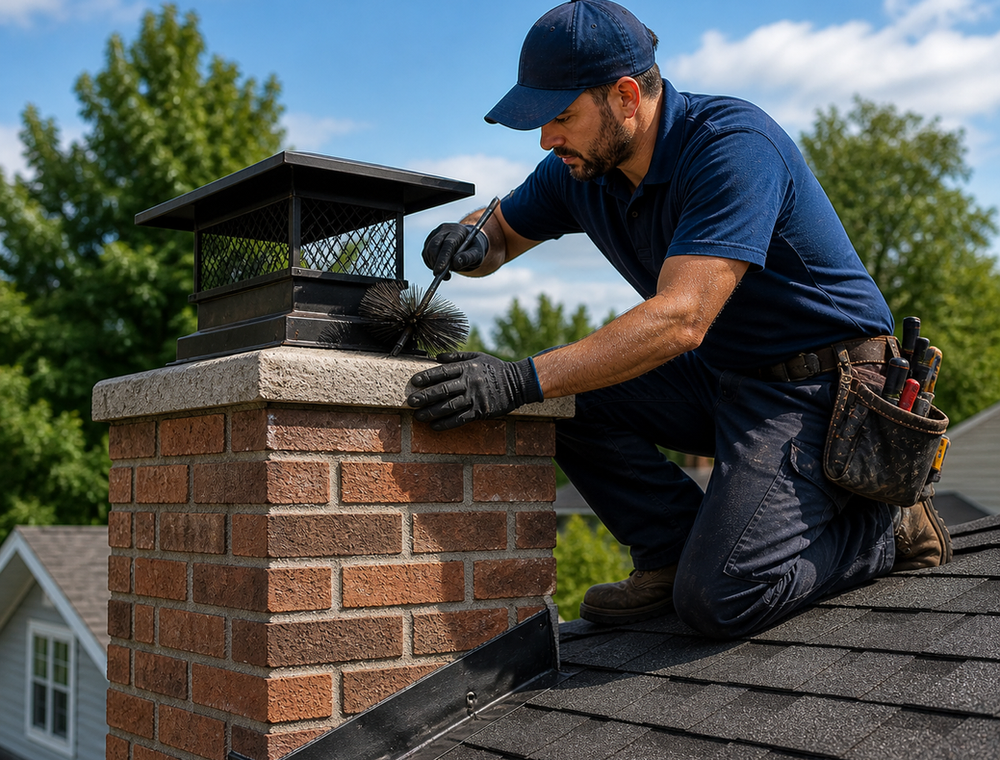
Short answer: The seven signs are spalling or flaking brick, open or crumbling mortar joints, a cracked chimney crown, persistent efflorescence, a visibly leaning stack, a rusted damper or cap, and interior water stains near the chimney. Each traces back to water getting into masonry that was built to shed it, usually starting at one failed detail rather than the whole chimney at once.
Why Small Chimney Problems Turn Into Big Ones Over a New Jersey Winter
A masonry chimney is built to shed water, and every sign in this guide starts with water finding a way past that system at one specific point. Northern New Jersey’s freeze-thaw cycle turns a small crack into a bigger one every winter, because water that gets into brick or mortar expands when it freezes and pries the masonry apart from the inside.
Chimneys look permanent, which is exactly why homeowners tend to notice damage only after it has been developing for a season or more. The brick and mortar are doing constant, quiet work shedding rain and snowmelt off the stack, and a single failed joint, crack or flashing detail is enough to let water in behind that defense.
The Office of the New Jersey State Climatologist at Rutgers notes that Northern New Jersey’s average winter temperatures run more than ten degrees Fahrenheit colder than the coastal zone, with the last spring frost typically not clearing until early May. That is a long freeze-thaw season for water trapped in masonry to keep expanding and contracting, which is why a hairline crack that would sit quietly in a milder climate can visibly widen here within a year or two.
None of the seven signs below require a homeowner to climb on the roof. Most are visible from the ground or the attic, and each one below names what it looks like, what usually causes it, and what fixing it involves.
Spalling Brick and Open Mortar Joints
Spalling is brick face cracking, popping off or crumbling into flakes, while open mortar joints show as crumbling, recessed or missing mortar between bricks. Both are freeze-thaw damage: water gets into the masonry through a failed joint or coating, freezes, expands, and physically breaks material apart from the inside over repeated winters.
| Sign | What causes it | Typical fix |
|---|---|---|
| Spalling brick | Water trapped inside the brick freezes and pops the face off | Individual brick replacement, or a rebuild if it has spread across several courses |
| Open or crumbling mortar joints | Original mortar has weathered past its service life, or water is entering through a joint above | Repointing with mortar matched to the original hardness and color |
Mortar joints are meant to be the sacrificial part of a masonry chimney. They are built softer than the brick on purpose, so weathering wears the joint down instead of cracking the brick itself. Once a joint has crumbled past a certain point, water bypasses that sacrificial layer and starts working directly on the brick.
Why the repair mortar has to match
Repointing with a mortar harder than the surrounding brick does more damage than the crumbling joint it replaces, because a stronger patch will not flex with the older, softer masonry around it under thermal movement. That mismatch concentrates stress at the edges of the new mortar, which is how a well-intentioned repair starts a new spalling problem a few feet away. See our chimney repointing and repair page for how that matching process works.
A Cracked Chimney Crown Lets Water In Every Time It Rains
The crown is the sloped concrete or mortar cap at the very top of the chimney, and it is the hardest-working water-shedding surface on the whole stack. A hairline crack lets water straight into the brick below it every time it rains, which makes crown repair one of the highest-priority fixes on an aging chimney.
A properly built crown overhangs the brick on all sides and slopes away from the flue, so water drips clear of the chimney face instead of running down it. A crown that has cracked, gone flush with the brick, or was never built with a proper overhang sends water straight down the outside of the stack and into the top course of masonry with every storm.
- A crown that is cracked but structurally sound can often be sealed and coated.
- A crown with a failed surface but intact structure can be resurfaced.
- A crown that has failed structurally, or lacks a proper slope and overhang, usually needs a full rebuild.
Under the 2021 IRC, adopted statewide in New Jersey, a masonry chimney cap must be sloped to shed water, which is the same principle a sound crown depends on. Left unaddressed, a cracked crown is one of the fastest routes to the spalling brick and open joints described above.
Efflorescence: When White Staining Means More Than a Cosmetic Problem
Efflorescence is the white, chalky deposit that appears when water carries dissolved salts to the brick surface and leaves them behind as it evaporates. New masonry can show a light bloom that weathers away within a year, but efflorescence that appears or returns well after that usually means water is getting into the wall somewhere and needs to be traced.
By itself, efflorescence is not structural damage. It is a moisture indicator, and treating it as purely cosmetic is the mistake that lets the actual problem run for another season or two. Persistent staining on a chimney that has been standing for years is worth investigating rather than pressure-washing away and forgetting about.
Why sealing over it can make things worse
Coating brick that is actively efflorescing, without first fixing the water intrusion behind it, can trap moisture and dissolved salts just below the surface instead of letting them evaporate. Those trapped salts can crystallize inside the masonry rather than on top of it, which is a mechanism that pushes the brick face apart from underneath rather than stops it. Finding and correcting the moisture source, whether that is a joint, the crown, or flashing, is the actual repair; removing the staining is the easy part people mistake for the fix.
A Leaning or Bulging Stack Is a Structural Sign, Not a Cosmetic One
A chimney that visibly leans away from the house, or shows a bulge along one face, points to a structural problem, most often a deteriorated or undersized foundation, corroded internal ties, or masonry that has lost so much mortar it can no longer carry itself plumb. This is the one sign on this list that should not wait for a convenient season.
A chimney is a tall, narrow masonry structure standing mostly free of the house it is attached to, and it depends on sound mortar and a stable base to stay plumb. Once enough joints have failed or the base has settled or eroded, the stack can begin to lean measurably, sometimes slowly enough that a homeowner only notices it by comparing old photos.
A leaning chimney is different from the other signs here because the failure mode is collapse, not just a leak. Wide stair-step cracks running through multiple courses, or masonry that has gone soft enough to press in with a hand, both point toward a partial or full chimney rebuild rather than a surface repair. If you notice a visible lean, treat it as worth a same-week inspection rather than something to schedule around.
A Rusted Damper or Chimney Cap
Rust on a metal damper or chimney cap means moisture has been reaching metal that is supposed to stay dry, usually because the crown, flashing or cap flashing above it has already let water in. A damper that will not close tightly, or a cap with visible corrosion or missing mesh, both need attention before the next heating season.
The damper sits directly in the flue’s airstream, and the cap sits at the very top of the chimney where it takes the brunt of weather. Both are metal in a location built to stay dry, so rust on either one is a signal that water is already getting past a detail above it, not a coincidence of age alone.
What a corroded cap risks
A chimney cap that has rusted through, or has mesh that has corroded open, stops doing the two things it is there for: keeping rain out of the flue and keeping animals from nesting in it. See our chimney cap installation page for what a proper replacement includes, and our deep chimney cleaning page if a damper that will not seal has let debris or creosote buildup go unnoticed.
Water Stains on the Ceiling or Wall Near the Chimney
A brown or yellow stain on a ceiling or wall where the chimney passes through the house almost always means water is getting past the flashing where the chimney meets the roof, not through the brick itself. This is frequently the first sign homeowners actually see, because it shows up inside the house rather than forty feet in the air.
By the time a stain is visible on drywall or plaster, water has usually been tracking down behind the chimney chase or along a rafter for a while. New Jersey’s residential code requires flashing at every roof-to-chimney intersection specifically to prevent this, and a stain near the chimney is the classic sign that the flashing or counterflashing at that joint has failed or was never installed correctly.
Because roofing and chimney work genuinely overlap at this detail, it is worth having both looked at together rather than assuming the stain means a roof leak unrelated to the chimney. Our companion guide on signs your chimney flashing is failing covers this specific failure point from the attic side in more depth.
Getting a Chimney Looked At Before the Next Storm
Any one of these seven signs is worth a hands-on inspection rather than a guess from the ground, because surface damage does not always match what is happening structurally underneath it. NJ Gold Star Construction inspects, diagnoses and repairs chimneys across Bergen and Passaic County with our own crew and a free written estimate before any work starts.
One recent customer summed up what that process looks like after a roof-and-chimney job: “NJ Gold Star, fixed part of my roof and rebuilt my Chimney as well. Fair price for both, the work was done on time and budget, no fuss and no mess.” — Walter G., Google review.
We repair and rebuild chimneys throughout the service area, including Totowa and Ridgewood, and our guide on why an annual chimney inspection matters covers how a routine check catches most of these signs before they reach this list. Request a free written estimate to get a chimney looked at properly.
Frequently asked questions
Can I repair spalling brick myself?
Individual brick replacement is possible for a handful of bricks on an otherwise sound chimney, but matching mortar hardness and color, and correctly tying new brick into the existing bond pattern, is easy to get wrong from a ladder. Spalling spread across multiple courses, or spalling combined with a lean, is a job for a hands-on inspection rather than a weekend project.
How much does chimney repair typically cost?
Cost depends heavily on which of these signs you have and how far the damage has spread — a few repointed joints is a different scope than a crown rebuild or a partial rebuild for a leaning stack. We do not publish general price ranges because every chimney is different; the real number comes from a free, itemized written estimate after an on-site inspection.
Is efflorescence dangerous if I just leave it?
Efflorescence itself is not structural damage, so leaving light, new-construction bloom alone is fine. Persistent or returning efflorescence on an older chimney is worth investigating, though, because it usually means water is entering the masonry somewhere, and that water is what eventually causes the spalling and joint failure that is genuinely damaging.
Can chimney repair work be done in cold weather?
Some of it. Cap and crown sealing, cap replacement, and flashing repair can typically proceed in cold weather. Mortar work is more temperature-sensitive, since repointing mortar needs to cure above freezing, so major repointing or rebuild work is often scheduled for milder stretches unless an active leak makes it urgent.
Do all these signs mean the same underlying problem?
Most trace back to water getting past one failed detail, but the specific detail differs: a crown crack, an open joint, failed flashing, or a foundation issue behind a leaning stack. That is why a hands-on inspection matters more than trying to diagnose from a single visible sign — the fix depends on finding where the water is actually getting in.
How urgent is a leaning chimney compared to the other signs?
More urgent. Spalling brick, efflorescence and a cracked crown are water-intrusion problems that get worse over seasons. A visible lean means the structure itself may be losing its ability to stand plumb, which is a different category of risk and worth a prompt inspection rather than scheduling around convenience.
Will homeowners insurance cover chimney repair?
It depends on the cause and your specific policy. Damage from a sudden event like a storm is more commonly covered than damage from gradual wear such as long-term freeze-thaw deterioration or age-related mortar failure. We provide a written estimate and photo documentation that homeowners commonly submit with a claim, but the coverage decision is between you and your insurer.
Sources
- Chapter 10 Chimneys and Fireplaces: New Jersey UCC One- & Two-Family Dwelling Subcode 2021 — UpCodes (New Jersey edition of the 2021 IRC)
- Chapter 9 Roof Assemblies: New Jersey UCC One- & Two-Family Dwelling Subcode 2021 — UpCodes (New Jersey edition of the 2021 IRC)
- Chapter 7 Wall Covering: New Jersey UCC One- & Two-Family Dwelling Subcode 2021 (Section R703.8) — UpCodes (New Jersey edition of the 2021 IRC)
- Overview of the Climate of New Jersey — Office of the New Jersey State Climatologist, Rutgers University
- Homeowner Resources — Chimney Safety Institute of America (CSIA)
Have a question about your own home? Call (862) 271-1225 or request a free written estimate.