Licensed & Insured — NJ HIC #13VH13359900
njgoldstarconstruction@yahoo.com · 24/7 Emergency · (862) 271-1225

Gutter Repair in Bergen County, NJ
Repair of sagging, leaking or overflowing gutters — reseating hangers, resealing seams and end caps, correcting pitch and replacing damaged sections.
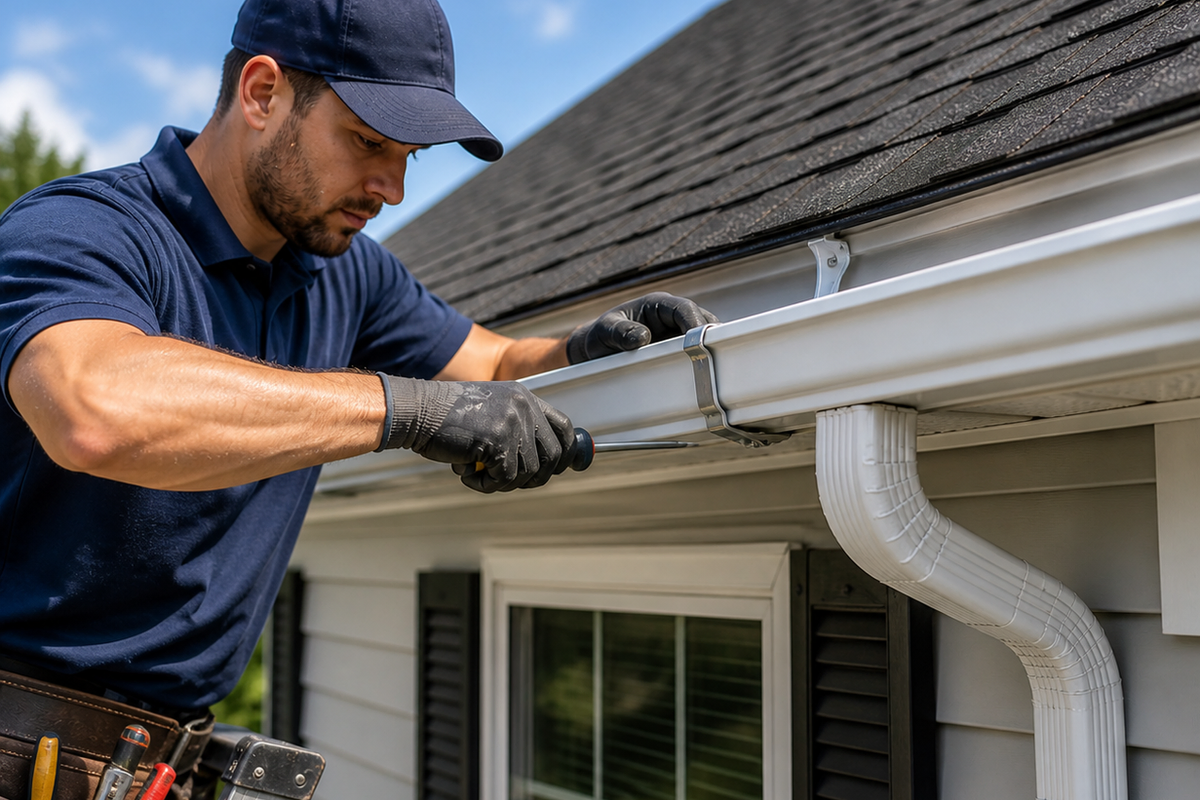
Most gutter problems are fixable. We reset and reseal before recommending replacement, and only replace runs that are dented, corroded or badly out of pitch.
This is one part of the gutters work we do across Bergen and Passaic County. Every job is quoted in writing after a hands-on inspection, performed by our own crew rather than subcontractors, and backed by our satisfaction guarantee. We are licensed under NJ HIC #13VH13359900 and fully insured.
What the work includes
- Hanger replacement and sag correction
- Seam, miter and end-cap resealing
- Pitch correction so nothing stands after rain
- Section and downspout replacement
What causes a gutter seam to start leaking?
Gutter seams leak most often because the original sealant has failed with age and thermal movement, because a corner miter was never properly soldered or sealed, or because standing water from bad pitch sits against the joint far longer than a properly sloped run ever would. A drip line at a seam almost always traces back to one of those three causes.
Seamless aluminum still has joints — at every corner, end cap and outlet, and wherever two lengths meet on a long run. Those are the points sealant is doing real work, and sealant is a wear item, not a permanent fix. Expansion and contraction through a New Jersey year, from summer heat on a south-facing run to winter cold, works the joint until the bead cracks.
- Failed sealant shows as a thin, steady drip at a corner or end cap, often worse right after rain starts before the trough fills enough to mask it
- A bad miter drips continuously along the seam line rather than at a single point
- Standing water from insufficient pitch soaks a joint that would otherwise stay dry between storms, so a leak that only shows up a day after rain usually means the slope, not the sealant, is the real problem
We reseal and re-set seams as standard repair work. A run with several failed joints spaced along its length usually means the original sealant or installation was the issue, not one bad spot — worth comparing against what a correct install looks like on our new gutter installation page, and against the warning signs in our article on signs of improper gutter installation in Passaic County.
Why do gutters sag or pull away from the fascia?
Gutters sag when hangers pull loose from the fascia board, most often because the wood behind them has softened from years of trapped moisture, because the original spacing was too wide for the load, or because a heavy buildup of wet leaves or ice added more weight than the hangers were ever set to carry. A sagging run rarely fixes itself and gets worse with the next storm.
A hanger only holds as well as the wood it is driven into. When a gutter has been overflowing for one season or several, water runs down the back of the fascia every time it rains, and the wood behind the hangers softens from the inside where nobody sees it until a section finally drops.
What we check before resetting hangers
- Whether the fascia is still solid enough to hold a new hanger, tested by hand pressure and, where doubtful, a probe
- Spacing — gutters hung on hangers set too far apart for the local snow and leaf load will sag again even on sound wood
- Whether the sag is isolated to one run (a hanger problem) or affects the whole gutter (usually a pitch or sizing problem from the original install)
Sound fascia gets new hangers on tighter spacing. Soft fascia gets replaced before any hanger goes back in — patching hangers into rotted wood is a repair that fails again within a season, and we say so in the written estimate rather than quoting a fix that will not hold. We see this pattern often on older homes around Hackensack and Fair Lawn, where decades-old fascia is a common reason a gutter that looks fine from the ground is quietly failing.
How do you know if fascia rot is more than a gutter problem?
Fascia rot has moved beyond a simple gutter fix when the wood is soft more than an inch or two deep, when rot has spread along several feet of board rather than staying local to one hanger, or when the soffit or roof sheathing above shows staining. At that point the repair scope grows from resetting a gutter to trim carpentry, and sometimes to work that touches the roof edge itself.
Fascia sits at the junction of the roof, the gutter and the wall, which means water damage there can point in three different directions. A small soft spot right under a leaking seam is usually just that seam’s fault. Rot running the length of a run, or staining on the soffit underneath, points further back — often years of overflow rather than one bad joint.
The Environmental Protection Agency’s guidance on moisture control is straightforward on this point: homeowners should clean and repair roof gutters regularly, because the water they mismanage does not stay at the roofline. It tracks down the fascia, behind the siding, and into the wall assembly below. Our siding repair page covers what that looks like once it reaches the wall, and foundation repair covers what it looks like once it reaches the ground.
We probe fascia as a standard part of every gutter repair estimate, not as an upsell added after the fact, and note the extent in writing before recommending trim work beyond the gutter itself.
What does a hard North Jersey winter do to a gutter run?
Winter damages gutters mainly through ice: a trough packed with frozen slush gains enough weight to pull hangers loose, ice that forms along the front lip can bend or split it, and ice dams built up at the roof edge add standing meltwater behind the ridge that eventually finds a seam. Damage that shows up every spring in the same spot usually has an ice cause, not a summer one.
Ice dams are not a gutter problem at the source — the Insurance Institute for Business & Home Safety explains they form when heat leaking into the attic melts snow on the roof deck, which refreezes into a ridge right at the cold overhang above the gutter line. But the gutter takes the physical load. A trough already holding slush when that ridge builds gets the full weight of ice on top of standing water, and something usually gives: a hanger pulls, a seam splits, or the front lip bends outward.
A late-fall gutter cleaning reduces how much ice has a chance to build in the trough itself, though it does not address the attic heat loss that causes the dam. That fix is covered on our attic ventilation page. Spring is when winter’s toll on gutters usually shows up as a repair call, once the ice that was masking a bent section or pulled hanger finally melts. If a run has already been damaged, our contact page is the fastest way to get a written repair estimate before the next storm.
Repair or replace: how the decision actually gets made
A gutter is worth repairing when the damage is isolated — a few loose hangers, one or two leaking seams, a short dented section — and the material underneath is sound. Replacement makes more sense once corrosion has gone through the metal, sagging affects most of a run, or the sizing was wrong from the start and no amount of resealing will fix an undersized trough.
| What you see | Likely cause | Usually fixed by |
|---|---|---|
| Drip at one corner or end cap | Failed sealant | Reseal and reset the joint |
| Sagging in one short section | Loose or too-widely-spaced hangers on otherwise sound fascia | Reset hangers on tighter spacing |
| Rust spots or pinholes in steel gutter | Corrosion through the coating | Patch small spots; replace the run once it is widespread |
| Whole run pitched wrong, overflows every storm | Original sizing or installation error | Usually replacement, sized correctly |
| Soft, spongy fascia along most of a run | Long-term overflow damage to the wood, not just the gutter | Fascia repair first, then new gutter, not a reset on rotted wood |
We do not default to replacement because it is the larger job. Most of the repair calls we get are fixable, and the written estimate says so plainly, with repair and replacement listed as separate priced options rather than one recommendation. The deciding factor is almost always the condition of what the gutter is attached to — sound fascia and metal that has not corroded through are worth saving; wood and metal that have not are not.
Related gutters services
Hand-cleaning of gutters and downspouts, flush-testing every outlet, and a check of hangers, sea…
Seamless aluminum, copper or vinyl gutters formed on site, sized and pitched to the roof area th…
Gutter guard installation matched to your debris load, from micro-mesh for pine needles and shin…
Simple, cost-effective gutter screens that keep leaves and twigs out of the trough while staying…
Frequently asked questions
My gutter overflows only in heavy rain — is it clogged?
Sometimes, but often it is undersized trough or too few downspouts for the roof area. We measure before recommending a fix.
Can a rusted steel gutter be repaired?
Small spots can be sealed, but corroded steel is at the end of its life. Seamless aluminum is usually the better spend.
Can a small section of gutter be replaced without redoing the whole run?
Often yes, if the damaged section is isolated and the seamless run can be cut and rejoined cleanly, or if the damage sits near a natural break like a corner or outlet. A full reformed seamless section usually looks and performs better than a patched-in piece from stock material, so we weigh both against the visible seam it leaves.
Does storm damage to gutters usually involve an insurance claim?
Sometimes, particularly after a named storm with wind or hail. We provide a written, itemized estimate and photos that a homeowner can submit to their insurer, but we do not handle the claim itself — that conversation stays between the homeowner and their insurance company.
Will resealing a leaking seam actually last?
A properly cleaned and resealed seam on sound metal typically holds for several years, but it is not permanent — sealant is a wear item that moves with the metal through every seasonal cycle. A seam that fails again within a year usually means the underlying miter or pitch needs correcting, not just another bead of sealant.
Is a gutter repair covered by NJ Gold Star's workmanship guarantee?
Yes. Repair work is backed by our satisfaction guarantee on workmanship the same as new installation. If a hanger we reset pulls loose or a seam we resealed reopens under normal conditions, that is a callback, not a new invoice.
- Gutters and Downspouts — U.S. Department of Energy, Building America Solution Center (PNNL)
- A Brief Guide to Mold, Moisture and Your Home — U.S. Environmental Protection Agency
- Ice Dams: Prevent Them and Your Roof Will Thank You — Insurance Institute for Business & Home Safety
Updated September 2026 · Reviewed by Edgar Lopez Gonzalez, owner · NJ HIC #13VH13359900
Licensed & insured. 25+ years in North Jersey. We answer 24/7 for leaks and storm damage.
- Service
- Gutter Repair
- Category
- Gutters
- Service area
- Bergen & Passaic County and surrounding North Jersey
- License
- NJ HIC #13VH13359900