Licensed & Insured — NJ HIC #13VH13359900
njgoldstarconstruction@yahoo.com · 24/7 Emergency · (862) 271-1225

Roofing Contractors in Bergen County, NJ — Repair & Replacement
NJ Gold Star Construction repairs and replaces asphalt shingle, flat and metal roofs across Bergen and Passaic County. Most repairs are completed in a single visit and full replacements in one to three days. Estimates are free and written, and we answer emergency leak calls 24/7.
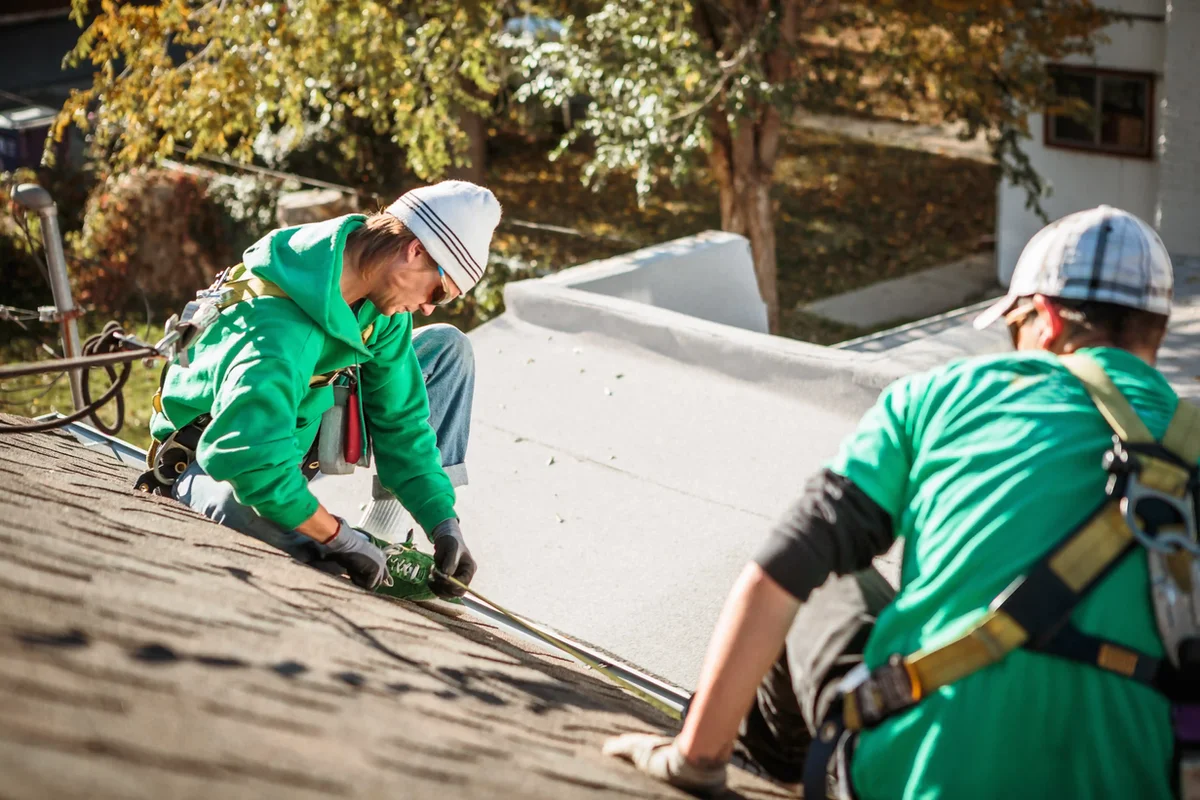
Your roof is the one system on the house that fails invisibly. Water finds a gap at a flashing joint or a lifted shingle, travels along the sheathing, and shows up as a ceiling stain three rooms away. By then the repair is no longer a roofing job — it is drywall, insulation and sometimes framing.
We inspect the whole assembly before quoting: shingle condition and granule loss, valleys and step flashing, chimney counterflashing, pipe boots, ridge and soffit ventilation, and the deck itself where we can see it. Then we tell you plainly whether a repair holds or whether the roof has reached the end of its service life.
Every roof we install is built for North Jersey weather — ice-dam protection at the eaves, synthetic underlayment, properly nailed architectural shingles, and balanced attic ventilation so the deck stays dry through freeze-thaw season.
What the work includes
- Roof repair for leaks, missing shingles, flashing failures and storm damage
- Full roof replacement with tear-off, deck inspection and new underlayment
- Attic intake and ridge ventilation to stop condensation and ice dams
- Flat and low-slope roofing for additions, porches and dormers
- 24/7 emergency tarping and leak containment
Roofing services for Bergen and Passaic County homes
NJ Gold Star Construction is a roofing contractor in Bergen County, NJ, offering four core roofing services: leak and storm repair, full tear-off replacement, attic ventilation, and scheduled roof maintenance. Each service starts with an on-site inspection and a free written estimate, and our own crew does the work from Totowa to the Hudson County line.
A roof is a system, so the services overlap. A leak call often turns up a ventilation problem, and a replacement is the right moment to fix intake at the soffits. Here is how the work divides:
- Roof repair for active leaks, wind-lifted or missing shingles, failed pipe boots, and step or valley flashing.
- Roof replacement with tear-off to the deck, sheathing repair, ice barrier at the eaves and new flashing throughout.
- Attic ventilation sized to the attic floor area, with soffit intake balanced against ridge exhaust.
- Roof maintenance visits that catch loose flashing, clogged valleys and moss before they become ceiling stains.
Roof leaks rarely stop at the shingles. Where a chimney passes through the roof, the counterflashing and crown are part of the same water path, so we handle chimney repair alongside the roofing. The same goes for the edge of the roof: gutters that overflow push water behind the fascia and into the eave, which is why a roofing inspection includes a look at the gutter system.
Repair or replace: how to make the call on a North Jersey roof
Whether to repair or replace a roof in North Jersey depends on how widespread the damage is, the condition of the deck, how many shingle layers are already on the house, and whether leaks trace to one detail or to many. Isolated flashing or shingle damage is usually a repair; wear across every slope points to replacement.
| What we find | Repair usually holds | Replacement usually makes sense |
|---|---|---|
| Leak source | One penetration, one wall or one valley | Several unrelated leak points on different slopes |
| Shingle surface | A few creased, torn or missing tabs | Granule loss, curling and brittle tabs on most slopes |
| Existing layers | Single layer in sound condition | Two layers already, which rules out another roof-over |
| Roof deck | Firm underfoot with one small soft spot | Soft or delaminated sheathing in multiple areas |
| Ice dam leaks | Eave leak with ventilation that can be corrected | Repeat eave leaks and no ice barrier under the shingles |
The layer count matters more than most homeowners expect. Under the International Residential Code that New Jersey adopts, a new roof cannot go over an existing roof that is water soaked, deteriorated, or already carries two or more applications of roof covering. At that point a tear-off is the only code-compliant path. Budget questions come next, and our guides to roof repair costs in New Jersey and roof replacement costs in New Jersey explain what drives each number. The figure for your house comes from a free written estimate.
How North Jersey weather wears down a roof
North Jersey roofs take snow, repeated freeze-thaw cycles and frequent summer thunderstorms. The Office of the New Jersey State Climatologist reports that the state’s Northern climate zone averages 40 to 50 inches of snow a year and sees about twice as many thunderstorms as the coastal zone, so roofs here need ice protection and wind-resistant installation.
Winter damage usually starts in the attic, not on the shingles. Heat leaking up from the living space melts the underside of the snow, the meltwater runs down to the cold overhang, and it refreezes into an ice dam. The U.S. Department of Energy’s Building America Solution Center notes that ice dams can form with as little as 2 inches of snow on a roof. Water backed up behind the dam works under shingles that were only designed to shed water running downhill.
Defenses that work together
- Ice barrier. The New Jersey edition of the residential code describes an ice barrier of self-adhering polymer-modified bitumen, or two cemented layers of underlayment, running from the eave to at least 24 inches inside the exterior wall line.
- Air sealing and ventilation. Stopping warm air at the ceiling and moving outdoor air through the attic keeps the deck cold. Our attic ventilation work covers both halves.
- Clear drainage. Gutters packed with leaves hold slush at the eave exactly where the dam forms.
Summer brings the other half of the problem: thunderstorm gusts that break the seal strips on older shingles, and falling limbs from the mature trees common across Bergen and Passaic County.
Roofing materials we see on Bergen County homes
Most Bergen County houses are roofed with asphalt architectural shingles, with low-slope membranes on porches, dormers and additions and metal on some accent areas. The National Roofing Contractors Association notes that asphalt shingles hold an overwhelming share of the U.S. steep-slope market, while slate and tile demand specialized installation and structural checks.
| Material | Where it fits | What to check first |
|---|---|---|
| Asphalt architectural shingles | Most pitched roofs on single-family homes | Wind rating, nailing pattern and ventilation requirements |
| Low-slope membrane | Porches, dormers and additions below 2:12 pitch | Drainage, seams and flashing at the house wall |
| Metal roofing | Accent roofs, porches and some full roofs | Panel attachment, fastener type and snow retention near walkways |
| Slate | Older houses built with it originally | Specialized repair skills; slate cannot be roofed over |
| Clay or concrete tile | Select architectural styles | Framing must be verified for the added weight |
Asphalt shingles are only allowed on slopes of 2:12 or steeper under the residential code, and slopes between 2:12 and 4:12 need a double underlayment. Anything flatter needs a membrane system instead. NJ Gold Star installs and repairs asphalt shingle, flat and metal roofs. For a deeper comparison of looks, weight and service life, read our guide to roofing materials for New Jersey homes.
How to vet a roofing contractor in New Jersey
To vet a roofing contractor in New Jersey, confirm the company’s Home Improvement Contractor registration with the NJ Division of Consumer Affairs, ask for proof of liability insurance, and insist on a written contract. State consumer guidance says contracts over $500 must be written and include the contractor’s registration number, a start date, completion date and total price.
The Division of Consumer Affairs consumer brief on hiring home improvement contractors lays out the protections every New Jersey homeowner has:
- Unregistered contractors cannot be issued municipal construction permits.
- You can cancel a signed contract for any reason before midnight of the third business day after you receive a copy.
- Be wary of any contractor asking for more than a third of the price before work begins, or demanding cash.
- Final inspections, where a permit applies, must be completed before final payment.
The National Roofing Contractors Association adds two practical checks: ask who will supervise the job and how many workers will be on site, and keep a healthy skepticism about the lowest bid. NJ Gold Star is registered under NJ HIC #13VH13359900, carries insurance, and quotes every job in writing. Our longer checklist on how to choose roofing contractors in New Jersey walks through the questions to ask at the estimate.
What to expect from first call to finished roof
A roofing project with NJ Gold Star Construction follows five steps: a call or text to (862) 271-1225, an on-site inspection of the roof and attic, a free itemized written estimate, the scheduled work by our own crew, and a cleanup and walk-through before we leave. Emergency leaks are tarped first and quoted after.
Homeowners notice the communication as much as the roofing. As one customer put it after a roof repair and chimney rebuild:
“the work was done on time and budget, no fuss and no mess.” — Walter G., Google review
We work across North Jersey, from roofing in Totowa to roofing in Hackensack. When you are ready, request a free estimate.
Call or text
Describe the problem and where you see water or damage. Active leaks get tarping priority, 24 hours a day.
Inspection
We walk the roof where it is safe, check flashing, valleys, penetrations and ventilation, and look at the attic side of any stain.
Written estimate
You receive an itemized scope that says whether the roof needs a repair or a replacement and why.
The work
Our own crew protects landscaping, completes the scope and replaces any rotted sheathing found once the old roofing is off.
Cleanup and walk-through
Debris is removed, the yard and driveway are magnet-swept for nails, and we review the finished work with you.
Roofing services we provide
Same-week roof repair for leaks, wind-lifted shingles, failed flashing and storm damage across B…
Full tear-off roof replacement with deck inspection, ice and water shield, synthetic underlaymen…
Balanced attic ventilation — ridge vent, soffit intake and box or powered vents — to clear moist…
Annual roof inspection and maintenance — sealing exposed fasteners, resetting flashing, clearing…
Frequently asked questions
How much should you expect to pay for roof repair in NJ?
Small repairs — a pipe boot, a section of step flashing, a dozen blown shingles — typically fall in the low hundreds. Larger repairs involving valleys, chimney flashing or deck replacement run higher. We quote in writing before any work starts, with the scope itemized so you can see what you are paying for.
Is it better to repair my roof or replace it?
Repair when the roof is under roughly fifteen years old and the damage is isolated. Replace when there are multiple leak points, widespread granule loss, curling or cupping shingles, or a second layer already on the deck. We give you the honest call either way, in writing.
How long does a typical roof replacement take?
Most single-family homes in Bergen County are torn off and re-roofed in one to three days, weather permitting. Complex rooflines, multiple old layers, or deck repairs can add a day.
Do you install and repair flat or low-slope roofs?
Yes. NJ Gold Star Construction repairs and installs flat and low-slope roofing on porches, dormers and additions in Bergen and Passaic County. Asphalt shingles are only permitted on slopes of 2:12 or steeper, so flatter sections need a membrane system with sealed seams and proper flashing where the low roof meets the house wall.
What should a written roofing estimate include?
A written roofing estimate should name the contractor’s legal business name and New Jersey HIC registration number, describe the scope slope by slope, list the materials, explain how rotted decking will be handled and priced, and give start and completion dates and a total price. New Jersey requires written contracts for home improvement work over $500.
What time of year is best for roofing work in North Jersey?
Late spring through fall is the easiest window for a full roof replacement in North Jersey, because shingle seal strips bond best in warm sun and long dry stretches are more common. Repairs and emergency tarping happen year-round. A winter leak should never wait for spring, since water in the deck and insulation keeps spreading.
- Overview of the Climate of New Jersey — Office of the New Jersey State Climatologist, Rutgers University
- Attic Air Sealing, Insulating, and Ventilating for Ice Dam Prevention — U.S. Department of Energy, Building America Solution Center (PNNL)
- Chapter 9 Roof Assemblies: New Jersey UCC One- & Two-Family Dwelling Subcode 2021 — UpCodes (New Jersey edition of the 2021 IRC)
- R908.3.1.1 Roof Recover Not Allowed (2021 IRC) — UpCodes
- Roofing Materials — National Roofing Contractors Association
- Hiring Home Improvement Contractors (consumer brief, revised 01/13/25) — New Jersey Division of Consumer Affairs
- Selecting a Contractor — National Roofing Contractors Association
Updated September 2026 · Reviewed by Edgar Lopez Gonzalez, owner · NJ HIC #13VH13359900
Licensed & insured. 25+ years in North Jersey. We answer 24/7 for leaks and storm damage.
- Service area
- Bergen, Passaic, Essex, Hudson, Morris & Union County, NJ
- License
- NJ HIC #13VH13359900
- Estimates
- Free, written and itemized
- Emergency
- 24/7 response for active leaks and storm damage