
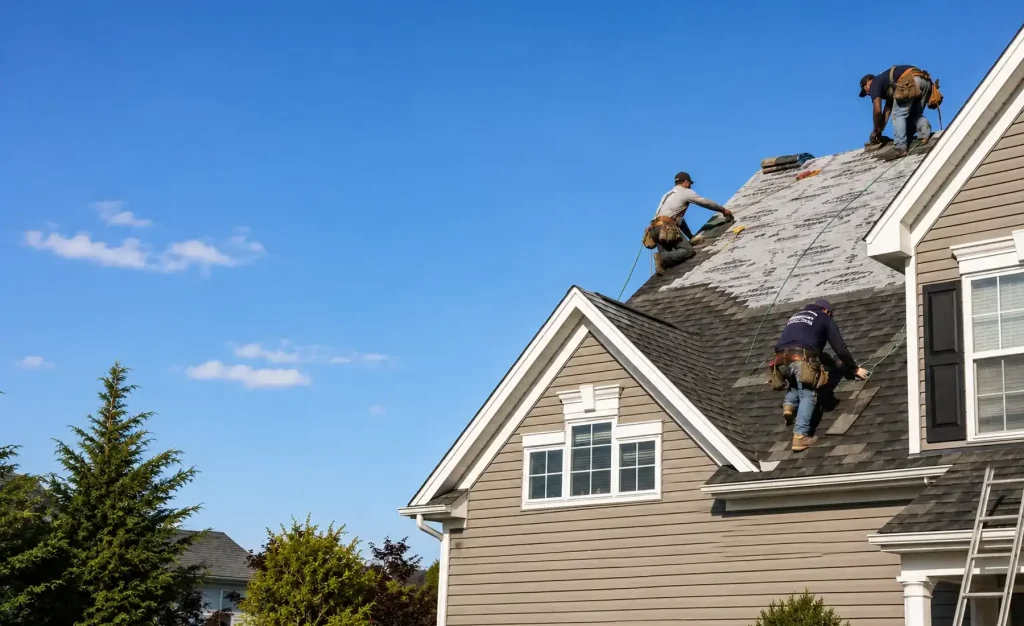
Short answer: Most New Jersey roofs are asphalt shingle, and for most houses that’s still the right choice. Metal, wood, slate, synthetic slate and clay or concrete tile are the alternatives, and the decision between them usually comes down to weight and what your existing roof frame can carry, not just looks or price.
Why Weight Decides More Than Looks Do
Roof covering weight, measured in pounds per square foot, is the variable that actually limits material choice on most New Jersey homes, because heavier materials like slate and tile weigh several times what asphalt shingles do. A house framed for a light covering can usually take a heavier shingle or metal without structural work; slate and tile are a structural decision, not a finish decision.
| Material | Relative weight | What it means for your frame |
|---|---|---|
| Asphalt shingles | Lightest | Fits almost any existing roof frame without structural review |
| Wood shakes | About 5x asphalt | Usually fine on standard framing; confirm on an older home |
| Synthetic slate / composite | Light to moderate | Engineered specifically to mimic slate without slate’s structural demands |
| Light-weight tile | About 7x asphalt | Often needs a structural check before installation |
| Natural slate or clay/concrete tile | Up to 9x asphalt | Needs an engineer’s review of the existing frame before anyone quotes a price |
Most roofing guides lead with looks. We lead with weight, because it’s the variable that actually rules materials in or out before appearance ever enters the conversation. HUD’s Residential Structural Design Guide documents this gap directly: composition asphalt shingle roofing is the lightest common covering, while clay or concrete tile roofing runs several times heavier, and the U.S. Department of Energy makes the practical point that tile roofing “requires roof framing and sheathing that are structurally adequate to support the weight.”
The honest version of “what roof should I get” starts here: a house framed for a light covering can usually take a heavier architectural shingle or a metal roof without any structural work. Moving to slate or tile is a decision for a structural engineer, not a contractor’s estimate alone.
How Long Each Covering Actually Lasts, According to HUD
HUD’s published service-life data is more conservative than the figures the roofing trade often quotes, putting composition shingle roofing in a 15-to-30-year range, metal standing seam higher, and slate at the top of the range among common coverings. The gap between HUD’s figures and trade marketing is worth understanding before you budget a replacement cycle.
| Covering | HUD estimated service life |
|---|---|
| Composition (asphalt) shingle, 3-tab or architectural | 15-to-30-year range |
| Wood shingle | 15-to-30-year range |
| Metal, standing seam | Multiple decades, often well beyond 50 |
| Concrete or clay tile | 50 years and up |
| Slate | 50-to-100-year range |
HUD’s Durability by Design guide states its own methodology: estimates drawn from industry data plus a published study of the life expectancy of home components. Two things stand out. First, HUD is more conservative than widely circulated trade charts, which tend to run longer and rarely cite a source. Second, HUD does not separate architectural shingles from 3-tab; both fall under “composition shingle.” Plenty of marketing claims architectural shingles last far longer than 3-tab, and we could not find an authoritative published source for that specific figure. The real, documented advantage of architectural shingles is wind resistance and warranty terms, not a proven longer lifespan.
The 10 Roofing Materials at a Glance
Three-tab and architectural asphalt shingles remain the practical default for most New Jersey roofs; metal, wood, slate, synthetic slate and clay or concrete tile each solve a different problem, from snow shedding to a historic look, at a different weight and cost position. Impact-resistant shingles and metal panel systems round out the list as variations worth understanding on their own terms.
| Material | Why homeowners choose it | What to verify first |
|---|---|---|
| Three-tab asphalt shingles | Lowest cost, lightest, easiest to repair | Weaker wind performance than architectural |
| Architectural shingles | The default for most re-roofs now | Wind class rating and correct nailing for your pitch |
| Impact-resistant (Class 4) shingles | Added resistance to hail impact | Ask your insurer directly whether any discount applies |
| Standing seam metal | Sheds snow well, light enough for most framing | Panel attachment method and installer experience |
| Metal shingles and panels | Metal’s look at a lower install cost than standing seam | More fasteners than standing seam means more penetrations to maintain |
| Wood shingles and shakes | A traditional cedar look | Weight versus asphalt, maintenance, and local fire-code rules |
| Natural slate | The longest-lived option in the HUD data | Structural review; slate cannot be roofed over later |
| Synthetic slate / composite | Slate’s look without slate’s weight | Newer products with less long-term field data than the marketed lifespan |
| Clay tile | Long-lived and distinctive on the right architectural style | Heaviest common option; fewer local installers for repairs |
| Concrete tile | Tile’s look at a lower weight and cost than clay | Still several times heavier than asphalt |
Positions on cost generally track this same order, cheapest first: three-tab asphalt, architectural asphalt, impact-resistant asphalt, metal shingles and panels, wood, synthetic slate, standing seam metal, then concrete and clay tile and natural slate at the top. Roof complexity, pitch and access move the number for any material, so treat this as a way to shortlist two or three options, then get a firm estimate on those.
Impact Ratings: What Class 4 Actually Tells You
Impact-resistant shingles are tested under UL 2218, with Class 4 the top rating. Testing by the Insurance Institute for Business & Home Safety found that even rated products can fail at repeat-strike locations under harder-than-standard test conditions, which means the rating describes performance under a specific protocol, not a guarantee against every hailstorm.
A Class 4 rating is a real, tested improvement in impact tolerance, and it’s worth understanding precisely rather than treating it as a guarantee. IBHS testing found that products, rated or not, showed at least one repeat-strike (double impact) location failing beyond Class 2 impacts, a harder condition than the standard single-impact test most ratings are based on. That’s a nuance, not a reason to dismiss the rating; it just means a Class 4 shingle is a genuine upgrade, not insurance against every possible storm.
Whether impact-resistant shingles earn you an insurance discount depends entirely on your carrier; ask directly rather than assuming, since we could not verify a statewide New Jersey mandate either way.
Do You Need a Permit to Replace a Roof in New Jersey?
For a detached one- or two-family home in New Jersey, re-roofing is classified as ordinary maintenance and does not require a permit, including stripping to the sheathing or adding a second layer. Townhouses and condos do need one, and replacing the sheathing itself always requires a permit regardless of building type.
New Jersey’s Department of Community Affairs states this plainly: re-roofing on detached one- or two-family dwellings, including accessory buildings like garages and sheds, does not require a permit, and that covers stripping down to the existing sheathing or adding a second layer of covering. The underlying regulation classifies ordinary roof covering repair or replacement on these homes as maintenance that can proceed without a permit application.
Two qualifiers matter. Townhouses and condos are not covered by that exemption. And separately, the code caps how many layers can be stacked: once a roof already carries two layers of any covering, a third is not allowed, and a full tear-off replacement is required instead of another layover. Confirm with your municipal construction office before work starts regardless, since the code exemption doesn’t override a historic district, zoning or an HOA.
How to Actually Choose a Roofing Material
Work through roof material choice in order: what your frame can carry, how long you plan to own the house, how much snow your specific roof sees, what the wind and fire ratings say, who can service the material locally in ten years, and only then, appearance. The early questions eliminate options; the later ones are preference.
Material choice is mostly determined by the house: what the frame can carry, what the roofline does with snow and water, and what’s already up there now. Anyone recommending a material before they’ve been on your roof is selling, not advising.
- Confirm what your frame can carry. If slate or tile appeals to you, this is the first question, and it needs a structural engineer, not a sales conversation. Most materials under wood-shake weight are fine on existing framing.
- Think about how long you’ll own the house. A shorter service-life covering makes sense differently on a house you’ll sell in a decade than on one you plan to stay in long-term.
- Ask about wind and fire ratings specifically. Ask for the rating standard by name, not just “wind rated,” and confirm it against your roof’s actual exposure and height.
- Consider who can repair it locally later. A material with local crews who service it is worth more in practice than the spec sheet alone suggests.
Getting a Recommendation for Your Roof
NJ Gold Star Construction installs and repairs asphalt, metal and low-slope roofing across Bergen and Passaic County, and every recommendation starts with a hands-on inspection, not a guess from a brochure. A free written estimate names the material, the scope and the price before any work begins.
If you’re not sure whether your roof needs a material change or just a repair, start with the signs first: our guide to the 10 signs you need a new roof in NJ covers what to look for before you commit to a material decision at all. When you’re ready to talk specifics, see our roof replacement page or request a free estimate and we’ll walk the roof with you, including homes in Wayne and Hawthorne.
Frequently asked questions
Do I need a permit to replace a roof in New Jersey?
Not for a detached one- or two-family home, including accessory buildings like garages and sheds. New Jersey classifies re-roofing on these homes as ordinary maintenance, which covers stripping to the sheathing or adding a second layer. Townhouses and condos do need a permit, and replacing the sheathing itself always requires one.
Which roofing material lasts the longest?
Slate, in a 50-to-100-year range per HUD’s published data, followed by concrete and clay tile at 50 years and up, and standing seam metal beyond that. Whether slate or tile is actually an option for your house is a structural question first, since both weigh several times what asphalt shingle does.
How long do asphalt shingles actually last?
HUD’s service-life data puts composition shingle roofing, which covers both 3-tab and architectural products, in a 15-to-30-year range. Longer figures circulate widely for architectural shingles specifically, but we could not find an authoritative published source backing that separate, longer number.
Are architectural shingles worth paying more for than 3-tab?
Usually yes, though not for the reason most often given. No authoritative source documents a longer service life for architectural shingles over 3-tab. The real, documented advantages are better wind resistance and typically stronger warranty terms, and the price gap on a full re-roof is generally modest.
How many layers of roofing can a New Jersey roof have?
Two. Once a roof already carries two layers of any covering, adding a third is not allowed under the code New Jersey has adopted, and the roof has to come off down to the deck for the next replacement rather than being roofed over again.
Is metal roofing a good choice for New Jersey snow?
Metal sheds snow better than shingle roofing, which is most useful in the state’s snowier northern and higher-elevation areas. It’s also light enough for most existing framing to carry without structural changes, unlike slate or tile.
Do impact-resistant shingles get you a discount on New Jersey homeowners insurance?
It depends entirely on your carrier; we could not verify a statewide mandate requiring a discount either way. Ask your insurance company directly whether Class 4 impact-resistant shingles qualify for a premium reduction on your specific policy before assuming one applies.
Sources
- Durability by Design: A Professional’s Guide to Durable Home Design, 2nd ed. — U.S. Department of Housing and Urban Development
- Residential Structural Design Guide — U.S. Department of Housing and Urban Development
- R908.3.1.1 Roof Recover Not Allowed (2021 IRC) — UpCodes
- Construction Code Communicator, Vol. 31 No. 3, Fall 2019 — New Jersey Department of Community Affairs
- N.J.A.C. 5:23-2.7, Ordinary Maintenance — New Jersey Department of Community Affairs, Division of Codes and Standards
- Relative Impact Resistance of Asphalt Shingles: Summary of UL 2218 Impact Tests — Insurance Institute for Business & Home Safety (IBHS)
- Roofing Materials — National Roofing Contractors Association
Have a question about your own home? Call (862) 271-1225 or request a free written estimate.