
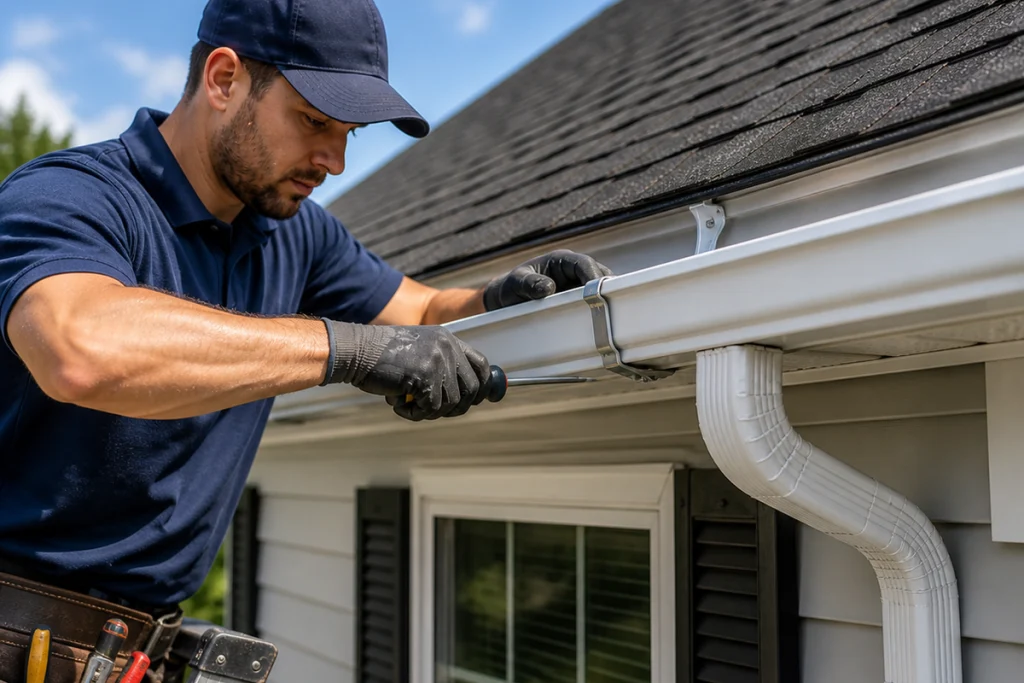
Short answer: Overflowing gutters in ordinary rain, a run pulling away from the fascia, standing water after the rain stops, and downspouts discharging within a few feet of the foundation are the clearest signs of an installation error rather than a worn-out material. Slope, hanger spacing and downspout placement are the specs that decide whether a gutter system works, and all three are set the day it goes up.
Why Installation Errors Show Up Faster in Passaic County
A gutter is a drainage appliance with a throughput limit, and Passaic County’s Northern New Jersey climate zone gives that limit less margin than a milder area would. The Office of the New Jersey State Climatologist notes the Northern zone sees roughly twice as many thunderstorms as the coastal zone, and winter freeze-thaw cycling works on any standing water an undersized or badly pitched system leaves behind.
The question that matters is not whether a gutter looks straight from the driveway, but whether it can move the volume of water this county actually drops on a roof. Installation errors that a drier climate might tolerate for years tend to surface here within the first hard autumn or winter.
Older housing stock compounds the problem. Fascia boards on a house built decades ago have often been drilled, patched and re-hung more than once by the time a new gutter system goes up, and a hanger driven into wood that soft will let go under load well before its rated service life. Volume, age and the river-valley terrain across Passaic County all push in the same direction: a marginal installation fails here sooner than the national averages suggest.
Overflow, Sagging Runs and Seam Leaks
Water spilling over the front lip during ordinary rain, a run that dips or has pulled away from the fascia, and drips at a corner miter or end cap are the three most visible installation failures. Each traces back to a different fitting error: insufficient slope or capacity, hangers set too far apart or into rotted wood, and a sealing or overlap error at assembly.
Overflow in a garden-variety downpour, not just a storm, is the clearest signal there is. The usual causes are insufficient slope, a trough undersized for the roof area feeding it, or too few downspouts across a long run.
Sagging and seam leaks
A gutter that dips in the middle or has separated from the fascia is almost always a fastening problem: hangers set too far apart, driven into rotted wood, or fixed into the shingle course rather than solid fascia. The failure compounds, since water collects at the low point instead of draining, and the added weight widens the gap. Small leaks at a corner or end cap look harmless because the volume is small, but they discharge in the same spot every time it rains, which is exactly how a localized soft patch develops in the soil against a foundation wall.
Standing Water, Foundation Pooling and Downspout Placement
Water still sitting in the trough well after the rain ends means the run is not pitched correctly, and a gutter should empty itself. Puddles that linger at the base of the house, or a downspout that turns down and stops at the wall, both send roof water back toward the foundation instead of away from it.
Standing water is heavy, corrodes the trough from the inside, and in a Passaic County winter it freezes, and ice expanding in a low spot will open seams and pull hangers loose. This is the sign that most often turns into a spring gutter repair call.
New Jersey’s residential code sets a benchmark for the grading half of this: lots must be graded so the ground falls at least 6 inches within the first 10 feet from the foundation. If downspouts discharge onto ground that does not meet that fall, or an elbow turns down and stops right at the wall, the gutters are only half the fix. See our foundation repair page for what happens when water reaches the foundation repeatedly.
Rust, Rotted Fascia, Recurring Clogs and Pests
Visible rust or pitting inside the trough, peeling paint or soft fascia behind the gutter line, debris that reblocks the same outlet within weeks of cleaning, and pest activity along the gutter line round out the list. All four are downstream consequences of the pitch and fastening errors above, not separate problems with separate causes.
Rust and corrosion on a system that is not near the end of its service life is usually a symptom of standing water rather than age. Blistered paint or fascia that gives when pressed means water is getting behind the gutter, often because the trough is hung too high or too low relative to the roof edge, or installed without flashing tying the roof edge into the trough.
Correct pitch flushes small debris toward the downspout during ordinary rain; a flat or reverse-pitched run holds it, so leaves compost in place and the blockage rebuilds on its own. Adding gutter guards to a badly pitched run hides the fault rather than fixing it. Standing water also draws mosquitoes, and gaps at separated joints give birds and rodents a sheltered, level place to nest.
The Specs Behind Most Installation Failures
Slope, hanger spacing, sizing and downspout discharge are the four specifications that determine whether a gutter system works, and every one of them is set on installation day. Building America guidance calls for a minimum slope of 1/16 inch per foot, downspouts sized to about 1 square inch of cross-section per 100 square feet of roof, and discharge at least 5 feet from the foundation.
| Spec | What good practice calls for | Source |
|---|---|---|
| Gutter slope | At least 1/16 inch per foot of run, about 5/8 inch over a 10-foot section | DOE Building America Solution Center; Texas A&M AgriLife Extension |
| Hanger spacing | Every 3 feet, tightening to every 1 foot where snow and ice persist | Texas A&M AgriLife Extension |
| Downspout sizing | About 1 sq in of downspout cross-section per 100 sq ft of roof area | DOE Building America Solution Center |
| Downspout spacing | One downspout every 20 to 50 feet along a run | DOE Building America Solution Center |
| Downspout discharge | At least 5 ft from the foundation, or underground to a catchment at least 10 ft out | DOE Building America Solution Center |
| Lot grading | Fall of at least 6 in. within the first 10 ft from the foundation wall | New Jersey UCC (2021 IRC, R401.3) |
A widely repeated figure worth double-checking: many retailer and DIY pages cite “1/4 inch per 10 feet” of gutter slope. That figure does not appear in the Department of Energy or Texas A&M guidance reviewed for this article, both of which specify 1/16 inch per foot, or 5/8 inch per 10 feet, about 2.5 times steeper than the commonly repeated number. If your gutters were set to the shallower figure, that is worth having looked at.
Sizing matters as much as slope. Both sources agree that K-style and half-round profiles differ mainly in appearance, not performance, so an undersized trough or too few downspouts is the more common cause of overflow than the shape of the gutter itself. See our gutter repair and installation page for how we size a system to the actual roof rather than defaulting to whatever was there before.
What Water Damage Costs When Gutters Fail
Water damage and freezing claims are not a minor line item on a homeowners policy. Insurance Information Institute data covering 2019 through 2023 puts the average payout at $15,400 per claim, and these claims made up more than a fifth of all homeowners insurance claims industry-wide in the most recent year measured, roughly one in 60 insured homes annually.
That is a national, all-cause figure covering burst pipes and appliance failures alongside exterior water, so read it as the scale of the category rather than the price of a specific gutter problem. It is still worth holding next to the cost of correcting a gutter run, since repeated overflow, downspouts discharging against the wall, and standing water against the foundation are exactly the paths that turn an installation error into a claim.
Persistent overflow against a wall is also how siding starts to fail early, since water running behind the trough tracks down sheathing and along the roof edge rather than draining where it was supposed to.
Repair or Replace? How to Decide
The decision comes down to three questions: how old the system is, whether the fault is contained to one section or spread across the whole run, and whether the same spot has already been repaired before. A gutter that is otherwise sound with one isolated fault is a repair; a system with the pitch wrong across the whole house is usually a replacement.
Repair is the right call when the gutters are structurally sound and the fault is contained: a section that needs re-pitching, a run of hangers to add, a corner to reseal, or a downspout to extend. These are installation corrections, and they are the least expensive way out of the problem.
Replace when the trough is corroded through, sections are separating in more than one place, or the same repair keeps coming back. If the original installation got slope wrong across the whole house, re-hanging the existing material costs nearly as much as new material and still leaves aging aluminum on the wall. The test that decides most cases: if you are correcting the installation and the gutter itself is still sound, repair it; if the gutter is also spent, replace it and get slope, spacing and discharge right from day one.
Cleaning Frequency and a Ground-Level Self-Check
Twice a year suits most Passaic County lots, once in late spring and once after leaf drop, plus a look after any storm heavy enough to bring branches down. Most of what indicates an installation problem is visible without a ladder: watch for overflow during rain, standing water after, gaps in hanger spacing, and downspouts that discharge close to the wall.
Adjust the schedule to your lot rather than the calendar. A house under mature trees may need three or four passes a year, while an open lot with no overhang can often go to one. If debris is back before the next scheduled gutter cleaning, a pitch problem is hiding under the debris problem, and cleaning more often will not fix it.
- During rain, walk the perimeter and note any point where water goes over the lip or behind the trough.
- After rain, look for water still standing in the trough and ground at the base of the house that has not drained.
- Sight along each run; gaps noticeably wider than a yard between hangers are outside the recommended spacing.
- Measure where each downspout discharges; anything under 5 feet from the wall needs an extension.
Getting a Gutter Problem Diagnosed
Improper gutter installation shows up as water where it should not be, and in Passaic County it tends to show up sooner than the national averages suggest. NJ Gold Star Construction handles gutter repair, cleaning, guards and new installation across the county with our own crew and a free written estimate before any work starts.
We work throughout Passaic County, including Totowa, Wayne and Hawthorne. Overflow in ordinary rain, a sagging mid-span, standing water long after the sky clears, or soft fascia behind the trough are each worth a look now rather than in January. Request a free written estimate to get a gutter problem diagnosed correctly.
Frequently asked questions
How much slope should gutters have?
At least 1/16 inch per foot of run toward the downspout, which is about 5/8 inch across a 10-foot section, per the Department of Energy’s Building America Solution Center and Texas A&M AgriLife Extension. The commonly repeated ‘quarter inch per 10 feet’ figure is considerably shallower and did not appear in either technical source.
How far should downspouts discharge from the house?
At least 5 feet from the foundation, or into an underground catchment system that outlets at least 10 feet away. Extensions and splash blocks are the inexpensive fix; buried leaders that daylight well clear of the foundation are the more permanent one.
How far apart should gutter hangers be?
Texas A&M AgriLife Extension recommends hangers every 3 feet on center, tightening to every 1 foot in areas where snow and ice persist on the roof. Given Northern New Jersey winters, the tighter spacing is the safer specification for most Passaic County roofs.
Can poor gutter installation cause basement leaks?
Yes, and it is one of the more common causes. When downspouts release water against the wall, or gutters overflow onto the same strip of soil repeatedly, that soil stays saturated and water finds the joint between the foundation wall and the slab. A basement that only leaks in heavy rain is usually a drainage problem rather than a waterproofing one.
Does New Jersey require an ice barrier at the eaves?
Not everywhere. New Jersey Department of Community Affairs Bulletin 07-3 limits the ice dam membrane requirement to areas where the average daily January temperature is 25°F or below, which within New Jersey applies to Sussex County only. Check with your municipality rather than assuming the requirement applies statewide.
How often should gutters be inspected?
Twice a year and after major storms, in addition to routine cleaning. Inspect for pitch and fastening, not just debris, since fitting errors are what turn an annual cleaning into an annual repair call.
Sources
- Gutters and Downspouts — U.S. Department of Energy, Building America Solution Center (PNNL)
- Rainwater Harvesting: Conveyance — Texas A&M AgriLife Extension Service
- Chapter 4 Foundations: New Jersey UCC One- & Two-Family Dwelling Subcode 2021 — UpCodes (New Jersey edition of the 2021 IRC)
- Bulletin 07-3, Ice Dam Membrane/Ice Barrier — New Jersey Department of Community Affairs
- Overview of the Climate of New Jersey — Office of the New Jersey State Climatologist, Rutgers University
- Facts + Statistics: Homeowners and Renters Insurance — Insurance Information Institute
Have a question about your own home? Call (862) 271-1225 or request a free written estimate.