Licensed & Insured — NJ HIC #13VH13359900
njgoldstarconstruction@yahoo.com · 24/7 Emergency · (862) 271-1225

Gutter Screens in Bergen County, NJ
Simple, cost-effective gutter screens that keep leaves and twigs out of the trough while staying easy to lift for cleaning.
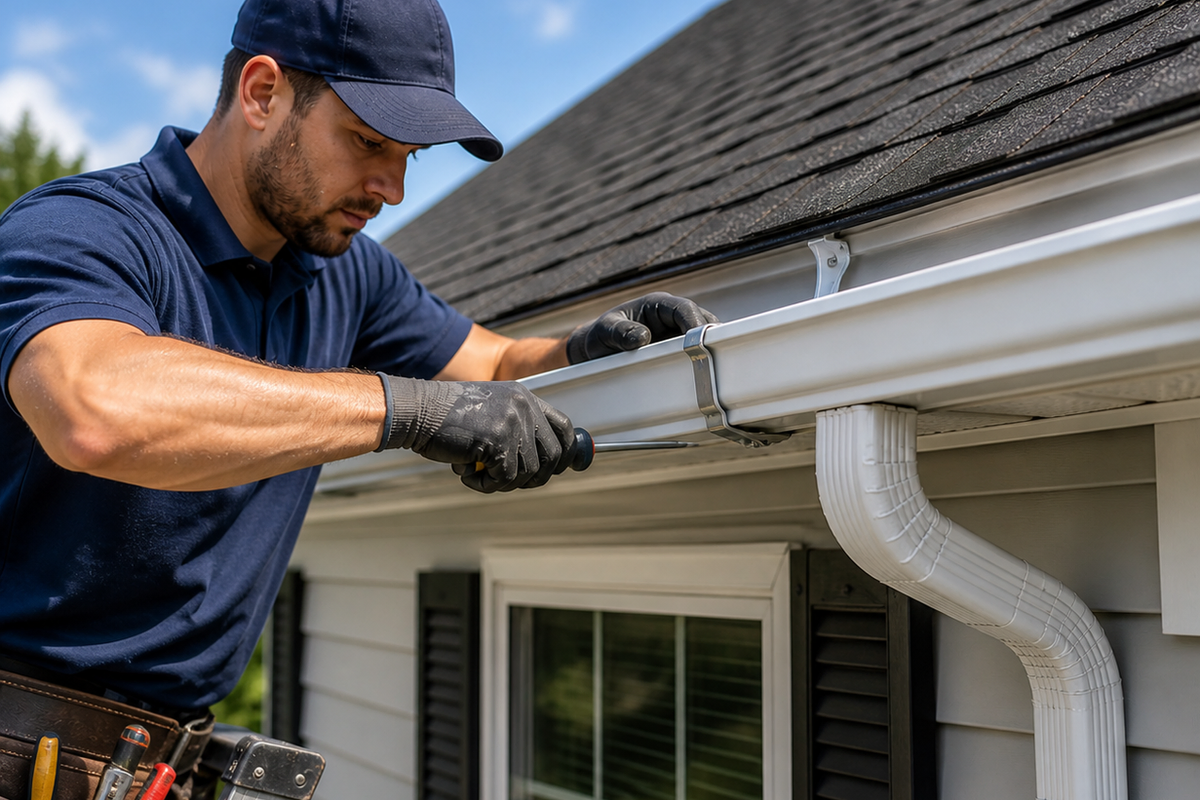
Screens are the budget option and they work well under maple and oak. Under pine, fine needles pass through and micro-mesh is the better buy.
This is one part of the gutters work we do across Bergen and Passaic County. Every job is quoted in writing after a hands-on inspection, performed by our own crew rather than subcontractors, and backed by our satisfaction guarantee. We are licensed under NJ HIC #13VH13359900 and fully insured.
What the work includes
- Aluminum and steel mesh screens
- Clip-in and under-shingle mounting options
- Fitted to existing trough profile
- Removable for seasonal cleaning
Screens or guards: what is actually different?
Gutter screens are flat or lightly ribbed mesh inserts that sit on top of the trough and lift out for cleaning, blocking mid-size debris like whole leaves and twigs at a lower cost. Gutter guards are engineered covers — micro-mesh, reverse-curve or brush systems — built for finer filtration and longer intervals between cleanings, at a higher price.
| Gutter screens | Gutter guards | |
|---|---|---|
| What it is | Flat or slightly domed mesh that sits over the trough opening | Engineered cover system: micro-mesh, reverse-curve, brush or foam |
| What it stops | Whole leaves, twigs, larger debris | Fine debris including needles and shingle grit, depending on the type |
| Cost | Lower, per linear foot | Higher, reflecting finer engineering and installation labor |
| Maintenance | Lifts out for a full cleaning; still needs an occasional check | Rarely lifted; designed to shed most debris on its own |
| Best fit | Moderate leaf cover, budget-conscious upgrades, rental properties | Heavy tree cover, pine needles, homeowners who want the least possible upkeep |
The two terms get used interchangeably in casual conversation, which causes real confusion when a homeowner compares quotes. A “screen” and a “guard” are not the same product tier, and pricing them as if they were leads to disappointment either way — paying guard prices for screen performance, or expecting guard-level upkeep from a screen. We quote them separately and explain the trade-off rather than defaulting to whichever is easier to install that day.
If your debris load leans toward pine needles or fine grit, our gutter guards page covers the micro-mesh option built for exactly that problem.
Installing either one, screen or guard, falls under the same ordinary-maintenance category as the gutter itself under New Jersey’s Uniform Construction Code, so neither requires a separate permit application on its own. What changes between the two is not paperwork — it is how much attention the system needs once it is up, and how much it costs to get there.
What are perforated and snap-in gutter screens made of?
Perforated screens are flat sheets of aluminum or vinyl-coated steel punched with small holes that let water through while catching leaves and twigs on top. Snap-in screens use a slightly domed or ribbed shape and clip under the gutter’s front lip and over the back edge, holding their position without separate fasteners so they can be popped off for a full cleaning.
Material choice affects how a screen holds up over a North Jersey winter more than it affects day-to-day performance. Aluminum resists rust and matches most seamless gutter systems we install. Vinyl-coated steel adds rigidity, which helps a screen keep its shape under snow load, but the coating can eventually wear at contact points.
- Perforated aluminum — lightweight, will not rust, and the standard choice on most of the gutter systems we install
- Perforated vinyl-coated steel — stiffer under load, a reasonable option on longer runs that see heavy snow accumulation
- Snap-in mesh panels — sized to standard 5-inch and 6-inch K-style troughs, held by tension against the front and back lips rather than screws
Every option we install fits cleanly under standard hidden hangers, so adding screens after the fact does not require reworking hardware set during a new gutter installation.
When is a gutter screen the right value for a North Jersey home?
A screen is usually the right value when a roof sees moderate leaf cover rather than a heavy canopy, when the homeowner is comfortable with an occasional lift-off cleaning instead of paying for years of reduced upkeep, or on a rental or investment property where the lower upfront cost matters more than the longest possible interval between service calls.
We do not push every customer toward the most expensive option. A screen earns its keep on a roof with a handful of shade trees rather than a full canopy — enough leaves to matter, not so many that a screen clogs every few weeks anyway. It also makes sense as a step up from an open trough on a budget, or as an interim fix while a homeowner decides whether a full guard system is worth the investment later.
Where trees are dense on all sides, or where pine needles dominate, a screen’s coarser mesh reaches its limit quickly and the ongoing labor of lifting and clearing it starts to cost more in time than a guard would in dollars. That trade-off is worth discussing honestly rather than assuming one option fits every roof on a street.
We also see screens make sense as a middle step for homeowners who are not ready to commit to a full guard system but want more than an open trough — a townhouse or a starter home where the current owner does not plan to be in the house for the next twenty years, for instance. The lower material and labor cost means a screen upgrade pays for itself faster in reduced cleaning visits, even if it never reaches the near-zero maintenance a well-fitted guard offers. That calculation changes once heavy tree cover is part of the picture, which is why we walk the property before recommending either option rather than quoting from a price list alone.
Why do pine needles and maple seeds get past standard screens?
Standard perforated and snap-in screens use openings sized for whole leaves, which are large enough that fine debris like pine needles and small maple seeds either passes straight through the holes or wedges into them sideways. Once wedged, needles catch more needles, and a screen that looked clear from the ground can be quietly building a mat of fine debris underneath.
This is the single biggest limit of a screen versus a true micro-mesh guard, and it is worth understanding before choosing between them. A leaf is roughly the size of the hole a perforated screen is built for, so it sits on top and sheds with the next rain or wind. A pine needle is a fraction of that width. It does not sit on top — it finds the hole and threads through, or lodges at an angle across several holes and starts collecting neighbors.
Under a heavy pine canopy, common around parts of Mahwah and Ramsey, we generally steer homeowners toward micro-mesh guards rather than screens, because the maintenance a screen would still require under that debris load erases most of the cost advantage. Under oak and maple without heavy pine mixed in, screens hold up well and stay the better value.
Related gutters services
Hand-cleaning of gutters and downspouts, flush-testing every outlet, and a check of hangers, sea…
Seamless aluminum, copper or vinyl gutters formed on site, sized and pitched to the roof area th…
Gutter guard installation matched to your debris load, from micro-mesh for pine needles and shin…
Repair of sagging, leaking or overflowing gutters — reseating hangers, resealing seams and end c…
Frequently asked questions
Screens or guards — what's the difference?
Screens sit over the trough and block larger debris at low cost. Guards are engineered systems with finer filtration and a higher price.
Do screens work under pine trees?
Not well. Needles slip through standard mesh; choose micro-mesh for pine and hemlock.
Can gutter screens be removed for a full cleaning?
Yes — snap-in screens are designed to lift out with hand pressure, and perforated panels are held by clips rather than sealant or fasteners. That is part of the appeal: an occasional full <a href="/gutter-repair-installation/gutter-cleaning/">gutter cleaning</a> is still straightforward, unlike some guard systems that are meant to stay in place for years at a time.
Will gutter screens fit gutters that another contractor installed?
In most cases, yes, as long as the existing gutter is a standard 5-inch or 6-inch K-style profile in reasonable condition. We inspect the trough first — screens installed over a poorly pitched or damaged gutter will not fix the underlying problem, so <a href="/gutter-repair-installation/gutter-repair/">gutter repair</a> comes before covering it. Our article on <a href="/post/signs-of-improper-gutter-installation-passaic-county-nj/">signs of improper gutter installation in Passaic County</a> covers what to look for first.
Do gutter screens work on a low-slope or flat-roof drainage system?
Screens are built for standard sloped-roof gutters, not the internal drains and scuppers used on flat or low-slope roofs. Low-slope drainage needs a different debris strategy, which we address as part of our <a href="/roofing-repair-installation/roof-maintenance/">roof maintenance</a> work. Ask through our <a href="/contact-us/">contact page</a> if you are not sure which applies to your roof.
How long do gutter screens typically last?
Aluminum and vinyl-coated steel screens generally last as long as the gutter system itself when installed correctly, since they are not a wear item in the way sealant or hangers are. The main reason a screen needs replacing sooner is physical damage — a fallen branch or a ladder set directly on top of it — rather than the material simply wearing out.
Is a permit required to add gutter screens in New Jersey?
No. New Jersey’s Uniform Construction Code treats the repair, replacement or installation of exterior gutters and leaders as ordinary maintenance that does not require a permit application, and adding a screen to an existing gutter falls under that same category. A local historic district may still have its own review for visible exterior changes, which is worth checking separately.
- Gutters and Downspouts — U.S. Department of Energy, Building America Solution Center (PNNL)
- A Brief Guide to Mold, Moisture and Your Home — U.S. Environmental Protection Agency
- N.J.A.C. 5:23-2, Uniform Construction Code: Administration and Enforcement — New Jersey Department of Community Affairs
Updated September 2026 · Reviewed by Edgar Lopez Gonzalez, owner · NJ HIC #13VH13359900
Licensed & insured. 25+ years in North Jersey. We answer 24/7 for leaks and storm damage.
- Service
- Gutter Screens
- Category
- Gutters
- Service area
- Bergen & Passaic County and surrounding North Jersey
- License
- NJ HIC #13VH13359900