Licensed & Insured — NJ HIC #13VH13359900
njgoldstarconstruction@yahoo.com · 24/7 Emergency · (862) 271-1225

Deck Repair & Restoration in Bergen County, NJ
Deck repair and restoration — structural fixes at ledger, joists and posts, board and railing replacement, then cleaning, sanding and sealing.
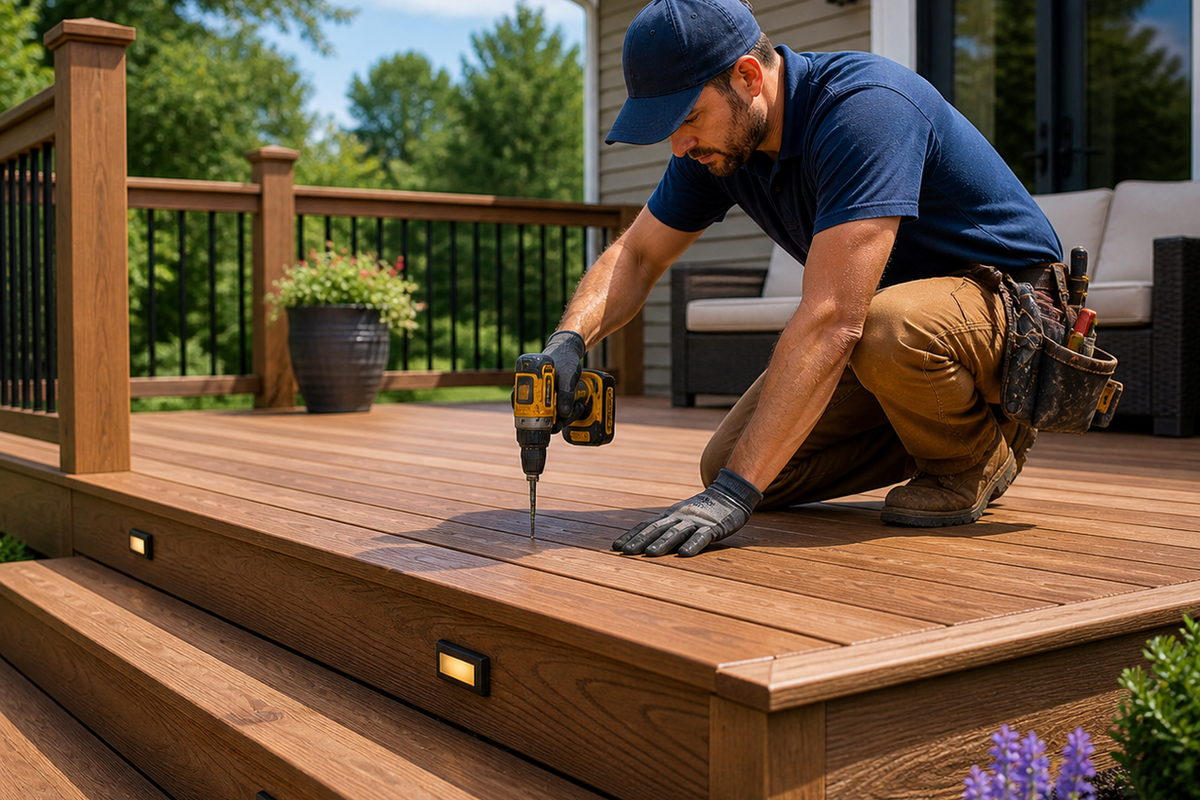
We start with the connections that make a deck safe, then move to the surface. Replacing boards on a failing frame is money spent on the wrong problem.
This is one part of the decks work we do across Bergen and Passaic County. Every job is quoted in writing after a hands-on inspection, performed by our own crew rather than subcontractors, and backed by our satisfaction guarantee. We are licensed under NJ HIC #13VH13359900 and fully insured.
What the work includes
- Ledger, joist, beam and post repair
- Rotted board and railing replacement
- Hardware upgrade to current standards
- Cleaning, sanding, staining and sealing
Why we probe the ledger and joists before touching the boards
A deck’s ledger and joists carry the entire structural load, so we probe them with an awl or screwdriver at every repair before replacing a single board, checking for soft, spongy wood that indicates rot. Surface boards can look fine while the framing underneath has already lost most of its strength, which is why a visual check alone is not enough.
Rot rarely announces itself on the surface first. A ledger board bolted to the house can be soaked and softening from the inside while the paint or stain on top still looks intact, because the damage starts where moisture gets trapped between the ledger and the house wall, not where sun and rain hit the visible face. We probe the ledger, the rim joist behind it, and the joist ends where they meet the ledger and the beam, since those are the spots water collects and lingers longest.
A screwdriver or awl pushed gently into suspect wood tells us more in ten seconds than a visual inspection tells us in ten minutes. Wood that is sound resists the point; rotted wood gives way with almost no pressure. We map every soft spot before deciding what gets replaced.
Board replacement versus a structural repair
Replacing individual decking boards fixes a cosmetic or surface problem — splitting, cupping, isolated rot in a board that does not touch the frame. A structural repair addresses the ledger, joists, beams or posts, and is required whenever probing finds soft wood in any load-bearing member, regardless of how the surface boards look.
We tell homeowners plainly which category their repair falls into, because the two are not interchangeable. New boards on a deck with a failing ledger connection is a cosmetic fix on top of an unsafe structure — the deck will look better and be no safer. Conversely, a deck with sound framing but several cupped or splitting boards rarely needs anything beyond a board swap. The inspection determines which situation you are in before we write the estimate, not after.
A wobbling railing is a structural symptom, not just an annoyance
A wobbly guard rail almost always means the post connection to the frame has loosened or the wood around the fasteners has begun to rot, not simply that a screw needs tightening. Since guards are required to resist a real lateral load under the residential code, a wobble is a safety issue to address the same day it is noticed, not a maintenance item to defer.
Guard posts take load in a direction the rest of the deck frame does not — sideways, from someone leaning or falling against the rail — and that connection is designed to a specific load rating for exactly that reason. When a post wobbles, the fasteners have usually backed out, the wood around them has softened, or the post was never properly through-bolted to solid framing in the first place. We rebuild the connection with the correct hardware rather than simply re-tightening a loose screw into wood that will not hold it.
Cleaning, sanding and sealing: restoring the surface once the structure is sound
Once a deck’s structure has been checked and any repairs made, restoration means cleaning the surface to remove mildew and graying, sanding down splinters and raised grain, and applying a fresh sealer or stain on wood decking. Composite decking skips sealing but benefits from the same thorough cleaning to remove mildew and embedded dirt from the board surface.
Wood decking grays and roughens over time as UV breaks down the wood fibers at the surface and mildew takes hold in shaded, damp spots. A restoration starts with a wash to lift dirt and mildew, moves to sanding wherever the grain has raised or splintered, and finishes with a sealer or stain that penetrates the cleaned, sanded surface rather than sitting on top of weathered wood. Skipping the cleaning and sanding step and just adding a fresh coat of sealer over gray, rough wood rarely holds up, since the sealer cannot bond properly to degraded fiber.
A simple annual check between full restorations
- Sweep debris out from between boards so moisture does not collect against the joists below.
- Look for standing water pooling anywhere on the surface, which points to a leveling issue worth addressing.
- Check railing connections and stair stringers for movement each spring.
When a repair is not enough and a rebuild is the honest answer
A rebuild becomes the right call once rot has reached the foundation-level connections — the ledger, multiple posts, or footings themselves — rather than being contained to a board or two. At that point, repairing piece by piece costs more in labor than starting the structure over, and it cannot fully restore the safety margin a proper rebuild provides.
One recent project involved exactly this situation. As the homeowner described it: “a complex project due to significant wood rot extending all the way to the foundation. Edgar’s team rose to the challenge, addressing every structural issue with precision and expertise. They didn’t just build a deck; they ensured the foundation was right and the construction was solid.” — Jwalin V., Google review.
We tell homeowners honestly when we see that level of damage during an inspection, rather than quoting a series of patches on a structure that needs to come down to sound framing and be rebuilt. For a first-time build on a site with no existing structure, see our new deck construction page instead.
What to expect from a deck repair call
A deck repair with NJ Gold Star Construction starts with a call or text to (862) 271-1225, an on-site inspection that probes the ledger, joists and posts before anything else, a free itemized written estimate that separates cosmetic from structural work, the repair or rebuild by our own crew, and a walk-through before we leave.
We repair and restore decks across Bergen and Passaic County and into Essex, Hudson, Morris and Union County, including Summit and Montclair. A deck repair sometimes turns up related issues nearby — foundation drainage problems near the posts, or gutters dumping water right where a post base sits — and we flag anything we see during the inspection. When you are ready, request a free estimate.
Related decks services
New deck construction from footings up — flashed ledger connection, code-compliant framing hardw…
Frequently asked questions
Is it cheaper to repair or replace a deck?
If the framing and footings are sound, repair and refinish is far cheaper. Widespread rot in the frame usually makes rebuilding the better value.
How often should a wood deck be sealed?
Every two to three years in North Jersey, sooner on decks in full sun or heavy foot traffic.
Is it cheaper to repair a deck or tear it down and rebuild?
It depends entirely on how far the damage has spread. Repair is usually cheaper when problems are contained to a handful of boards or one connection point. Once rot has reached the ledger, multiple posts or footings, the cost of a series of structural patches can exceed a rebuild, and a rebuild also restores the full safety margin in a way repeated patching cannot.
How can I tell if my deck is unsafe to use right now?
Warning signs include a bouncy or springy feel underfoot, any visible gap or rust streak at the ledger connection to the house, a wobbling guard rail, and soft or spongy wood anywhere you can press a screwdriver in easily. Any of these warrants an inspection before continued regular use, especially with groups or heavier loads like a hot tub or large gathering.
How often should a wood deck be cleaned and resealed?
Most wood decks benefit from cleaning and resealing every one to two years, depending on sun exposure, tree cover and foot traffic. A deck in full sun with little tree cover typically needs it closer to yearly, since UV exposure breaks down a sealer’s protection faster than shade does. Composite decking does not need sealing but benefits from a periodic wash.
Can a deck repair be scheduled around an upcoming event?
We try to accommodate timing when we can, especially for safety issues like a wobbling rail or soft ledger that should not wait. Cosmetic board replacement and full restoration work have more scheduling flexibility than structural repairs, which we prioritize regardless of the calendar once probing confirms a safety concern.
- Residential Wood Deck Guidelines — Borough of Mendham, NJ, Construction Department
- Guards and Window Fall Protection — UpCodes (International Residential Code reference)
- Renovation, Repair and Painting Program: Work Practices — U.S. Environmental Protection Agency
Updated September 2026 · Reviewed by Edgar Lopez Gonzalez, owner · NJ HIC #13VH13359900
Licensed & insured. 25+ years in North Jersey. We answer 24/7 for leaks and storm damage.
- Service
- Deck Repair & Restoration
- Category
- Decks
- Service area
- Bergen & Passaic County and surrounding North Jersey
- License
- NJ HIC #13VH13359900